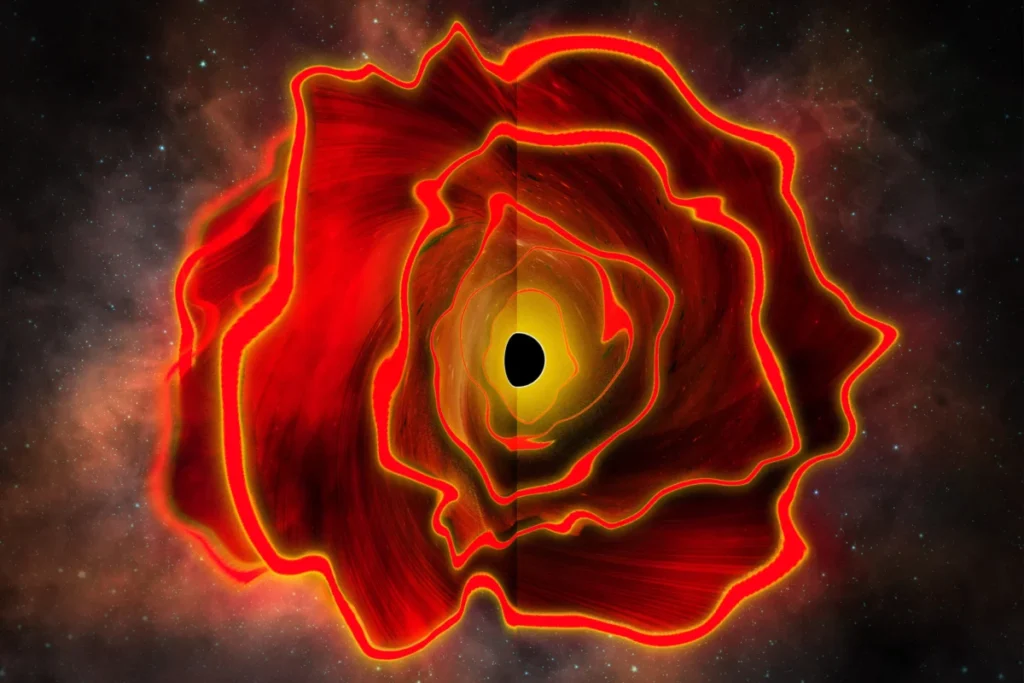
In a discovery that challenges the traditional boundaries between stellar physics and galactic evolution, an international team of astronomers led by researchers at the Massachusetts Institute of Technology (MIT) has identified a singular cosmic object that may rewrite our understanding of the early universe. Known as MoM-BH*-1, this "black hole star" represents a hybrid celestial entity—a massive black hole core enshrouded within a gargantuan, star-like envelope of hydrogen gas. The findings, published in a new study, offer a compelling solution to one of the most persistent enigmas of the James Webb Space Telescope (JWST) era: the nature of the "little red dots" that have appeared in nearly every deep-field image captured by the observatory since its deployment.
The object in question is staggering in its proportions. According to lead author Rohan Naidu, a NASA Hubble Fellow and Pappalardo Fellow at MIT’s Kavli Institute for Astrophysics and Space Research (MKI), the central black hole possesses a mass approximately 100,000 times that of the sun. Surrounding this gravitational powerhouse is an extended envelope of gas so vast that its physical dimensions rival the entirety of our solar system. This discovery suggests that many of the bright, distant objects previously thought to be early galaxies may, in fact, be these exotic "black hole stars," which outshine their host galaxies through a mechanism entirely different from the nuclear fusion that powers conventional stars.
The Mirage or Miracle Survey: A Search for Cosmic Origins
The identification of MoM-BH*-1 was not an intentional search for an exotic hybrid object but rather the result of a systematic survey titled "Mirage or Miracle" (MoM). The survey was designed to address a growing tension in modern cosmology: the appearance of unexpectedly bright and mature-looking galaxies in the very early universe, just a few hundred million years after the Big Bang.
Standard cosmological models, such as the Lambda Cold Dark Matter (ΛCDM) model, suggest that galaxies should take a significant amount of time to assemble their mass and light. However, JWST’s initial observations revealed a population of galaxies that appeared far too bright and well-developed for their age—a phenomenon astronomers dubbed the "Too Many, Too Early" problem. The MoM survey sought to determine if these objects were "miracles"—galaxies that formed much faster than theory predicted—or "mirages"—astrophysical objects that appear to be galaxies but are actually something else entirely.
While scanning deep-space images for high-redshift candidates, Naidu and his colleagues noticed a specific source that defied easy categorization. It was exceptionally red and intensely bright, standing out against the backdrop of more conventional infant galaxies. The team utilized JWST’s sophisticated spectroscopic instruments to break down the light from this source, seeking the chemical fingerprints that would reveal its true identity.
Decoding the Spectral Signature: The Balmer Break
To understand why MoM-BH-1 appeared so red, the researchers first looked for signs of interstellar dust. In the cosmos, dust acts much like smoke or smog in Earth’s atmosphere; it scatters shorter, bluer wavelengths of light while allowing longer, redder wavelengths to pass through. This "reddening" is a common feature in star-forming regions, but the data from MoM-BH-1 did not align with typical dust models.
Instead, the team observed a rare and dramatic spectral feature known as a "Balmer break." This is a sharp drop-off in light intensity at specific wavelengths, caused by dense hydrogen gas absorbing photons. While Balmer breaks are seen in the atmospheres of mature stars like Vega, the break observed in MoM-BH*-1 was the deepest ever recorded in any astronomical object.
"The break we observed in this object is the deepest break we have ever observed in any object, ruling out ‘ordinary’ stars as the source," Naidu noted. The presence of this break indicated that the light was passing through a screen of hydrogen so dense that it behaved like a stellar atmosphere rather than a diffuse nebula. Furthermore, the spectrum showed almost no traces of "metals"—astronomical shorthand for any element heavier than hydrogen or helium—suggesting the object formed from the pristine gas of the early universe.
Powering a Giant: Accretion vs. Nuclear Fusion
The most significant challenge for the research team was explaining the object’s luminosity. MoM-BH*-1 is approximately 100 billion times brighter than a typical star. In a standard star, energy is produced through nuclear fusion, where hydrogen atoms are crushed together in the core to form helium, releasing energy in the process. However, no fusion-based engine could produce the sheer volume of light observed from this red dot.
To solve this, the team turned to the most efficient energy-conversion process in the universe: black hole accretion. As gas and matter fall toward a black hole, they form an accretion disk where gravitational energy is converted into intense heat and radiation. By running complex simulations, the researchers found that an active, accreting black hole of 100,000 solar masses could provide the necessary power.
When this black hole is placed inside an incredibly dense cocoon of hydrogen, the resulting "black hole star" matches the JWST observations perfectly. The dense hydrogen envelope absorbs the high-energy radiation from the black hole and re-emits it as the bright red light seen by the telescope, creating the deep Balmer break in the process. This hybrid model explains both the extreme brightness and the specific "stellar" spectral features that had previously confused observers.
Solving the "Little Red Dot" Enigma
The discovery of MoM-BH*-1 provides a potential "Rosetta Stone" for understanding a broader class of objects known as "little red dots" (LRDs). Since JWST began its mission, these LRDs have been ubiquitous in deep-field surveys, appearing in the early universe but seemingly vanishing by the present day. Their nature has been the subject of fierce debate, with some astronomers arguing they are compact galaxies filled with old stars and others suggesting they are obscured active galactic nuclei (AGN).
The MIT study suggests that many, if not all, of these LRDs are black hole stars. In most cases, these objects are embedded within young galaxies, but their light is so intense that it dominates the signal received by JWST. In the specific case of MoM-BH*-1, the black hole star is so powerful that it completely outshines its host galaxy, allowing astronomers to see the "pure" light of the hybrid object for the first time.
"Every little red dot is consistent with being a black hole star, embedded in a generic early galaxy," Naidu explained. This realization may finally resolve the "Too Many, Too Early" problem. If the bright light we see from the early universe is coming from individual black hole stars rather than the collective light of billions of stars in a galaxy, then the galaxies themselves might not be as massive or as mature as they initially appeared. This would bring JWST’s observations back into alignment with standard cosmological models.
Broader Implications and the Evolution of Black Holes
The existence of black hole stars has profound implications for our understanding of how supermassive black holes formed. One of the biggest mysteries in astronomy is how black holes at the centers of galaxies grew to be millions or billions of times the mass of the sun so quickly after the Big Bang.
If black hole stars like MoM-BH*-1 were common in the early universe, they might represent the "missing link" or "seed" black holes. These objects provide a mechanism for black holes to grow rapidly within a massive reservoir of gas before they eventually shed their hydrogen envelopes and become the naked quasars and galactic nuclei we observe in the later universe.
Robert Simcoe, Director of the MIT Kavli Institute and a co-author of the study, highlighted the importance of the environment in which these objects formed. "When we see something very red in the universe, we often assume that it is surrounded by dust," Simcoe explained. "To our surprise, it turns out you can make something that red using just hydrogen, without any dust, if you have an extremely dense screen of hydrogen." This shift in perspective allows astronomers to probe the conditions of the "Cosmic Dawn"—the era when the first stars and galaxies began to light up the darkness.
Conclusion and Future Research
The discovery of MoM-BH*-1 marks a milestone in the JWST mission, showcasing the telescope’s ability to not only find new objects but to provide the high-resolution data necessary to decode their physics. The research, supported by NASA, the MIT Department of Physics, and the Space Telescope Science Institute, opens a new chapter in stellar and galactic archaeology.
Moving forward, the team intends to use JWST to search for more examples of these black hole stars to determine how their properties vary across different environments. By studying the "little red dots" in greater detail, astronomers hope to map the transition from the first black hole seeds to the supermassive giants that anchor galaxies like our own Milky Way today.
As our picture of the early universe continues to evolve, MoM-BH*-1 stands as a testament to the surprises that await in the deep reaches of space. What was once thought to be a simple "miracle" of early galaxy formation has revealed itself to be a complex "mirage," hiding a 100,000-solar-mass engine within a shell of pure hydrogen—a black hole star that bridges the gap between the birth of stars and the rise of the giants.