The National Football League (NFL) stands as an unparalleled titan in the American sports landscape, its popularity dwarfing all other professional leagues. This dominance is mirrored, albeit with a unique nuance, by the United States’ military aviation structure, where the U.S. Air Force is followed by the U.S. Navy’s formidable air arm. For a significant portion of the year, American society becomes deeply engrossed in the strategic plays and thunderous impacts of football. Yet, in an era acutely aware of the long-term neurological consequences of concussions and Chronic Traumatic Encephalopathy (CTE), the specter of football’s potential impermanence occasionally looms, casting a shadow over the game’s enduring appeal.
The sport’s deep entwinement with a vast and complex network of commercial interests presents a formidable barrier to any drastic changes. A hypothetical ban on football, however improbable, would undoubtedly trigger catastrophic economic repercussions, not just for the United States but on a global scale. Consequently, sustained and multifaceted efforts are underway to ensure the sport’s continued viability and evolution. One prominent manifestation of this commitment is the NFL’s strategic, long-term investment in popularizing flag football as a legitimate and competitive iteration of the game. Concurrently, significant technological advancements, largely propelled by additive manufacturing (AM), are making substantial strides in enhancing the protective capabilities of football helmets.
Revolutionizing Helmet Technology Through 3D Printing
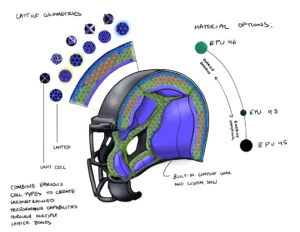
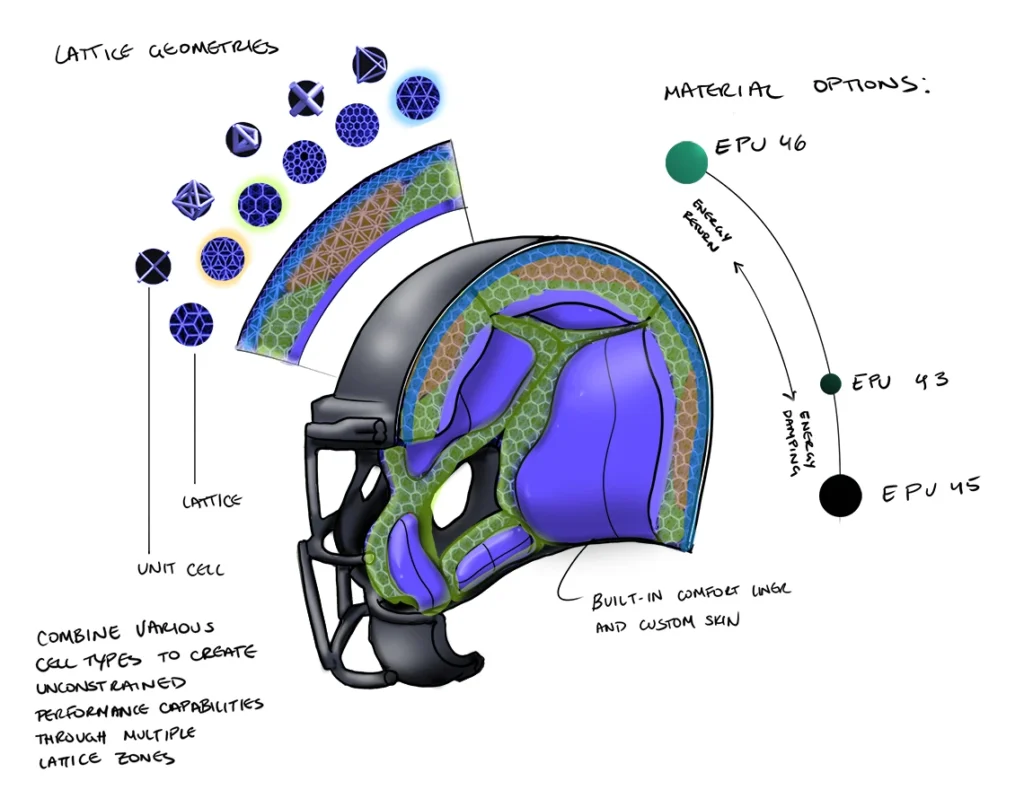
Traditional football helmets, while designed for impact protection, typically achieve a compression rate of around 50 percent upon impact. This means that half of the energy is not absorbed effectively, leaving a significant portion to be transferred to the player’s head. In contrast, helmets incorporating liners engineered with 3D printed lattices exhibit a remarkable compression rate ranging from 80 to 90 percent. This dramatic improvement in energy absorption is a direct result of the precise, lattice-like structures that AM allows engineers to create. These structures can be meticulously designed to deform in a controlled manner, dissipating impact forces far more effectively than conventional foam materials.
The Virginia Tech Helmet Lab, a preeminent institution dedicated to advancing the science of sports helmet safety, has been instrumental in this progress. Their rigorous testing and development have provided indispensable data and insights into the efficacy of 3D printed components. According to their research, helmets equipped with 3D printed foam add-ons can reduce the risk of concussions by an impressive 15 to 34 percent, depending on the specific helmet model and the nature of the impact. This significant reduction in concussion incidence is a critical development for player welfare. The NFL has recognized and embraced these advancements, with statistics indicating that an overwhelming 97 percent of players now utilize custom-fit helmets, a testament to the growing adoption of advanced protective equipment.
Expanding the Reach of Additive Manufacturing in Protective Gear
The initial successes achieved with 3D printed helmet liners have inspired researchers to explore further applications of this transformative technology within football protective equipment. Beyond concussions, which are acute traumatic brain injuries, the pervasive threat of CTE arises from repeated sub-concussive head trauma—blows that may not result in a diagnosed concussion but accumulate damage over time. Addressing this persistent risk is a major focus.
In collaboration with researchers at Stanford University, Certor Sports, a prominent manufacturer of innovative helmet brands, including VICIS, has been at the forefront of leveraging AM. VICIS, a company that has partnered with 3D printer original equipment manufacturers (OEMs) such as Carbon, has utilized AM to develop a novel chinstrap known as the SoftShox. This innovative design, engineered with 3D printed internal structures, has demonstrated the potential to reduce impact intensity by as much as 35 percent. By strategically absorbing and dispersing impact forces around the jaw and neck area, the SoftShox chinstrap contributes to a more holistic approach to head protection.
The application of 3D printing extends beyond helmets and chinstraps. Custom-designed 3D printed mouthguards are also gaining traction, offering personalized fit and enhanced shock absorption. The principles behind these advanced mouthguards are transferable to a wide array of sports, underscoring the broad applicability of AM in athletic safety.
Focusing specifically on football, other protective components are also being reimagined through 3D printing. Thigh pads, shoulder pads, and other forms of padding are undergoing development and production using AM techniques. This allows for the creation of precisely tailored geometries and material properties to optimize protection and comfort. The NFL has further signaled its commitment to innovation by identifying facemasks as the next frontier for improvement. Earlier this year, the league launched a challenge for innovators, mirroring the successful initiative that catalyzed much of the progress seen in helmet liner technology, aiming to enhance facemask design and further reduce the risk of head injuries.
A Paradigm Shift in Athletic Safety: Expert Perspectives
The quantitative improvements in protective gear are striking, but the subjective assessments from those actively engaged in the field of athletic safety offer an equally compelling perspective on the transformative nature of these advancements.
Steve Rowson, a biomedical engineer and the director of the Virginia Tech Helmet Lab, remarked in an interview with Science magazine earlier this year, "We’ve seen more change in roughly the last 14 years than we probably did in the previous 40." This statement is particularly significant when considering that Rowson’s reference to the preceding 40 years encompasses an era where football helmet design remained remarkably static, with the fundamental structure of helmets seeing little to no alteration between 1939 and 1976. This long period of stagnation highlights the revolutionary pace of innovation witnessed in recent years.
Jeff Crandall, a biomechanical engineer associated with helmet manufacturer Biocore, offered a stark illustration of this rapid evolution: "What was a top [helmet] in 2015 is now not even allowed on the field." This assertion underscores a fundamental shift in safety standards and performance expectations, driven by a deeper understanding of impact mechanics and the capabilities of advanced materials and manufacturing processes. The continuous drive for improvement means that equipment once considered state-of-the-art is now deemed insufficient by current safety benchmarks.
Rowson further drew a pertinent analogy, stating, "If you look at what we’re doing with helmets, it’s a straight analogy out of automotive safety." This comparison to the automotive industry, which has a long history of prioritizing safety innovations and rigorous testing, suggests that the trajectory for football safety is mirroring established pathways of technological advancement and regulatory oversight. The lessons learned and the methodologies employed in making vehicles safer are proving highly applicable to protecting athletes.
The Future of Football: A Culture of Innovation and Collective Well-being
While significant progress has been achieved, the journey toward optimal athlete safety is ongoing. This continuous evolution, however, offers a profound source of hope. It signifies that the convergence of football, sports science, and 3D printing is only beginning to unlock its full potential to mitigate harm and reduce risk for athletes. If the iterative improvements in even a single component of a helmet can yield such substantial benefits, the implications of applying these advancements across all protective padding, coupled with successive generations of feedback and refinement, are immense.
Steven Broglio, a neuroscientist at the University of Michigan, astutely observed in the same Science article, referring to the Virginia Tech Helmet Ratings: "Everybody wants to be at the top of the list, so they are becoming more and more innovative." The very existence of a standardized rating system for football helmet safety has created a competitive environment among manufacturers. This rating system has become a primary differentiator in the market, compelling companies to invest heavily in research and development to produce safer and more effective protective gear. The ability of researchers to analyze the impact of hits at the granular level of individual lattices provides invaluable data, creating fertile ground for further innovation and optimization.
Beyond the undeniable business advantages and technological advancements, the importance of football, and indeed sports in general, transcends mere commercial or engineering interests. Sports often serve as a crucial anchor for collective goodwill in an increasingly fragmented society. Moments where a sense of shared experience and national unity emerge, even fleetingly, are invaluable. The collective engagement with major sporting events can momentarily transcend societal divisions, fostering a sense of shared identity and communal pride.
Ultimately, anything that enables athletes to focus more on their performance and less on the inherent risks of injury is not just a matter of technological advancement but a cultural imperative. For those who may not be swayed by abstract notions of cultural significance, the economic implications are equally compelling. The continued growth and evolution of football, underpinned by a commitment to player safety, represent a significant economic opportunity and a vital sector of innovation. The ongoing narrative of football’s adaptation and improvement, driven by cutting-edge technologies like additive manufacturing, promises a future where the thrill of the game can coexist with a paramount concern for the well-being of its athletes.