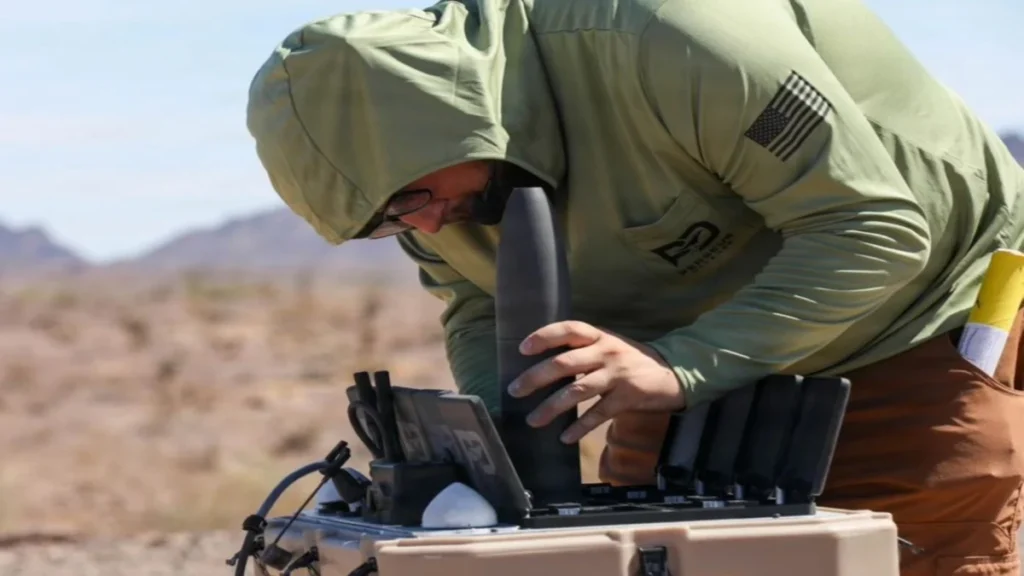
A significant stride in counter-drone technology was made this month as Perseus Defense, a US defense startup, successfully tested its Mk-III interceptor missile, a low-cost solution designed to physically neutralize small unmanned aerial systems (sUAS). The demonstration, conducted at Cibola Range Site 17 within Arizona’s Yuma Proving Ground, marks a pivotal moment in the ongoing effort to fortify military installations against increasingly sophisticated and prevalent aerial incursions. The test was a key component of Falcon Peak 26.2, a comprehensive counter-small unmanned aircraft systems experiment spearheaded by US Northern Command (NORTHCOM), North American Aerospace Defense Command (NORAD), and the Pentagon’s Joint Interagency Task Force 401 (JIATF-401).
Addressing the Cost Imbalance in Counter-Drone Warfare
At the heart of Perseus Defense’s innovation lies its remarkable cost-effectiveness. Each Mk-III interceptor is reportedly built for approximately $2,500. This figure stands in stark contrast to the exorbitant costs associated with conventional air-defense missiles, which can easily exceed $100,000 per unit. The prevailing challenge in modern asymmetric warfare is the "cost imbalance" – where militaries are forced to expend high-value assets to counter low-cost threats. Drones, particularly commercial off-the-shelf (COTS) models, can be acquired for mere hundreds of dollars, yet pose significant security risks. The Mk-III offers a paradigm shift, enabling a more economically sustainable defense posture where the cost of interception does not drastically outweigh the cost of the threat.
The proliferation of drones, from hobbyist quadcopters to purpose-built reconnaissance and attack platforms, has transformed the battlefield and introduced new vulnerabilities for critical infrastructure and military bases. Conflicts globally, such as the war in Ukraine, have underscored the pervasive and often devastating impact of small drones used for intelligence gathering, target acquisition, and direct attacks. This global trend has intensified the urgency for agile, affordable, and effective counter-drone systems that can address a wide spectrum of threats without depleting national defense budgets or straining logistical chains.
Kinetic Hit-to-Kill: A Robust Defense Mechanism
The Mk-III interceptor employs a kinetic "hit-to-kill" methodology. This means it physically destroys the target drone through direct impact, rather than relying on electronic disruption. This approach offers a crucial advantage over many existing counter-sUAS systems, particularly electronic warfare (EW) solutions. While EW systems are effective at jamming or spoofing the radio links used to control unmanned aircraft, their efficacy can be limited against drones that operate autonomously via preprogrammed routes or communicate through secure, non-RF methods like fiber-optic cables or advanced encrypted protocols.
A kinetic interceptor like the Mk-III provides an essential additional layer of defense, capable of engaging threats that might bypass electronic countermeasures. This multi-layered defense strategy is increasingly recognized as vital for robust protection against the evolving drone threat landscape. Furthermore, Perseus Defense emphasizes the Mk-III’s design as a low-collateral option. This characteristic is particularly critical for protecting military installations on US soil, or in any densely populated area, where commanders must meticulously weigh the risks posed by falling debris from destroyed drones and the potential collateral damage from conventional air-defense missiles, which typically carry larger warheads. The precise, kinetic impact minimizes fragmentation and reduces the danger to surrounding civilian areas or infrastructure.
Falcon Peak 26.2: A Collaborative Pursuit of Innovation
The recent demonstration at Yuma Proving Ground was an integral part of Falcon Peak 26.2, a collaborative experimentation exercise designed to evaluate emerging counter-drone systems. This year marked a relocation for the experiment, previously hosted at Eglin Air Force Base in Florida, signaling a dynamic approach to testing environments. The campaign’s objectives are multifaceted: to rigorously assess cutting-edge technologies, to foster improved cooperation between military and civilian partners, and to provide developers with rapid, actionable feedback. A core tenet of Falcon Peak 26.2 is its explicit emphasis on technologies capable of defeating drones while minimizing collateral damage, directly aligning with the Mk-III’s design philosophy.
Participants like US Northern Command and NORAD, responsible for homeland defense, are acutely interested in systems that can seamlessly integrate into existing command-and-control structures and respond effectively to threats within the continental United States. The involvement of JIATF-401 underscores the Pentagon’s commitment to accelerating the development and deployment of robust counter-drone capabilities. During the Yuma event, the Mk-III interceptor was showcased to distinguished visitors, loaded into an eight-shot launcher. Perseus Defense highlighted the system’s "Lattice-level integration," referring to its compatibility with Anduril Industries’ Lattice command-and-control software, a critical feature for networked defense operations. This integration capability ensures that the Mk-III can be a seamless component of a broader, integrated air defense architecture. The Yuma demonstration followed an earlier appearance at Operation Jailbreak, another experimentation exercise held at Fort Carson, indicating a progressive testing and evaluation roadmap for the system.
A Chronology of Rising Concerns: From Langley-Eustis to JIATF-401
The demand for enhanced domestic counter-drone systems surged dramatically after a series of unsettling incidents in late 2023 and early 2024. In December 2023, unidentified drones repeatedly penetrated the airspace of Joint Base Langley-Eustis in Virginia. These incursions reportedly forced the temporary relocation of sensitive assets, including F-22 fighter jets, and starkly illuminated significant legal and operational limitations surrounding responses to unauthorized drone flights over US territory. Existing regulations and protocols often proved inadequate for rapidly and decisively addressing these ambiguous threats without risking collateral damage or legal ramifications.
Similar sightings continued at other military installations throughout 2024 and 2025, signaling a persistent and growing vulnerability. These events served as a stark wake-up call, emphasizing the urgent need for comprehensive, adaptable, and legally sound counter-drone solutions. In response to this escalating threat, JIATF-401 was formally established in 2025. Its mandate is clear: to accelerate the development and deployment of advanced counter-drone capabilities specifically for US forces and domestic installations, addressing the gaps identified by incidents like those at Langley-Eustis. This task force represents a concentrated effort by the Pentagon to fast-track solutions and ensure the security of critical assets and personnel within the US.
Technical Specifications and Strategic Advantages
Further details emerging from the exercise identified the Perseus interceptor as "Harpe," which is likely the formal designation for the Mk-III. The missile itself is compact, measuring approximately 24 inches (61 centimeters) in length, and boasts a stated engagement range of 1.2 miles (2 kilometers). This range, while suitable for point defense of installations, underscores its role as a close-in defense system.
Crucially, its launcher weighs less than 79 pounds (36 kilograms). This lightweight design offers significant operational advantages. It potentially allows military personnel to move and deploy the system rapidly without requiring heavy vehicles or extensive permanent infrastructure. Such mobility is a key consideration for base defense, enabling flexible and adaptable deployment in response to dynamic threat environments. US Northern Command specifically evaluated the system alongside other short-range counter-drone technologies, with mobility, cost per interception, and magazine depth cited as primary considerations for effective base defense. A system that can be quickly relocated, offers a high volume of intercepts at low cost, and can sustain engagements through a deep magazine, provides a powerful deterrent and defense capability.
Perseus Defense, founded in 2025 by Penn State aerospace engineering graduates Jason Cornelius and Steve Messinger, represents the innovative spirit driving new defense solutions. The company, backed by the prestigious Y Combinator accelerator, has already secured $6.5 million in seed funding, a testament to the perceived potential and strategic importance of its technology. This infusion of capital allows the startup to rapidly develop and refine its systems, bringing novel solutions to market at a pace often challenging for larger, more traditional defense contractors.
Broader Implications for US Base Defense and Beyond
The successful testing of the Perseus Mk-III interceptor carries profound implications for US base defense and the broader landscape of counter-sUAS technology. Firstly, it offers a tangible solution to the economic conundrum of drone warfare, making it financially viable to engage and neutralize even the cheapest of threats. This shifts the economic burden back onto the aggressor, who must then invest more significantly to overcome a cost-effective defense.
Secondly, the kinetic hit-to-kill approach addresses critical vulnerabilities inherent in purely electronic warfare solutions, providing a robust countermeasure against a wider array of drone capabilities, including those employing advanced navigation or communication methods. This positions the Mk-III as a vital component of a layered defense strategy, complementing rather than replacing other counter-drone technologies.
Thirdly, its low-collateral design is a game-changer for domestic defense. The ability to neutralize a drone over a military installation within the US without significant risk of secondary damage to surrounding civilian areas or infrastructure alleviates major legal and public safety concerns that have hampered decisive action in past incidents. This aspect is crucial for gaining public and political acceptance for more aggressive counter-drone postures within national borders.
Finally, the system’s compact size and lightweight launcher promise enhanced mobility and flexibility for base commanders. This allows for rapid deployment to evolving threat areas, establishing a dynamic defense perimeter that can adapt quickly. The integration with advanced command-and-control software like Anduril’s Lattice further ensures that these individual systems can operate as part of a cohesive, intelligent network, enhancing situational awareness and response times.
The development and successful testing of the Perseus Mk-III highlight the growing role of agile defense startups in addressing urgent national security needs. By leveraging venture capital and innovative engineering, these companies are accelerating the pace of technological advancement, bringing disruptive solutions to complex problems. As drone technology continues to evolve, systems like the Mk-III will be indispensable in shaping a resilient and adaptable defense against the persistent and multifaceted threat posed by small unmanned aircraft systems.