In a significant departure from conventional robotic design, which predominantly relies on intricate pneumatic and electronic systems, a collaborative team of researchers has unveiled a novel class of miniature robots capable of flight, flotation, and steering, driven entirely by sound waves. This pioneering development, spearheaded by a research group from the United Kingdom (specifically the EPFL/MICROBS team, as indicated by the image credit), challenges long-standing engineering paradigms and opens new avenues for the miniaturization and application of autonomous systems.
The Genesis of Sound-Powered Movement: Helmholtz Resonance Revisited
The foundational principle underpinning this remarkable robotic innovation is the physical phenomenon known as Helmholtz resonance. First systematically studied and described by the eminent German physician and physicist Hermann von Helmholtz in 1856, this concept explains how air within a hollow cavity can resonate at the same frequency as an incoming sound wave, subsequently producing a directed jet of air through an opening in the cavity. When the pressure inside such a resonator is sufficiently increased, this generated air jet can become powerful enough to induce mechanical movement.
Helmholtz’s initial demonstrations, while groundbreaking for their time, utilized equipment that was far too large and unwieldy for any practical application in miniature robotics. For over a century, the principle remained largely confined to applications in acoustics, such as the design of musical instruments (e.g., the resonance chambers of guitars), architectural sound dampening, and the muffling systems in internal combustion engines. The sheer scale required to generate meaningful thrust prevented its consideration for micro-scale actuation. However, rapid advancements in materials science and precision manufacturing techniques have now bridged this historical gap, enabling the fabrication of exceptionally small resonators with precisely controlled geometries. Crucially, as these resonators are scaled down, their optimal operating frequency naturally shifts upwards, entering the ultrasonic range. This characteristic is particularly advantageous because ultrasonic sound, being beyond the range of human hearing, can be focused with remarkable precision without generating dangerously loud or disruptive audible noise. This property is vital for potential applications in sensitive environments or where human presence is required.
Precision Engineering at the Micro-Scale: Two-Photon 3D Printing
To achieve the unprecedented miniaturization required for these sound-driven robots, the researchers employed an advanced manufacturing technique known as two-photon 3D printing. This sophisticated additive manufacturing process allows for the creation of intricate three-dimensional structures with resolutions often in the nanometer range, far exceeding the capabilities of conventional 3D printing methods. Unlike typical layer-by-layer deposition, two-photon polymerization uses a focused femtosecond laser to cure photosensitive resin at specific points within a volume, enabling the construction of complex hollow structures and highly precise geometries that are critical for efficient acoustic resonance. This method provides the exactitude necessary to tune individual resonators to specific frequencies and directions, a prerequisite for controlled movement.
The research team meticulously manufactured these hollow structures, which were then subjected to rigorous experimental testing. The empirical results were subsequently compared against sophisticated computer simulations, validating the design principles and the efficacy of the acoustic propulsion mechanism. Initial demonstrations of this technology involved small boats, approximately 5 centimeters in length. Each boat was equipped with multiple resonators, each precisely tuned to different frequencies and orientations. This multi-resonator configuration allowed the researchers to manipulate the boat’s movement—forward, backward, and steering—simply by adjusting the pitch and intensity of an external speaker emitting ultrasonic waves.
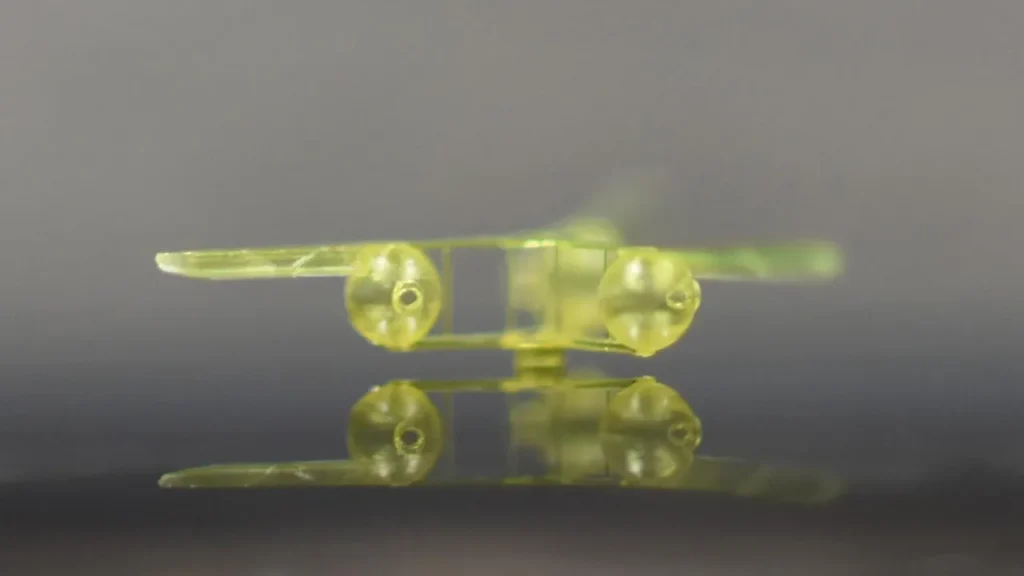
Building on the success of the aquatic demonstrations, the team pushed the boundaries of miniaturization even further, creating microfliers measuring as little as 1 millimeter across. To put this into perspective, a typical human hair has a diameter of about 0.08 to 0.1 millimeters, meaning these microfliers are roughly 10-12 times the width of a human hair. Some of these incredibly tiny devices generate lift by producing a downward air thrust directly from the resonating cavities, akin to miniature jet engines. Others incorporate sound-driven blades that rotate, mimicking the operational principles of miniature helicopter rotors. This dual approach to acoustic propulsion demonstrates the versatility of the Helmholtz resonance principle when applied at such minute scales.
The Paradigm Shift: Advantages Over Conventional Motor Systems
One of the most compelling advantages of this acoustic propulsion approach lies in its inherent lack of a conventional motor. Traditional electric motors, whether brushed or brushless, rely on a complex interplay of electromagnetic fields generated by coils and magnets to produce rotational or linear motion. As the demand for miniaturization increases, the design and manufacturing of these components become exponentially more challenging. Maintaining sufficient magnetic force and mechanical stability in components that shrink to sub-millimeter scales is a formidable engineering hurdle. Issues such as heat dissipation, friction, power density, and the precision required for assembling microscopic coils and magnets pose significant limitations to further miniaturization.

In stark contrast, the sound-driven resonators are primarily hollow structures. Their operational principle does not depend on electromagnetic forces or intricate mechanical linkages, but rather on the precise geometry of their internal cavities and the elastic properties of the material. This fundamental difference means that their size can potentially be reduced far beyond what is practical or even physically possible for a conventional motor, where the scaling laws for electromagnetic forces and mechanical tolerances become increasingly unfavorable at smaller dimensions. This simplicity in design translates to fewer moving parts, potentially lower manufacturing costs once scaled, and greater robustness in micro-environments.
Broader Implications and Potential Applications
The researchers envision that this groundbreaking technology could eventually extend beyond merely propelling tiny robots. The ability to manipulate objects without physical contact, using focused sound, presents a wealth of potential applications. This could include the precise control of flexible structures, the intricate manipulation of micro-components in manufacturing, or even non-invasive interaction with biomedical devices within the human body.
The implications for various sectors are profound:
- Medical and Biomedical: Extremely small robots, propelled by sound, could navigate the intricate pathways of the human circulatory system, delivering targeted drug therapies with unprecedented precision. They could perform minimally invasive diagnostic procedures, explore capillaries, or assist in micro-surgery. The absence of electromagnetic interference from traditional motors would be a significant advantage in sensitive biological environments.
- Industrial Inspection and Maintenance: The ability to access extremely confined spaces, such as inside micro-cracks in turbine blades, intricate piping systems, or delicate electronic assemblies, could revolutionize industrial inspection. These robots could detect flaws, monitor conditions, or even perform localized repairs in areas inaccessible to human technicians or larger robotic systems.
- Environmental Monitoring: Tiny, sound-driven robots could be deployed in challenging environmental conditions, such as monitoring air quality in ducts, sampling water in inaccessible aquatic environments, or studying micro-climates within soil structures. Their unobtrusive nature and potential for silent operation could make them ideal for sensitive ecological studies.
- Exploration and Disaster Response: In scenarios such as collapsed buildings or hazardous industrial sites, these micro-robots could serve as scouts, navigating rubble and confined spaces to search for survivors or assess damage, relaying crucial information without exposing human personnel to danger. Their ability to move without relying on traditional electromagnetic signals could be advantageous in environments with high interference.
Navigating the Path Ahead: Challenges and Future Outlook
Despite the ingenious nature of this breakthrough, the researchers acknowledge that significant work remains before these systems can transition from laboratory demonstrations to practical, real-world applications. The primary challenges revolve around control, navigation, and the development of truly useful robotic designs that can integrate sensing and computational capabilities.
Currently, a tiny resonator capable of flight, while impressive, operates as a largely unguided projectile. Without integrated sensors, onboard computing, or conventional motor controls, its utility outside a precisely controlled laboratory environment is severely limited. A robot that can move but cannot perceive its surroundings, determine its position, or execute complex tasks autonomously, is not yet a practical tool. The current setup relies on external sound sources and control signals, which restricts its operational range and autonomy.
However, the future becomes far more intriguing if electronics can eventually be seamlessly integrated into these systems. Imagine robots that utilize sound for propulsion, while miniature, low-power electronics provide sophisticated sensing, data processing, and communication capabilities. This hybrid approach could give rise to an entirely new family of extremely small robotic devices, capable of operating effectively in environments where conventional propulsion or communication systems are either difficult to use or entirely impractical.
Environments characterized by extreme electromagnetic interference, such as certain industrial facilities or even space applications, could greatly benefit from acoustic propulsion. Similarly, enclosed spaces like caves, long tubes, or narrow hallways, where radio waves might struggle to propagate effectively, could become prime operational zones for these robots. Sound waves, particularly at ultrasonic frequencies, can propagate through these environments relatively easily. This means an external system could potentially control a small robot, send commands, and even receive acoustic feedback to determine the robot’s position and map its surroundings, all within the same acoustic environment. This synergistic use of sound for both propulsion and communication could eventually allow tiny robots to explore spaces that are currently inaccessible, difficult, or dangerous for humans, while maintaining an incredibly small form factor.
The basic idea is remarkably clever and represents a fundamental rethinking of how machines can be powered and moved. Historically, sound has been primarily understood as a medium for carrying information—from human speech to complex data signals. This research, however, vividly demonstrates its untapped potential as a direct source of physical movement and energy. As engineers globally continue to push the boundaries of miniaturization in robotics, this innovative use of acoustic principles could become an indispensable tool, enabling machines to venture into realms where the limitations of conventional motors previously rendered access impossible. The journey from laboratory curiosity to widespread application is often long and arduous, but the foundational work laid by these researchers marks a pivotal step towards a future where the silent hum of ultrasonic waves propels the next generation of micro-robots.