In the vast and continuously evolving universe of electric motors, the methods of categorization are as diverse as the applications they power. Engineers typically classify these essential machines by their power source—alternating current (AC) or direct current (DC)—their construction methodology, or, critically, by the fundamental properties of their magnetic circuits. Among these classifications, the path of magnetic flux relative to the axis of rotation stands as a primary differentiator, giving rise to the prevalent categories of radial flux and axial flux machines. However, a third, increasingly significant player is reshaping the landscape: the transverse flux motor (TFM), distinguished by its unique magnetic flux properties and promising performance characteristics.
The Established Landscape: Radial and Axial Flux Motors
For decades, radial flux motors have dominated the industrial and consumer sectors, representing the vast majority of electric motor installations globally. In a radial flux design, the magnetic flux lines are inherently perpendicular to the axis of rotation. This configuration is intuitive and robust, exemplified by the most basic rotary motor designs, from ubiquitous AC synchronous motors to various DC motor types, where the motor shaft forms an integral part of an internal rotor enveloped by a stationary stator. Their widespread adoption is a testament to their reliability, cost-effectiveness, and established manufacturing processes, making them the workhorse of countless applications, from household appliances to heavy industrial machinery. The global electric motor market, largely driven by radial flux designs, was valued at over $130 billion in 2022, underscoring their economic significance and pervasive presence.
Axial flux motors, conversely, orient their magnetic flux parallel to the axis of rotation. This distinct arrangement often results in a flatter, more compact form factor, earning them the moniker "pancake-style motors." Their inherent thinness and reduced bulk make them particularly attractive for applications where space is at a premium and a high power-to-volume ratio is desired. Emerging applications in electric vehicles (EVs), drones, and certain specialized robotics have seen increasing integration of axial flux designs, capitalizing on their ability to deliver substantial power within confined spaces. For instance, in-wheel motor designs for EVs often explore axial flux configurations due to their low axial profile.
Introducing the Transverse Flux Motor: A Unique Magnetic Topology
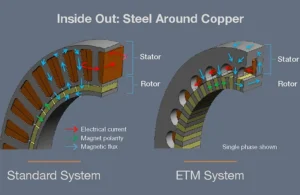
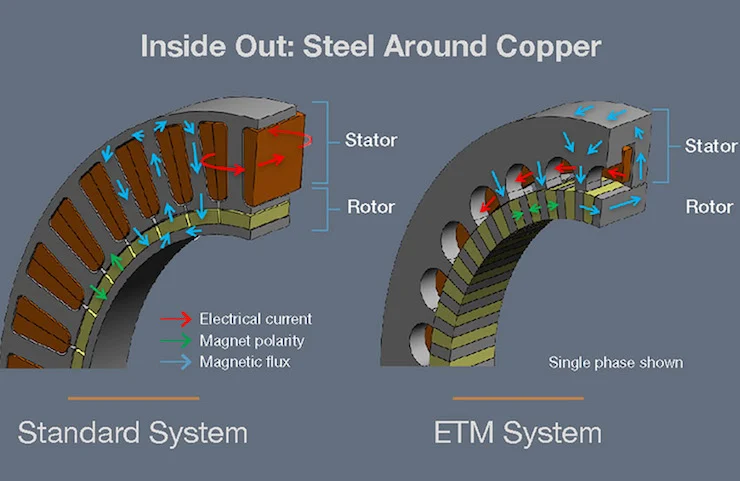
While radial and axial flux motors adhere to well-defined magnetic flux orientations, transverse flux motors carve out their own niche by featuring a magnetic flux path that is transverse to the axis of rotation. This means the magnetic flux flows across the axis, rather than strictly parallel or perpendicular to it. The architectural ingenuity of TFMs lies in their construction: they are typically built with a single winding for each phase, wound circumferentially around the stator, or precisely around the axis of rotation. This novel winding approach facilitates a multi-directional magnetic flux flow, encompassing axial paths across the stator, circumferential paths along the rotor, and radial paths through the air gap between them. This complex, three-dimensional magnetic circuit is a hallmark of TFM technology and the key to its distinctive performance.
A critical design advantage stemming from this unique construction is the decoupling of the number of machine poles from the physical size of the windings themselves. In conventional motors, increasing the number of poles often necessitates smaller, more intricate windings, which can lead to manufacturing complexities and thermal management challenges. By decoupling these parameters, TFMs offer engineers greater design flexibility, enabling the integration of a higher number of poles without compromising winding size or thermal performance. This characteristic directly translates into one of the most compelling benefits of transverse flux motors: significantly higher torque density.
Unpacking the Advantages: High Torque Density and Efficiency
The primary allure of transverse flux motors lies in their exceptional torque density and impressive efficiency. Torque density, measured in Newton-meters per kilogram (Nm/kg) or Newton-meters per liter (Nm/L), quantifies how much torque a motor can produce relative to its mass or volume. TFMs consistently outperform conventional radial and axial flux designs in this metric, often delivering several times the torque for a given size and weight. This attribute is transformative for applications where powerful motion must be generated from a compact and lightweight package. For example, in industrial robotics, a higher torque density means a smaller, lighter motor can achieve the same lifting or manipulation capabilities as a much larger, heavier conventional motor, leading to more agile robots with increased payload capacity.
Accompanying their high torque density is superior efficiency. The optimized magnetic circuit and winding configuration of TFMs minimize copper losses (due to larger windings for a given pole count) and iron losses (due to efficient flux utilization). High efficiency is paramount in an era focused on energy conservation and sustainability. For battery-powered applications, such as electric vehicles or autonomous mobile robots, higher motor efficiency directly translates into extended operating range and reduced charging frequency. In grid-powered industrial settings, it means lower electricity consumption, leading to significant operational cost savings and a reduced carbon footprint. Studies have shown that even a few percentage points increase in motor efficiency across industrial sectors can save gigawatts of power annually.
These combined advantages make TFMs exceptionally well-suited for direct-drive applications. Direct-drive systems eliminate the need for traditional gearboxes, which are typically employed to increase torque or reduce speed in conventional motor setups. Gearboxes introduce mechanical complexity, friction losses, backlash, noise, and require regular maintenance. By directly coupling the motor to the load, TFMs simplify mechanical designs, improve positional accuracy and stiffness, reduce overall system weight, and enhance reliability by removing a significant point of failure and wear. This paradigm shift is particularly impactful in fields demanding high precision and robustness, such as advanced manufacturing, CNC machining, and high-performance robotics.
Timeline and Key Developments: ETM’s Entry into Robotics
While the theoretical underpinnings of transverse flux motors have been explored by researchers for several decades, their commercial viability and market penetration have accelerated in recent years, largely due to advancements in materials science, manufacturing techniques, and sophisticated control electronics. Early research in the late 20th century highlighted the potential of TFMs but struggled with practical implementation challenges, including complex manufacturing and cost.
A significant recent milestone demonstrating the burgeoning potential of TFMs occurred with ETM, an innovative motor technology company, which announced its foray into the robotics market with its proprietary transverse flux motor technology. While specific dates for ETM’s initial public announcement are generally cited in late 2023 or early 2024, the company’s research and development efforts would have spanned several years prior. ETM explicitly stated that its motor technology effectively "eliminates trade-offs between efficiency and size" – a perennial challenge for engineers designing high-performance robotic systems. This achievement is attributed to their ability to decouple magnetic flux from electrical windings, a direct consequence of the TFM’s unique architecture.
ETM’s claims are substantial: their patented architecture reportedly provides "up to 10x greater torque density than conventional motors." This figure, if realized consistently across various applications, represents a monumental leap in motor performance. Such an increase in torque density would allow robotic arms to be significantly lighter, more compact, and yet capable of handling heavier payloads or executing faster, more dynamic movements. For collaborative robots (cobots), which operate in close proximity to humans, this could mean more slender, less intimidating designs that are also more powerful and responsive. Inferred statements from ETM executives or product managers would likely emphasize the disruptive potential of this technology for robot manufacturers seeking to enhance performance metrics while reducing the overall footprint and energy consumption of their systems. This move by ETM signals a growing industry recognition of TFMs as a viable and superior alternative for demanding applications.
Navigating the Challenges: Drawbacks and Ongoing Research
Despite their compelling advantages, transverse flux motors are not without their inherent drawbacks, which have historically impeded their widespread adoption. Addressing these challenges remains a focal point for ongoing research and development.
One commonly cited issue is cogging torque and ripple torque. Cogging torque refers to the periodic variation in torque that occurs even when the motor windings are not energized, caused by the interaction between the permanent magnets on the rotor and the ferromagnetic material of the stator. Ripple torque, on the other hand, is the variation in torque produced when the motor is energized, typically due to the commutation process and magnetic non-uniformities. Both phenomena can lead to unwanted vibrations, acoustic noise, and reduced precision in motion control, which are particularly problematic in high-accuracy applications like robotics or medical devices. Researchers are actively exploring various mitigation strategies, including optimized pole and slot geometries, stator skewing, and advanced control algorithms, to minimize these torque disturbances.
Another significant hurdle is the complex mechanical design of transverse flux motors. The intricate three-dimensional magnetic paths and the specific circumferential winding arrangement often necessitate more sophisticated manufacturing processes and tighter tolerances compared to conventional radial flux machines. This complexity can translate into higher design and manufacturing costs, especially for low-volume production. The assembly of these motors can also be more challenging, requiring specialized tooling and expertise. As manufacturing technologies advance, particularly in areas like additive manufacturing and automated assembly, these complexities may become more manageable and cost-effective.
Furthermore, TFMs exhibit non-linear dynamics, which complicates the accurate modeling of their behavior. The complex magnetic circuits and saturation effects make it difficult to predict motor performance under varying load conditions and speeds using simplified linear models. This necessitates the use of advanced finite element analysis (FEA) simulations and empirical testing during the design phase, adding to development time and cost. The non-linearities also pose challenges for developing precise and robust control strategies, often requiring sophisticated adaptive or model-predictive control algorithms.
Finally, transverse flux motors can suffer from a low power factor. The power factor is a measure of how effectively electrical power is converted into useful work. A low power factor indicates that a significant portion of the apparent power supplied to the motor is reactive power, which does not contribute to mechanical work. This can lead to increased current draw for the same real power output, requiring larger current-carrying components, increasing transmission losses, and potentially incurring penalties from utility providers in industrial settings. While power factor correction techniques can be employed, they add to the system’s complexity and cost.
Broader Impact and Future Implications
The emergence and refinement of transverse flux motor technology hold profound implications across a multitude of industries. Their unique combination of high torque density, efficiency, and suitability for direct-drive applications positions them as a disruptive force, challenging the long-standing dominance of conventional motor designs.
In robotics and automation, TFMs could catalyze the development of a new generation of robots that are lighter, more powerful, and more agile. This would not only enhance industrial productivity but also enable more sophisticated and safer human-robot collaboration, expanding robotics into new domains such as healthcare, logistics, and service industries. The ability to eliminate bulky gearboxes directly translates to more compact robotic joints, reducing inertia and improving dynamic response.
For the electric vehicle (EV) market, where efficiency, power density, and weight are critical determinants of range and performance, TFMs present an intriguing alternative to existing motor technologies. While axial flux motors are gaining traction in some EV applications, TFMs could offer even greater power-to-weight ratios, potentially leading to lighter powertrains, extended battery life, and more dynamic driving experiences. Their direct-drive capability could simplify EV transmissions, reducing component count and improving reliability.
The renewable energy sector, particularly large-scale wind turbines, could also benefit significantly. Direct-drive wind turbines, which eschew multi-stage gearboxes, are already a growing trend due to their reduced maintenance and improved reliability. TFMs, with their high torque density, could enable even more compact and efficient direct-drive generators, potentially reducing the nacelle size and weight, and thus the overall cost of energy production.
Beyond these major sectors, TFMs could find applications in aerospace (for lighter actuators and propulsion systems), medical devices (for compact, high-precision surgical tools or prosthetic limbs), and advanced industrial machinery where precision, compactness, and high efficiency are paramount.
The continued investment in research and development, coupled with advancements in materials science (e.g., higher-performance permanent magnets, advanced composites) and manufacturing techniques (e.g., automated winding, precision additive manufacturing), will be crucial for overcoming the remaining challenges associated with TFMs. As production scales and costs decrease, transverse flux motors are poised to move from specialized, high-performance niches to broader market adoption, fundamentally reshaping the landscape of electric motor technology and powering the next generation of efficient, compact, and powerful machines. The shift towards greater energy efficiency and electrification across all sectors ensures a strong impetus for the continued innovation and integration of advanced motor technologies like the transverse flux motor.