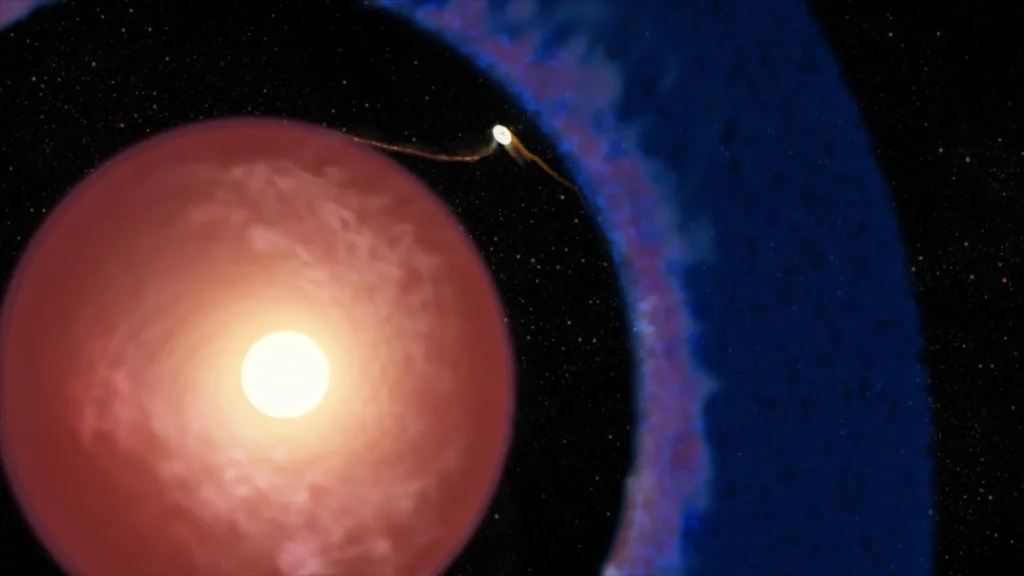
Astronomers have confirmed the existence of Elias 2-24 b, a planet less than one million years old, marking it as the youngest celestial body of its kind ever discovered. This nascent world remains enshrouded in the very gas and dust from which it coalesced, presenting scientists with an unparalleled opportunity to observe the intricate processes of planet formation in real-time. The discovery, detailed in a recent publication in The Astrophysical Journal Letters, challenges existing theoretical models and opens a new frontier in our understanding of how planetary systems come into being.
A Landmark Discovery in Planet Formation Research
The identification of Elias 2-24 b was made possible through meticulous analysis of archived observational data, generously supported by NASA funding. This exoplanet is currently orbiting within the protoplanetary disk of its host star, Elias 2-24, a young stellar system located approximately 450 light-years from Earth. The proximity of Elias 2-24 b to its nascent star, and its immersion in the primordial material, makes it a veritable "baby planet," allowing researchers to witness planetary evolution at its earliest and most dynamic stages.
"Our planet-formation models have historically struggled to account for the previous record holders for the youngest known planets," stated Lucas Cieza, a professor at the Instituto de Estudios Astrofísicos in Chile and a co-author of the study. "These were planets more than 5 million years old, orbiting stars like PDS 70 and WISPIT 2. The discovery of Elias 2-24 b indicates that our current understanding of planetary formation is still incomplete; there are fundamental processes we have yet to fully grasp."
The implications of Elias 2-24 b’s existence are profound. For decades, astronomers have relied on observing more mature exoplanets, typically billions of years old and orbiting close to their stars, to infer the processes of planet formation. These methods, such as the transit method, where a planet briefly dims its star’s light as it passes in front, are less effective for younger, dust-obscured planets that may also reside in more distant orbits. Elias 2-24 b offers a direct window into the very beginning of this cosmic journey.
Unveiling Elias 2-24 b: A Chronology of Discovery
The journey to confirming Elias 2-24 b was a multi-year effort, involving observations from several powerful telescopes and the crucial re-examination of existing data. The initial hints of a forming planet emerged from observations of the young star Elias 2-24, which is surrounded by a substantial debris disk – a swirling torus of gas, dust, ice, and rocky material.
Early Observations and Theoretical Puzzles:
Around 2013, the Atacama Large Millimeter/submillimeter Array (ALMA) in Chile detected a significant gap within the dusty disk encircling Elias 2-24. This gap was interpreted as a potential sign of a forming planet carving out its orbital path through the disk. Subsequent observations by the European Southern Observatory’s Very Large Telescope (VLT) in Chile, around 2017, captured a faint point of light nestled within this gap.
This faint object immediately piqued the interest of astronomers. However, its existence posed a significant theoretical challenge. Current planet formation models suggest that the formation of a gas giant like Jupiter, with a mass comparable to that of Elias 2-24 b, takes a considerable amount of time, estimated to be around 5 million years, even under ideal conditions at distances similar to Jupiter’s orbit from our Sun. Elias 2-24 b, however, is located approximately 55 times farther from its star than Earth is from the Sun, a region where planet formation is expected to be even slower. The presence of a discernible forming planet at such a young age and extreme orbital distance defied these established theories.
The Role of Archival Data and Advanced Instrumentation:
The breakthrough came with the meticulous examination of archival data from the W. M. Keck Observatory in Hawaii, a facility that collaborates with NASA through a cooperative agreement. Andrea Bernardi, a doctoral candidate at the Universidad Diego Portales in Chile and the lead author of the study, spearheaded this effort. Bernardi and her team focused on observations of seven young stars, including Elias 2-24, that had been captured using the observatory’s coronagraph.
A coronagraph is an instrument designed to block out the intense light of a star, making it possible to detect fainter objects in its immediate vicinity. This technique is particularly vital for spotting planets hidden within the glare and dust of their parent stars. By sifting through data collected by Keck in 2018 and 2020, Bernardi’s team identified the same faint object within the gap of Elias 2-24’s disk.
"The planets should be found within the gaps, since they are carving them," Bernardi explained. "And that’s exactly where we found Elias 2-24 b."
Crucially, by combining observations from different epochs and tracking the object’s movement over time, the researchers were able to confirm that it was indeed orbiting Elias 2-24. Its trajectory and behavior were consistent with a planet, rather than an artifact of the imaging process or a background star. This rigorous analysis, drawing on data from multiple observations and utilizing sophisticated analytical techniques, ultimately led to the definitive confirmation of Elias 2-24 b.
Supporting Data: The Characteristics of Elias 2-24 b
Elias 2-24 b is estimated to possess a mass comparable to that of Jupiter. Its host star, Elias 2-24, is a young star, estimated to be less than one million years old, placing it in the very early stages of its stellar evolution. The protoplanetary disk surrounding Elias 2-24 is rich in gas and dust, providing the raw materials for planet formation. The gap within this disk, where Elias 2-24 b resides, is approximately 150 astronomical units (AU) in diameter. For context, one AU is the distance between the Earth and the Sun. Therefore, Elias 2-24 b orbits at a staggering distance of roughly 55 AU from its star, a region far beyond the traditional "snow line" where ice can condense, a key factor in the rapid growth of gas giants.
The faintness of Elias 2-24 b, even with advanced instruments, underscores its youth and the challenges of detecting such objects. Its mass and orbital distance present a compelling case study for refining models of core accretion and gravitational instability, two leading theories for how planets form. The speed at which this Jupiter-analog appears to have formed at such a great distance from its star suggests that either our understanding of accretion rates needs revision, or that gravitational instability – where a massive disk fragment collapses under its own gravity – may play a more significant role in the outer regions of protoplanetary disks than previously thought.
Official Responses and the Scientific Community’s Reaction
The confirmation of Elias 2-24 b has generated considerable excitement within the astronomical community. Scientists involved in the discovery have expressed both awe and a sense of urgency to further investigate this unique system.
"This is just the beginning of a new era of discovery," Cieza remarked. "It’s incredible that with modern technology, we are actually able to see planet formation in action."
The findings are expected to spur new theoretical work and observational campaigns aimed at identifying more such "baby planets." The success of using archival data from facilities like the Keck Observatory also highlights the immense scientific value locked within these archives, often revealing new discoveries years after the initial observations were made.
"We usually hear about telescopes working separately, but this confirmation was possible only by using multiple telescopes together," Bernardi emphasized. "Elias 2-24 b is at the limit of what current telescopes can detect, but with new instruments like NASA’s Nancy Grace Roman Space Telescope, such detections should become easier."
This sentiment is echoed by exoplanet researchers worldwide, who see Elias 2-24 b as a critical data point that can help resolve long-standing debates about the speed and mechanisms of planet formation, particularly in the outer reaches of stellar systems.
Broader Impact and Future Implications: The Dawn of a New Era
The discovery of Elias 2-24 b is more than just an astronomical curiosity; it represents a significant leap forward in our ability to probe the earliest moments of planetary system development. For years, the study of exoplanets has been hampered by a "detection gap," where planets in their infancy, particularly those forming far from their stars, have remained largely invisible to our instruments. Elias 2-24 b begins to bridge this gap.
The implications extend to our understanding of our own solar system’s formation. By studying young systems like Elias 2-24, scientists can gain insights into the conditions that prevailed billions of years ago when Earth and its planetary neighbors were taking shape. This could shed light on critical questions, such as the timing of water delivery to terrestrial planets and the early evolutionary paths of gas giants, which may have influenced the subsequent development of habitable worlds.
The Promise of Next-Generation Telescopes:
The development and upcoming deployment of advanced telescopes, such as NASA’s Nancy Grace Roman Space Telescope, are poised to revolutionize the search for young planets. The Roman Space Telescope, with its enhanced coronagraph capabilities, is specifically designed to detect planets that are currently beyond the reach of existing instruments. Its increased sensitivity and wider field of view are expected to enable the discovery of numerous planets in their formative stages, including those orbiting at wider separations and with lower masses.
"Roman will take planet hunting to the next level," Cieza stated. This new generation of observatories will allow astronomers to move beyond studying a handful of rare, formative planets to building statistical samples, which are essential for robust scientific understanding.
The confirmation of Elias 2-24 b serves as a powerful testament to the ongoing progress in observational astronomy and theoretical modeling. It underscores the dynamic and often surprising nature of the universe, reminding us that even our most sophisticated models are continuously refined by new discoveries. As astronomers turn their gaze to the cosmos with ever more powerful tools, the secrets of planetary genesis are slowly but surely being unveiled, promising an exciting future for exoplanet science. The universe, it seems, is still a remarkably fertile ground for uncovering cosmic infant prodigies.