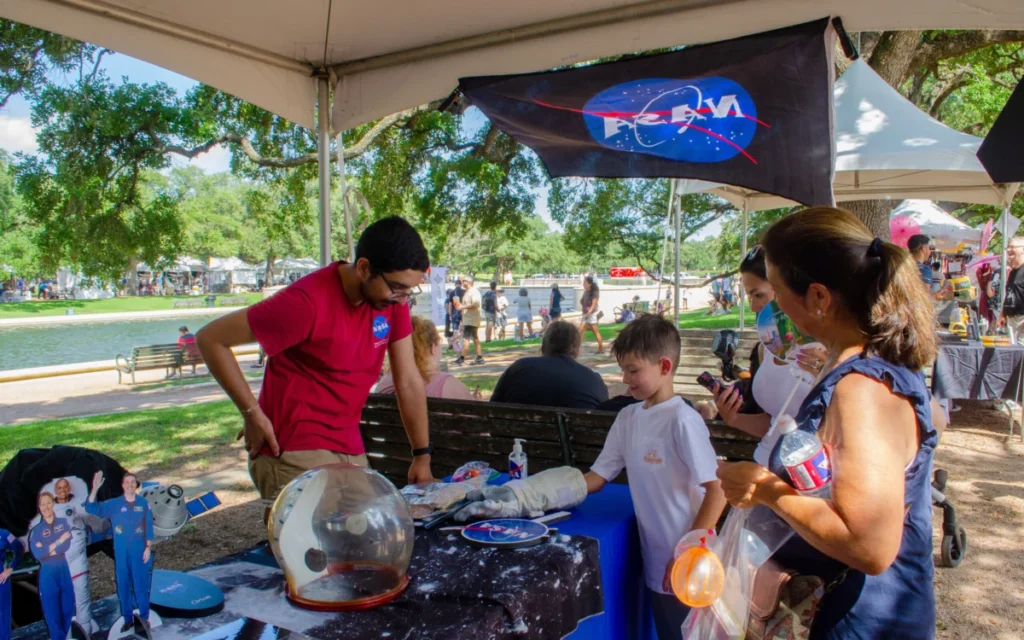
The air in Hermann Park on September 12th and 13th buzzed with more than just the usual vibrant energy of Houston’s Japan Festival. For two days, amidst the rich tapestry of traditional Japanese culture – from the rhythmic beats of taiko drums and the graceful movements of dancers to the tantalizing aromas of authentic cuisine – a different kind of excitement took root. Employees from NASA’s Johnson Space Center (JSC) transformed a corner of the beloved annual event into a gateway to the cosmos, showcasing humanity’s ongoing quest to explore the final frontier and fostering a spirit of international partnership. This marks the fourth consecutive year JSC has participated as an exhibitor, deepening its connection with the Houston community and highlighting the global nature of space exploration.
A Cosmic Connection at a Cultural Celebration
For over three decades, the Japan Festival has served as a cornerstone event for celebrating and immersing the public in the diverse traditions of Japan. Held annually, it draws thousands of attendees eager to experience Japanese heritage firsthand. This year, NASA’s presence provided a unique intersection of terrestrial culture and celestial ambition. The JSC exhibit, strategically positioned to engage the thousands of festivalgoers, served as a powerful reminder that the pursuit of knowledge and discovery transcends borders and cultures.
The Johnson Space Center’s booth was a focal point of fascination, meticulously designed to offer a glimpse into NASA’s ambitious future. At the forefront of the display was the highly anticipated Artemis III mission, the groundbreaking endeavor poised to return humans to the lunar surface for the first time since the Apollo era. The exhibit provided detailed insights into the mission’s objectives, the advanced technologies being developed, and the diverse crew that will undertake this historic journey. Complementing this, JSC also elaborated on its long-term vision for establishing a sustainable Moon Base, a crucial stepping stone for future deep space exploration.
Tangible Links to the Stars
Attendees were treated to a tangible representation of these ambitious goals. Scale models of NASA’s Orion spacecraft, the deep-space vehicle designed to carry astronauts beyond low-Earth orbit, and the iconic International Space Station (ISS), a testament to decades of international cooperation in space, were prominently displayed. These models, often accompanied by informative placards and knowledgeable JSC personnel, allowed visitors to visualize the complex engineering and scientific endeavors that underpin space missions.
Beyond static displays, the exhibit offered interactive experiences designed to spark imagination and engagement. Visitors had the unique opportunity to sample space food, providing a taste of the specially prepared meals astronauts consume during their missions. This hands-on element brought a personal connection to the daily realities of spaceflight. Perhaps the most popular interactive element was the chance to try on a genuine astronaut glove and helmet. The weight and feel of these specialized pieces of equipment, designed for the harsh environment of space, offered a visceral understanding of the challenges and preparedness required for spacewalks and lunar excursions. The sheer delight and awe on the faces of both children and adults as they donned the gear underscored the enduring power of space exploration to captivate the human spirit.
Inspiring the Next Generation of Explorers
The impact of the JSC exhibit extended far beyond mere entertainment. Over the course of the weekend, Johnson employees engaged with more than 3,000 festivalgoers, serving as ambassadors for NASA’s mission and its ongoing initiatives. These interactions were characterized by a spirit of education and inspiration. Staff members diligently explained NASA’s current projects, from Earth observation and climate research to the continued exploration of the solar system. They distributed NASA stickers and pins, cherished mementos that serve as tangible reminders of the agency’s presence and aspirations.
The most profound aspect of the weekend, as consistently reported by JSC employees, was witnessing the unadulterated joy and excitement on the faces of attendees, particularly children, as they interacted with the exhibits. This visible enthusiasm highlighted the powerful role such public outreach plays in nurturing a passion for science, technology, engineering, and mathematics (STEM) fields.
Brendan King, a software engineer with Johnson’s Flight Dynamics Division, shared his perspective: "It was amazing to see students as early as high school so passionate about NASA and asking questions on how to prepare for a NASA career. Their genuine curiosity and eagerness to learn about the pathways into space exploration were incredibly encouraging. It validates the importance of these outreach efforts in shaping the future workforce." King’s observation points to the long-term benefits of such events, not only in fostering public support for NASA but also in actively cultivating the next generation of scientists, engineers, and astronauts.
A Collaborative Orbit: JAXA’s Presence and the Artemis Accords
Adding another significant layer to the international dimension of the event, the Japan Aerospace Exploration Agency (JAXA) maintained a prominent booth adjacent to NASA’s. This strategic placement was not coincidental but rather a deliberate reflection of the robust and enduring partnership between the two leading space agencies. JAXA’s exhibit featured a model of the HTV-X1 cargo spacecraft, a vital component in supplying the ISS, alongside displays of Japanese space food and captivating images of JAXA’s pressurized rover. This rover, designed for extended lunar surface exploration, represents a significant contribution to future crewed and uncre uncrewed missions on the Moon.
The presence of JAXA astronaut Akihiko Hoshide further amplified the collaborative spirit. Hoshide, a seasoned spacefarer with multiple missions to the ISS under his belt, generously signed autographs and posed for photographs with festival attendees. His participation served as a powerful symbol of the human element of space exploration and the international camaraderie that defines it.
The close proximity of the NASA and JAXA booths underscored a shared commitment to advancing space exploration through collaboration. This partnership is deeply rooted, dating back to the integration of Japan’s Kibo laboratory, the ISS’s largest single module, which significantly enhanced the station’s scientific capabilities. More recently, Japan’s signing of the Artemis Accords, a set of principles guiding peaceful and responsible space exploration, and its active development of critical lunar surface hardware, further solidify this alliance. These joint efforts are instrumental in pushing the boundaries of human knowledge and capability in space.
Broader Implications: Houston as the Hub of Human Spaceflight
As the undisputed hub of human spaceflight, NASA’s Johnson Space Center recognizes the profound importance of engaging with the public. Events like the Japan Festival provide invaluable opportunities for the JSC community to connect with the broader Houston population, sharing the agency’s rich history, its current groundbreaking work, and its ambitious future missions. These interactions serve a dual purpose: they educate the public about the significance of NASA’s endeavors and reinforce Houston’s identity as a city at the forefront of space exploration.
The slogan, "Giant Leaps Start Here," prominently displayed and embodied by JSC’s work, resonates deeply within the city. By participating in local events, NASA not only inspires awe and wonder but also cultivates a sense of civic pride and collective ownership in the monumental achievements of human spaceflight. The festival’s diverse audience, encompassing individuals from all walks of life, provides a fertile ground for sowing the seeds of curiosity and fostering a lasting appreciation for the scientific and exploratory spirit that NASA embodies.
The Chronology of Collaboration and Future Visions
The participation of NASA’s Johnson Space Center at the Japan Festival is a relatively recent but significant tradition, now in its fourth year. This growing engagement reflects a deliberate strategy to enhance public outreach and to highlight the international nature of space exploration. The festival itself boasts a history spanning over 30 years, evolving from a smaller community gathering into a major cultural event that attracts tens of thousands of attendees annually.
The timeline of NASA and JAXA’s collaboration is extensive, with key milestones including:
- Early 2000s: The addition of the Kibo module to the International Space Station, a complex and technologically advanced undertaking that symbolized a new era of international partnership in orbital research.
- Ongoing: Continuous collaboration on ISS operations, scientific experiments conducted in microgravity, and the exchange of expertise in astronaut training and mission planning.
- 2020s: The development of lunar exploration technologies by JAXA, such as the pressurized rover, and Japan’s commitment to the Artemis program, culminating in the signing of the Artemis Accords.
The presence of JAXA at the festival alongside NASA is a testament to the synergistic relationship that has developed. This partnership is not merely symbolic; it is foundational to achieving ambitious goals such as the Artemis program. The Artemis Accords, signed by numerous nations, establish a framework for responsible and sustainable lunar exploration, emphasizing transparency, interoperability, and the peaceful use of outer space. Japan’s active role in developing lunar surface hardware further solidifies its position as a key partner in humanity’s return to the Moon and its eventual journey to Mars.
Supporting Data: The Reach of Outreach and the Scale of Ambition
The impact of public outreach events like the Japan Festival can be quantified in several ways. The attendance figures for the festival itself, typically exceeding 30,000 over the weekend, indicate a significant audience reach. The interaction with over 3,000 festivalgoers directly by JSC employees represents a substantial portion of this audience engaging in meaningful dialogue about space exploration. The distribution of NASA stickers and pins, while seemingly small, serves as a persistent reminder of the agency’s presence and mission in the homes and lives of many.
Furthermore, the data from such events informs future outreach strategies. Feedback from employees, like Brendan King’s observation about student interest in NASA careers, provides valuable insights into the types of programming and information that resonate most effectively with the public. This data can guide the development of more targeted and impactful educational initiatives.
Looking at the scale of NASA’s current and future ambitions, the Artemis III mission, for example, represents a significant technological and logistical undertaking. The development of the Human Landing System (HLS) by private companies, in partnership with NASA, along with the advanced capabilities of the Orion spacecraft and the Space Launch System (SLS) rocket, are all part of a multi-billion dollar investment in lunar exploration. Similarly, the vision for a Moon Base involves sustained efforts in habitat development, resource utilization, and long-term sustainability. The public’s understanding and support, fostered through events like this, are crucial for the continued funding and success of these monumental endeavors.
Official Responses and the Broader Impact
While direct quotes from high-ranking NASA officials specifically about the Japan Festival might not be available, the agency’s consistent participation and the emphasis placed on public engagement by centers like JSC speak volumes. The strategic decision to exhibit at a culturally significant event like the Japan Festival demonstrates a commitment to broadening the appeal of space exploration beyond traditional science and technology enthusiasts.
The broader impact of this collaboration is multifaceted. It strengthens international ties by showcasing joint efforts in a globally recognized forum. It educates the public about the complex realities and exciting possibilities of space exploration. Crucially, it inspires future generations, igniting a passion for STEM that can lead to innovation and discovery for decades to come. The proximity of NASA and JAXA booths at the festival serves as a powerful, visible reminder of the global nature of space exploration and the shared human endeavor to push the boundaries of what is possible. It underscores the fact that in the vastness of space, collaboration is not just an option; it is a necessity for achieving humanity’s grandest ambitions. The echoes of these interactions at Hermann Park will undoubtedly reverberate in classrooms, laboratories, and perhaps even on future lunar landscapes, a testament to the enduring power of shared curiosity and international partnership.