On August 12, 2026, as Europe prepared to witness a breathtaking total solar eclipse, the European Space Agency’s (ESA) Proba-3 mission, a unique dual-satellite observatory, experienced its own extraordinary cosmic event. Hours before the Moon’s shadow traced a path across Earth, Proba-3’s two spacecraft, positioned 60,000 kilometers above our planet, found themselves in a privileged position to observe this celestial ballet. This unique vantage point not only allowed them to capture stunning imagery of the natural eclipse but also presented an unprecedented opportunity to study the Sun’s corona under exceptionally pristine conditions, thanks to a remarkable cosmic coincidence.
The Proba-3 mission, designed to artificially create eclipses of the Sun, operates with a specific scientific objective: to study the Sun’s corona, the ethereal outer atmosphere, which is normally obscured by the Sun’s brilliant disc. The mission comprises two identical satellites, the Occulter and the Coronagraph. In their operational configuration, they fly in precise formation. The Occulter spacecraft positions itself directly between the Sun and the Coronagraph, effectively acting as an artificial Moon. This maneuver allows the Coronagraph to achieve an unobstructed, long-duration view of the Sun’s corona, revealing its intricate structures and dynamics in ways not possible from Earth-bound observatories.
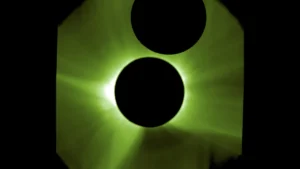
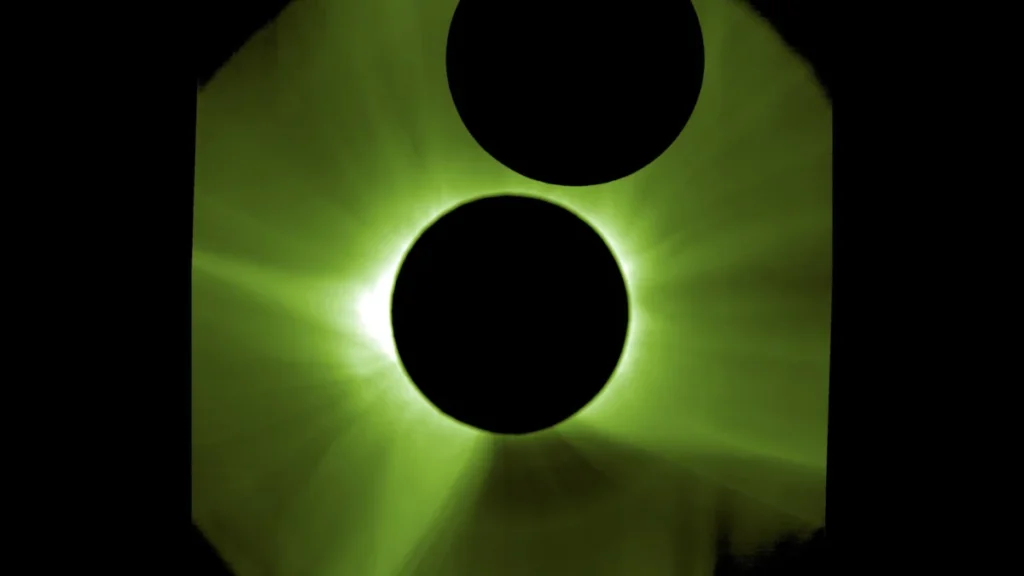
However, on August 12, 2026, nature intervened with a celestial alignment that offered Proba-3 an even more profound observational opportunity. The Moon, in its predictable orbit, decided to put on its own show. The mission’s coronagraph instrument, known as ASPIICS (Advanced Space-borne Polarimetric Imager for Coronal Investigating Satellites), captured a series of images over a three-hour period in the morning. These images documented the Moon’s majestic passage across Proba-3’s field of view, an event that serendipitously coincided with the spacecraft’s own artificial eclipse maneuvers.
A Cosmic Coincidence: The Double Eclipse
The Moon’s shadow, slightly larger than the occulting disc deliberately created by Proba-3’s Occulter spacecraft, fully eclipsed the Sun for a duration of 8 minutes and 40 seconds. This celestial overlap meant that Proba-3 was experiencing a "double eclipse" – a natural eclipse by the Moon occurring while the spacecraft were actively engaged in their own mission of creating an artificial one. This extended period of darkness for the ASPIICS instrument, occurring at an altitude of 60,000 km, significantly surpassed the maximum duration of totality experienced on Earth. For context, the longest period of totality during the 2026 European eclipse was a mere 2 minutes and 18 seconds, observed just off the coast of Iceland.
The significance of this extended double eclipse lies in the reduction of "parasitic light." This unwanted light is typically generated by the diffraction of the Sun’s disc light as it grazes the edge of the Occulter spacecraft. When the Moon’s disc, larger than the Occulter’s, completely obscured the Sun, it effectively eliminated this source of parasitic light for the ASPIICS instrument. This pristine viewing condition provided an exceptional opportunity for scientists to calibrate the optical performance of the ASPIICS coronagraph with unparalleled accuracy. Furthermore, it allowed for brief but crucial observations of the solar corona under the most ideal conditions possible.
Proba-3’s Mission: Mimicking the Moon
The Proba-3 mission’s core objective is to replicate the Moon’s natural eclipsing capability in space. Launched in 2024, the mission consists of two identical satellites, each weighing approximately 150 kilograms. These spacecraft are designed to fly in a precise formation, maintaining a specific distance and alignment relative to each other and the Sun. The Occulter, as its name suggests, is tasked with blocking the Sun’s direct light. The Coronagraph, positioned behind it, is equipped with sensitive instruments to observe the Sun’s faint outer atmosphere, the corona.
The corona is a region of immense scientific interest, reaching temperatures of millions of degrees Celsius and extending millions of kilometers into space. It is the source of the solar wind, a stream of charged particles that permeates the solar system and influences space weather. Understanding the corona’s dynamics, its magnetic field, and the processes that heat it to such extreme temperatures are key to comprehending solar activity, such as solar flares and coronal mass ejections, which can have significant impacts on Earth’s technological infrastructure and astronaut safety.
Traditional ground-based coronagraphs face limitations due to atmospheric interference and the overwhelming brightness of the solar disc. Space-based coronagraphs, like ASPIICS on Proba-3, overcome atmospheric issues but still contend with scattered light from the Sun’s disc, which can obscure the fainter coronal structures. Proba-3’s innovative approach of using a dedicated occulting spacecraft in precise formation offers a novel solution to minimize this scattered light, enabling more detailed and extended observations of the corona.
A Rare Opportunity: The Value of a Double Eclipse
The double eclipse witnessed on August 12, 2026, was an exceptionally rare event for the Proba-3 mission. While the mission is designed to create artificial eclipses regularly, the alignment with a natural solar eclipse presented a unique calibration and observational window. This fortuitous occurrence allowed scientists to validate the performance of the ASPIICS instrument against a known celestial object (the Moon) blocking the primary light source, effectively providing a perfect "dark screen" for calibration.
This event also offered a valuable opportunity to observe the solar corona with reduced parasitic light, which can be a significant challenge in coronagraphy. The ability to capture coronal images under such pristine conditions, even for a short duration, can yield critical data on the fine structures, plasma flows, and magnetic field configurations within the corona. This data can contribute to refining solar models and improving our understanding of the Sun’s behavior.
The Proba-3 mission is scheduled to continue its operations for a planned duration, and future opportunities for observing natural eclipses are anticipated. However, these will likely involve partial eclipses, where the Moon passes through the ASPIICS field of view but does not fully obscure the solar disc. The next planned total solar eclipses visible from Earth, on August 2, 2027, and July 22, 2028, will present further partial eclipse opportunities for Proba-3. While these will not offer the same degree of darkness as the August 12, 2026, event, they will still provide valuable data for calibration and scientific study.
Broader Impact and Future Implications
The successful observation of the double eclipse by Proba-3 underscores the power of innovative space missions in pushing the boundaries of scientific understanding. The data gathered from this event will contribute to a broader effort to monitor and predict space weather. Accurate space weather forecasts are becoming increasingly crucial as our reliance on satellite technology and critical infrastructure grows. Geomagnetic storms, triggered by solar activity, can disrupt satellite communications, damage power grids, and pose risks to astronauts in space.
The insights gained from Proba-3’s observations of the solar corona can help scientists better understand the mechanisms driving solar flares and coronal mass ejections, the primary drivers of severe space weather events. By studying the corona in unprecedented detail, researchers can improve models that predict the timing, intensity, and direction of these solar phenomena, enabling better preparedness and mitigation strategies.
Moreover, the Proba-3 mission serves as a testament to international collaboration in space exploration. ESA, through its ambitious projects like Proba-3, continues to play a leading role in advancing our knowledge of the Sun and its influence on the solar system. The mission’s success also highlights the value of multi-faceted approaches to scientific inquiry, where the confluence of planned mission objectives and serendipitous celestial events can yield extraordinary scientific dividends.
As the world looks back at the awe-inspiring natural solar eclipse of August 12, 2026, the Proba-3 mission offers a unique perspective from the heavens, a testament to human ingenuity and our enduring quest to unravel the mysteries of the cosmos. The double eclipse it witnessed, a rare cosmic dance between the Moon and a meticulously engineered artificial eclipse, has provided invaluable data that will undoubtedly contribute to our understanding of the Sun for years to come.