The trajectory of a scientific career is often dictated by chance encounters and the willingness of established experts to foster the curiosity of the next generation. For Manu Srivastava, a doctoral student at the Massachusetts Institute of Technology (MIT) specializing in quantum gravity, a single "cold email" from a group of high school students in India transformed into a months-long mentorship that culminated at the world’s premier particle physics laboratory. This past spring, Srivastava, a researcher at the MIT Center for Theoretical Physics—a Leinweber Institute—received an unsolicited message from a group of ambitious secondary students he had never met. They were seeking guidance for their entry into the Beamline for Schools (BL4S) competition, an international initiative organized by CERN (the European Organization for Nuclear Research) that allows students to conduct professional-grade experiments using particle accelerator beams.
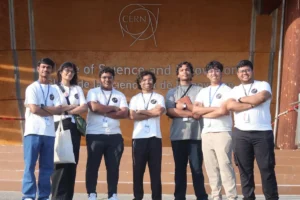
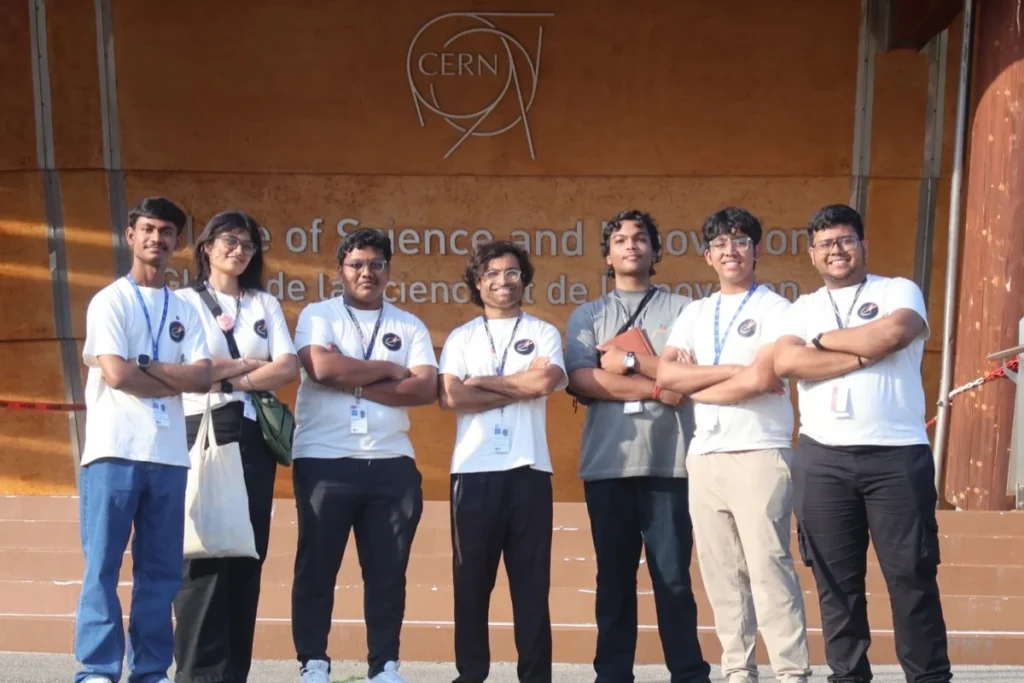
While Srivastava frequently receives requests for mentorship, often through commercialized platforms that charge families for access to Ivy League academics, this particular outreach stood out for its sincerity. Recalling his own early career attempts to contact researchers, Srivastava noted that such unsolicited efforts rarely yield results. However, the genuine passion and preliminary legwork displayed by the Indian students prompted him to break his usual habit of declining. What followed was a rigorous collaborative process that saw the students—collectively known as Team attoPION—beat out hundreds of competitors from across the globe to secure a coveted research slot at CERN’s headquarters in Geneva, Switzerland.
The Global Scale of the Beamline for Schools Competition
The Beamline for Schools competition has grown into one of the most prestigious science contests for secondary students worldwide. Now in its 13th edition, the 2024 cycle saw a record-breaking level of participation, with 712 teams from 89 different countries submitting proposals. This represented more than 4,500 students vying for just five winning spots. Team attoPION’s success is particularly notable given the geographic and institutional diversity of its members. The six students attend four different schools across four separate cities in India, having connected through various science fairs and mutual acquaintances.
The competition is designed to bridge the gap between classroom theory and experimental reality. While most high school physics curricula focus on established laws and textbook problems, BL4S requires students to identify a gap in current scientific knowledge or a unique way to test a hypothesis using a subatomic particle beam. For Team attoPION, the challenge was not just coming up with an idea, but ensuring that the idea was both scientifically significant and logistically feasible within the constraints of CERN’s Proton Synchrotron (PS) accelerator environment.
Scientific Objectives: Measuring Pion Charge Exchange
Under Srivastava’s mentorship, the students moved through several iterations of experimental designs before settling on the study of pion charge exchange. Pions, or pi-mesons, are subatomic particles composed of a quark and an antiquark. They play a fundamental role in the strong nuclear force, which binds protons and neutrons together in the nucleus of an atom. Pions exist in three states of electric charge: positive, negative, and neutral.
The specific process Team attoPION proposed to investigate involves the interaction between a positively charged pion ($π^+$) and a neutron ($n$) within a target material. In this "charge exchange" reaction, the positive pion transfers its charge to the neutron, resulting in the creation of a neutral pion ($π^0$) and a positively charged proton ($p$). The mathematical representation of this interaction ($π^+ + n rightarrow π^0 + p$) is a cornerstone of hadronic physics, yet the precision with which this occurs in specific energy ranges remains a subject of active research.
The team’s goal was to characterize the cross-section—essentially the probability or frequency—of this reaction occurring. This is a task of significant technical difficulty. Because neutral pions are extremely short-lived, decaying almost instantly into two high-energy photons (gamma rays), detecting them requires sophisticated electromagnetic calorimeters and precise timing systems. Srivastava’s role was to act as a "sanity check" for the students, helping them navigate the complexities of detector geometry and the statistical requirements for a valid measurement.
Synergies with the Deep Underground Neutrino Experiment (DUNE)
While the experiment was conceived by high schoolers, its implications reach into the upper echelons of contemporary particle physics research. Srivastava identified an immediate connection between the students’ work and the Deep Underground Neutrino Experiment (DUNE), a multi-billion-dollar international flagship project currently under construction. DUNE aims to study neutrino oscillations by sending an intense beam of neutrinos from Fermilab in Illinois to a massive detector located 1.5 kilometers underground in a former gold mine in South Dakota.
Dave Newbold, a co-spokesperson for the DUNE collaboration, emphasized the utility of the students’ proposal. In the massive liquid argon detectors used by DUNE, neutrinos interact with atomic nuclei, producing a shower of other particles, including pions. To accurately determine the "flavor" and energy of the incoming neutrinos, scientists must have an extremely precise understanding of how these secondary pions behave as they travel through the detector material.
"The proposal is real experimental particle physics," Newbold stated, noting that the data on pion charge exchange helps researchers quantify the uncertainties in DUNE’s measurements. If the students can successfully characterize how often pions swap charges, they contribute a small but vital piece of the puzzle that allows DUNE to search for "new physics," such as evidence of CP violation in the lepton sector, which could explain why the universe is dominated by matter rather than antimatter.
Chronology of the Project: From Email to Geneva
The journey from an initial inquiry to the halls of CERN followed a rigorous timeline of development and execution:
- Spring 2024: Team attoPION sends a "cold email" to Manu Srivastava at MIT. After several introductory meetings, Srivastava agrees to mentor the group.
- Spring to Early Summer 2024: The team undergoes a period of intense literature review and proposal drafting. Srivastava helps the students narrow their focus to pion charge exchange, ensuring the project is "publishable" in quality.
- June 2024: CERN announces the winners of the 13th BL4S competition. Team attoPION is named one of the five winning teams from a pool of 712.
- Summer 2024 (Pre-trip Preparation): The students begin weekly technical sessions with Berare Göktürk, a CERN support scientist. They utilize simulation software to predict the behavior of the particle beam and design the detector layout.
- Autumn 2024: The team travels to Geneva, Switzerland. They spend two weeks at CERN, working 12-hour shifts to set up their detectors, calibrate the data-acquisition (DAQ) systems, and monitor the beam runs.
- Post-Experiment Phase: The team enters the data analysis phase, processing the gigabytes of information collected during their 12 days of beam time to extract the cross-section of the pion charge exchange.
Navigating the Realities of Experimental Science
The transition from a theoretical proposal to a physical experiment is often fraught with technical hurdles. At CERN, the students were confronted with the reality that the charge-exchange process they sought to observe is exceptionally rare. This necessitated a deep dive into "triggering" logic—programming the hardware to only record data when a specific signature of particles was detected, thereby filtering out the "noise" of thousands of irrelevant interactions.
Berare Göktürk, who worked closely with the team in Geneva, noted that the educational value of the program lies in navigating these uncertainties. "We prepare in the best way possible, but we also stay humble," she said. The goal was for the students to experience the true "journey of a scientist," which includes equipment failures, software bugs, and the realization that experimental results are rarely as clean as textbook diagrams.
For Srivastava, the experience also served as a departure from his primary research in quantum gravity—a field that deals with the theoretical unification of general relativity and quantum mechanics. He attributed his ability to mentor the experiment to the interdisciplinary culture at MIT, which encourages physicists to engage with seminars and research outside their immediate niche.
Broader Implications for Global STEM Outreach
The success of Team attoPION serves as a powerful case study for the impact of scientific mentorship across borders. Srivastava, who grew up in India before moving to the United States for his doctoral studies, viewed the project as a way to give back to his home country’s scientific community. He noted that while he was unaware of CERN’s existence during his own high school years, the current generation of Indian students is increasingly connected to the global scientific infrastructure.
The achievement of these six students highlights a shifting landscape in STEM (Science, Technology, Engineering, and Mathematics) education, where high-speed internet and open-access research allow motivated individuals to engage with high-level science regardless of their geographic location. However, the role of the mentor remains indispensable. By providing the "social capital" and technical vetting required to succeed in a competition like BL4S, Srivastava helped bridge the gap between raw talent and international recognition.
As Team attoPION concludes their data analysis, the possibility of a peer-reviewed publication looms—a feat almost unheard of for secondary school students. Regardless of the final statistical significance of their findings, the project has already succeeded in its primary mission: demonstrating that the boundaries of particle physics are accessible to anyone with the persistence to ask the right questions and the courage to send an email to a stranger across the world.