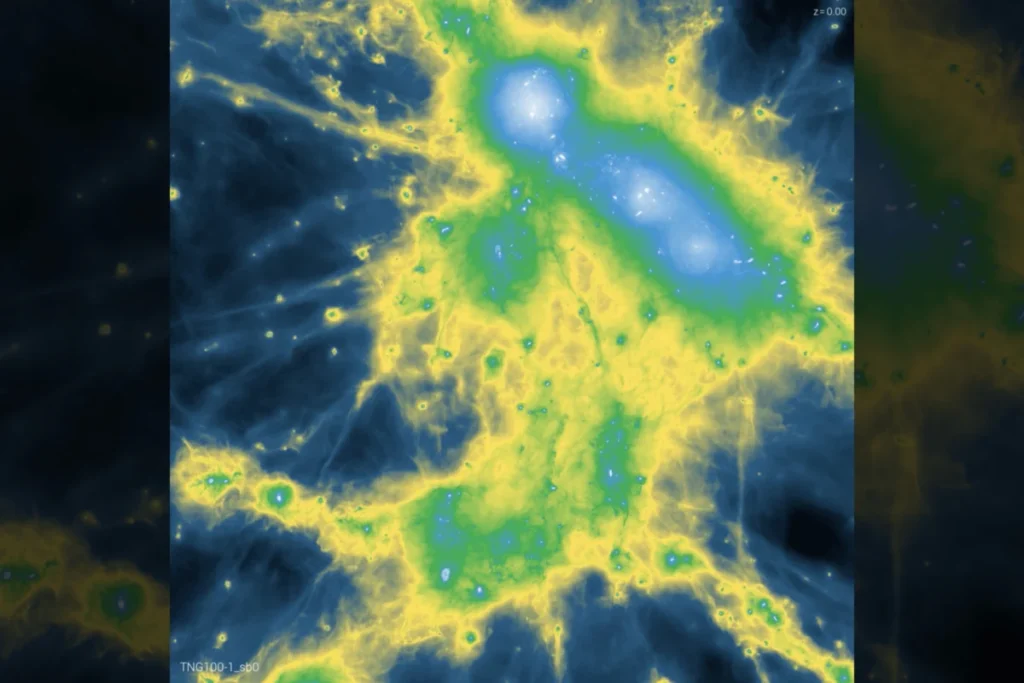
For decades, the field of cosmology has been haunted by a fundamental discrepancy in the inventory of the universe. While the luminous beauty of stars, nebulae, and galaxies paints a picture of a crowded cosmos, the mathematical ledger of the Big Bang suggests that the vast majority of "ordinary" matter—the atoms that make up everything from planets to people—is missing. This "missing baryon problem" has long suggested that a significant portion of the universe’s building blocks is hidden in the dark, cold voids between galaxies. Now, a groundbreaking study led by researchers at the Massachusetts Institute of Technology (MIT), as part of the CHIME/FRB Collaboration, has utilized the ephemeral signals of fast radio bursts (FRBs) to finally track down this elusive matter.
The research, published in the journal Physical Review Letters, reveals that the missing matter is not merely floating aimlessly in the intergalactic medium. Instead, it exists in massive, diffuse clouds extending far beyond the visible boundaries of galaxies. These "galactic fountains," as the researchers describe them, suggest that the internal processes of galaxies—specifically the explosive deaths of stars and the violent jets emitted by supermassive black holes—are far more energetic than previously theorized, pushing matter out into space across distances of millions of light-years.
The Cosmological Accounting Gap
To understand the significance of this discovery, one must look back to the origins of the universe. Cosmologists have developed highly precise models of the early universe’s composition based on the Cosmic Microwave Background (CMB) radiation and the laws of Big Bang nucleosynthesis. These models indicate that approximately 83 percent of all matter in the universe is "dark matter," an invisible substance that interacts only through gravity. The remaining 17 percent is "baryonic matter," or ordinary matter composed of protons and neutrons.
However, when astronomers count the baryonic matter they can actually see—the gas and dust within galaxies and the stars themselves—they find only about 10 percent of what should be there. This leaves roughly 90 percent of the universe’s ordinary matter unaccounted for in the modern epoch. For nearly thirty years, the search for these missing baryons has been a primary objective of observational astronomy.
Detecting this matter is an immense technical challenge. Because it is spread across the vastness of intergalactic space, its density is incredibly low—estimated at roughly one proton per cubic meter. For comparison, the air we breathe contains approximately $10^25$ molecules per cubic meter. Traditional telescopes, which rely on capturing emitted or reflected light, are largely blind to such a tenuous medium.
The Mechanism of Fast Radio Bursts
The breakthrough came through the study of fast radio bursts. First discovered in 2007, FRBs are intense, millisecond-long flashes of radio energy originating from distant galaxies. While their exact origins remain a subject of intense study—with magnetars and black hole interactions being leading candidates—their utility as cosmic probes is now undeniable.
As an FRB travels through the universe toward Earth, it must pass through the ionized gas that occupies the space between galaxies. This gas acts as a dispersive medium. Much like a prism splits white light into a rainbow, the free electrons in the intergalactic medium slow down radio waves. Crucially, lower-frequency (longer wavelength) radio waves are slowed down more than higher-frequency (shorter wavelength) waves.
This phenomenon, known as "dispersion," causes the signal to arrive at Earth "smeared" in time. By measuring the "Dispersion Measure" (DM)—the degree to which the high-energy "blue" frequencies arrive before the low-energy "red" frequencies—scientists can calculate the total amount of matter the signal encountered during its multi-billion-light-year journey.
A Statistical Synthesis: CHIME and DESI
The MIT-led team, including lead author Haochen Wang and associate professor Kiyoshi Masui, did not rely on a single signal. Instead, they pioneered a statistical method that combined data from two of the world’s most powerful astronomical surveys: the Canadian Hydrogen Intensity Mapping Experiment (CHIME) and the Dark Energy Spectroscopic Instrument (DESI).
CHIME, located at the Dominion Radio Astrophysical Observatory in British Columbia, Canada, is a unique stationary telescope with no moving parts. It uses a massive digital correlator to "steer" its vision across the entire northern sky, making it the most prolific hunter of FRBs in history. For this study, the team analyzed 2,870 FRB signals from the CHIME catalog.
To make sense of the smearing in these signals, the researchers needed to know where the matter was likely to be located. They turned to the DESI survey, which uses a specialized instrument on the Mayall Telescope in Arizona to map the three-dimensional positions of tens of millions of galaxies. By cross-correlating the smearing data from the FRBs with the precise locations of over six million galaxies provided by DESI, the team could determine how much matter was associated with specific galactic environments versus the "voids" of deep space.
Mapping the Shape of the Invisible
The results of this cross-correlation were startling. The analysis confirmed that missing baryonic matter is indeed clustered around galaxies, but the scale of this clustering defied existing models.
"A galaxy is maybe a few hundred thousand light-years across, and we found missing matter out to about four million light-years," explained Kiyoshi Masui. "That’s further than the simulations predict, by quite a bit."
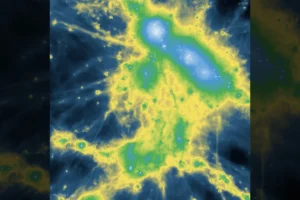
The researchers discovered that the missing matter takes the form of diffuse, halo-like clouds. While scientists previously expected matter to be concentrated relatively close to galactic centers due to gravitational pull, the data showed it was being "pushed" out. This suggests that galaxies are not closed systems but are instead "busy and messy" environments characterized by massive outflows of gas.
This "feedback" mechanism is likely driven by two main sources:
- Supermassive Black Holes: Located at the centers of most galaxies, these "Active Galactic Nuclei" (AGN) produce powerful jets of plasma that can blast gas out of the galaxy at relativistic speeds.
- Supernova Feedback: The collective energy from generations of exploding stars can create "galactic winds" that sweep gas out of the galactic disk and into the surrounding circumgalactic medium.
The fact that matter is found 4 million light-years away from galactic centers implies that these processes are significantly more violent and energetic than current astrophysical simulations have accounted for.
Chronology of the Discovery
The journey to this discovery has been a decades-long pursuit:
- 1990s: Theoretical models of the Big Bang and early universe first identify the "Missing Baryon Problem," noting that the observed matter in the local universe does not match the predicted density from the early universe.
- 2007: The first Fast Radio Burst (the "Lorimer Burst") is discovered in archival data, though its nature remains a mystery.
- 2018: The CHIME telescope begins full operations, drastically increasing the rate of FRB detections from a few dozen to thousands.
- 2020: A landmark study led by the late Jean-Pierre Macquart used a small sample of FRBs to confirm that the missing matter was likely in the intergalactic medium, though the specific location and "shape" remained unknown.
- 2024: The MIT-led study uses a massive dataset of nearly 3,000 FRBs and 6 million galaxies to map the distribution of this matter, revealing the "fountain" structure and the 4-million-light-year extent of the clouds.
Implications for Galaxy Formation and Evolution
This discovery has profound implications for our understanding of how the universe evolved. The movement of gas into and out of galaxies is the primary regulator of star formation. If a galaxy’s gas is pushed too far away by black hole activity or supernovae, the galaxy loses the "fuel" it needs to create new stars, eventually becoming "quenched" or "red and dead."
By mapping the shape and extent of these baryonic clouds, researchers can now refine their models of galactic evolution. The finding that matter is pushed to such extreme distances suggests that "feedback" plays a much more dominant role in shaping the large-scale structure of the universe than previously believed.
"We are finding that the activity in galaxies is messier than we thought," said Haochen Wang. "They’re more like fountains, and really push out gas to very large distances."
Furthermore, this method provides a new tool for probing the "Cosmic Web"—the vast network of filaments that connects galaxies across the universe. As the CHIME telescope continues to operate and the DESI survey expands, the precision of these measurements will increase. This could eventually allow scientists to map the temperature and turbulence of the missing matter, providing a complete picture of the "hidden" universe.
Future Outlook
The success of the MIT team’s method marks a shift in how FRBs are utilized in astronomy. No longer just mysterious signals to be explained, they have become essential tools for weighing the universe. As next-generation radio telescopes come online, such as the Square Kilometre Array (SKA) and the upcoming CHIME outriggers, the number of detected FRBs is expected to grow into the tens of thousands.
The CHIME/FRB collaboration’s work, supported by the Canada Foundation for Innovation and the U.S. National Science Foundation, represents a triumph of interdisciplinary "big data" astronomy. By bridging the gap between radio astronomy and optical galaxy surveys, researchers have finally turned the page on one of the 20th century’s most persistent cosmic mysteries, proving that while the matter was missing, it was never truly gone—it was simply waiting to be seen through the smear of a radio wave.