Artificial intelligence is already playing a major role in helping cosmologists study the universe. Now, new research suggests a machine learning technique called transfer learning could make the search for new physics much faster and less expensive, potentially revolutionizing how scientists explore the cosmos. However, the study also uncovered a surprising downside: AI can sometimes become so dependent on what it has already learned that it struggles to recognize something truly new, a phenomenon dubbed "negative transfer" that presents a significant challenge for future scientific exploration.
The study, published in the Journal of Cosmology and Astroparticle Physics (JCAP), delved into how transfer learning might empower researchers to investigate theories that go beyond the current standard cosmological model. This work comes at a critical juncture in cosmology, as observational data grows exponentially, pushing the boundaries of what our current models can explain and demanding more efficient analytical tools.
Unveiling the Universe’s Deepest Secrets: The Enduring Quest for New Physics
The universe, in its vastness and complexity, remains an enigma in many respects. The current standard model of cosmology, known as Lambda-CDM (ΛCDM), has been remarkably successful in explaining many large-scale features of the cosmos. It posits that the universe is composed of approximately 5% ordinary baryonic matter, 27% mysterious dark matter, and 68% enigmatic dark energy, which drives its accelerating expansion. This model accurately predicts phenomena such as the cosmic microwave background (CMB) anisotropies, the large-scale distribution of galaxies, and the abundance of light elements.
Yet, despite its triumphs, the ΛCDM model is not considered the final answer. Its fundamental components—dark matter and dark energy—remain undetected directly and their true nature unknown. Moreover, recent high-precision observations have begun to expose subtle discrepancies, or "tensions," that challenge the model’s completeness. For instance, the "Hubble tension," a persistent disagreement between local and early-universe measurements of the universe’s expansion rate, and the "S8 tension," a discrepancy in the clustering of matter, suggest that our understanding of cosmic evolution might be incomplete. These anomalies, alongside theoretical questions about the mass of neutrinos, the nature of gravity on cosmic scales, and the potential evolution of dark energy, strongly point toward the existence of "new physics" beyond the standard model.
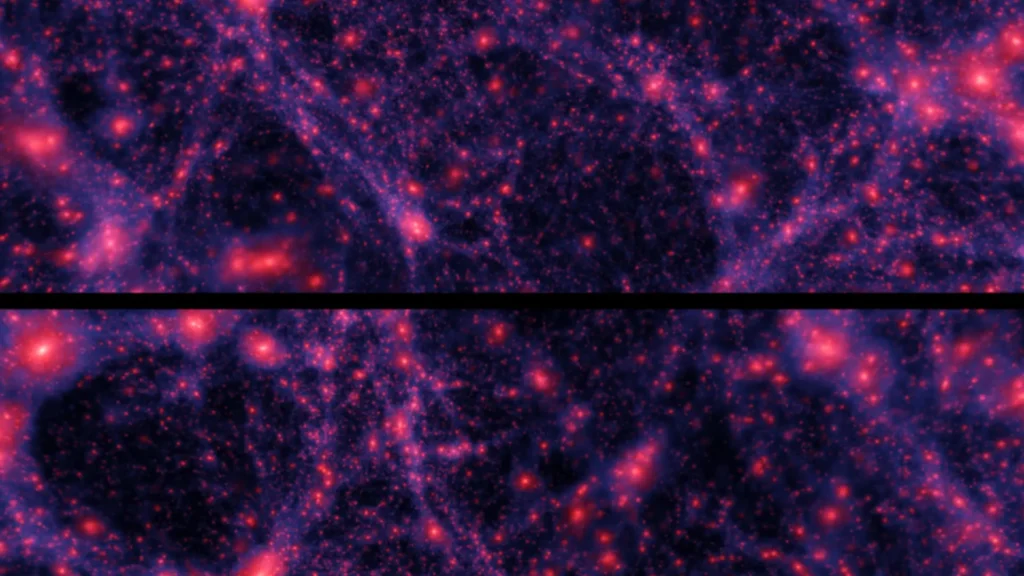
Exploring these tantalizing possibilities requires researchers to generate enormous numbers of detailed computer simulations. Each simulation represents a virtual universe, meticulously constructed based on different physical assumptions—perhaps a slightly different dark energy equation of state, an alternative gravity theory, or varying neutrino masses. These simulations model the gravitational interactions and fluid dynamics of matter and energy over billions of years, from the Big Bang to the present day. Producing these highly sophisticated simulations is computationally expensive, demanding immense processing power from some of the world’s most powerful supercomputers, often requiring thousands of CPU hours for a single high-resolution run. This computational bottleneck severely limits the number of alternative cosmological models that can be thoroughly investigated.
The Computational Bottleneck: Simulating Cosmic Realities
Cosmological simulations are the astrophysicist’s laboratory, allowing them to test theoretical predictions against the observed universe. These simulations range from "N-body" simulations, which track the gravitational evolution of millions or billions of dark matter particles to form cosmic structures like galaxy halos and filaments, to more complex "hydrodynamical" simulations that also incorporate baryonic matter (ordinary gas and stars), electromagnetism, and thermodynamic processes. The latter are particularly demanding, as they must account for complex physics like star formation, supernova feedback, and black hole accretion.
The sheer scale of these simulations is staggering. A single high-resolution simulation can generate terabytes or even petabytes of data, detailing the positions, velocities, and properties of countless cosmic objects at various epochs. Running a suite of simulations to explore a parameter space—even a modest one—can consume millions of core-hours on supercomputing clusters. For example, projects like the IllustrisTNG simulations or the Millennium Run have leveraged thousands of processors running for months to produce their datasets. This monumental investment of computational resources underscores the urgent need for more efficient methodologies to accelerate the pace of discovery. Without such advancements, the comprehensive exploration of the vast landscape of "beyond-ΛCDM" theories would remain largely out of reach.
Transfer Learning: A New Accelerator for Discovery
The research team, led by first author Veena Krishnaraj, an undergraduate student at Princeton University, alongside Adrian Bayer, a cosmologist at the Flatiron Institute and Princeton University, and colleagues Christian Kragh Jespersen and Peter Melchior, investigated whether transfer learning could make this computationally intensive process more efficient. Transfer learning, a powerful paradigm in machine learning, allows an AI system to apply knowledge gained from solving one task to another, related task. Instead of training a neural network entirely from scratch on a new, complex problem, it leverages a pre-existing "base" of knowledge.
In the context of cosmology, the team ingeniously designed their AI system to first learn from simpler, less computationally costly simulations based on the standard ΛCDM model. This initial phase, known as pretraining, is analogous to an aspiring doctor first mastering foundational anatomy and physiology from basic textbooks. The AI learns to recognize fundamental patterns and relationships inherent in the standard model of the universe. Only after this foundational understanding is established does the system move on to additional training using more sophisticated models that incorporate potential new physics—like massive neutrinos, modified gravity, or evolving dark energy.
"It’s basically a shortcut," explains Adrian Bayer. "Usually people train the AI directly on the most computationally expensive simulations. What we do instead is first use simpler and less expensive ΛCDM simulations to give the AI an idea of what’s happening, and only afterward move to the more complex models." Bayer draws an accessible analogy: "You first read a basic book to get an idea of the knowledge, and then move to the really complicated book." Krishnaraj adds that this strategy prevents the AI from having to "digest everything at once," streamlining the learning process significantly.
The results of this innovative approach were striking. The application of transfer learning dramatically reduced the number of expensive simulations required for the AI to achieve a high level of accuracy in identifying parameters of new physics. In some cases, the reduction was by more than a factor of ten, translating into substantial savings in computational time and resources. This efficiency gain has profound implications, potentially allowing researchers to explore a much wider array of "beyond-ΛCDM" theories than previously feasible, thus accelerating the search for the universe’s hidden truths.
The Unexpected Pitfall: When Knowledge Becomes a Blind Spot (Negative Transfer)
However, the study also revealed a less obvious, yet critical, challenge: the phenomenon known as "negative transfer." While prior knowledge is generally beneficial, it can, under certain circumstances, become a hindrance. Using Bayer’s textbook comparison, imagine a medical student thoroughly versed in common ailments. When encountering a rare disease that presents with symptoms strikingly similar to a common cold, the existing knowledge, while usually helpful, might inadvertently encourage a misdiagnosis. The student’s learned patterns could lead them to overlook subtle distinctions indicative of a truly novel condition.
The same issue can arise in AI systems, especially when searching for entirely new physics. In some cases, the observational signatures of new physics can closely resemble patterns that the AI has already associated with parameters within the standard cosmological model. When this happens, the pretrained network, optimized to interpret data through the lens of what it already knows, may struggle to recognize genuinely new effects. It might "force-fit" novel information into existing categories, effectively blinding itself to discovery.
The researchers observed this negative transfer effect vividly while studying simulations that included massive neutrinos. Neutrinos, once thought massless, are now known to possess a tiny but non-zero mass. This mass influences the formation of large-scale structures in the universe, as massive neutrinos stream freely, slightly smoothing out density fluctuations. Some of the observational signatures linked to neutrino mass—such as changes in the power spectrum of matter distribution—closely resemble changes associated with an existing ΛCDM parameter called sigma-8 (σ8). Sigma-8 measures the amplitude of matter fluctuations on scales of 8 megaparsecs and is a key indicator of how strongly matter clusters throughout the universe.
Because of this inherent similarity, the pretrained neural network initially had difficulty telling the two effects apart. It might attribute changes caused by neutrino mass to a variation in σ8, or vice-versa, leading to an incorrect interpretation. "The negative transfer is not random. It is driven by underlying physical degeneracies in the model," says Krishnaraj. In other words, different physical processes can produce very similar observable signatures, creating an "alias" that makes it challenging for the AI to correctly identify which specific parameter is responsible for an observed effect. "So this is something we need to be aware of and try to mitigate," she concludes, highlighting the necessity for a nuanced approach to AI deployment in cutting-edge scientific research.
Historical Context: AI’s Evolving Role in Scientific Discovery
The integration of artificial intelligence into scientific research is not a new phenomenon, but its capabilities have evolved dramatically. Early applications of AI in science, dating back to the 1970s and 80s, often involved expert systems—rule-based programs designed to mimic human decision-making in specific domains, such as medical diagnosis or chemical synthesis. The advent of neural networks in the late 20th century, followed by the deep learning revolution in the 2010s, marked a paradigm shift.
In physics, AI has transformed data analysis at facilities like the Large Hadron Collider (LHC), where it helps sift through petabytes of collision data to identify rare particle events, such as the Higgs boson. In astronomy, AI algorithms are routinely used for tasks like classifying galaxies, detecting exoplanets from photometric data, and even generating synthetic astronomical images. This study by Krishnaraj, Bayer, and their team positions AI not just as a tool for pattern recognition or data classification, but as an integral part of the scientific method itself—a means to generate and test hypotheses in complex theoretical landscapes. It represents a significant step towards employing AI in the very process of scientific model building and exploration, moving beyond merely analyzing existing data to actively searching for novel phenomena.
Broader Implications for Future Cosmological Surveys
The findings of this research hold profound implications for the next generation of cosmological surveys, which are poised to collect unprecedented amounts of high-precision data about the universe. Missions like the European Space Agency’s Euclid satellite, NASA’s Nancy Grace Roman Space Telescope, and ground-based observatories such as the Vera C. Rubin Observatory (which will host the Legacy Survey of Space and Time, LSST) and the Square Kilometre Array (SKA) are expected to generate petabytes of observational data. This impending "data deluge" presents both an incredible opportunity for discovery and an immense challenge for data processing and interpretation.
Without highly efficient and intelligent analytical tools, the sheer volume and complexity of this data could overwhelm researchers. Transfer learning, with its demonstrated ability to accelerate the exploration of complex models, could become an indispensable tool for these upcoming surveys. It could enable cosmologists to rapidly test a vast number of theoretical scenarios against real observational data, significantly speeding up the identification of potential deviations from the ΛCDM model. However, the caveat of negative transfer highlights a critical need: the AI tools deployed must be not only efficient but also robust enough to detect truly novel physics, rather than misinterpreting it through the lens of existing knowledge. The future of cosmic discovery hinges on developing AI systems that can strike this delicate balance.
Mitigating the Risks: Towards Smarter AI for Science
Recognizing the dual nature of transfer learning—its immense potential for acceleration and its inherent risk of bias—researchers are already exploring strategies to mitigate negative transfer. One key approach involves careful selection and curation of pretraining data, ensuring that the AI’s foundational knowledge base is as broad and unbiased as possible. Another avenue is the development of novel AI architectures specifically designed to detect novelty or anomalies, rather than merely classifying data into known categories. Techniques like outlier detection, uncertainty quantification in AI predictions, and Bayesian neural networks can provide insights into when the AI is operating outside its comfort zone, flagging potentially new physics for human investigation.
Furthermore, the emphasis remains on human-AI collaboration. AI should be viewed as a powerful assistant, not a replacement for human intuition, critical thinking, and domain expertise. By understanding the limitations and biases of AI, scientists can design experiments and analyses that leverage AI’s strengths while compensating for its weaknesses. The findings underscore that the path to discovery with AI is not merely about building bigger, more powerful models, but about building smarter, more self-aware AI that can acknowledge its own boundaries and signal when it encounters something truly unexpected.
The Road Ahead: From Simulations to Real Observations
So far, the approach developed by Krishnaraj, Bayer, and their team has only been tested using computer simulations—virtual universes. The next crucial step will be to apply these sophisticated transfer learning techniques to real astronomical observations. This transition from theoretical models and simulated data to empirical validation is where the true power of this methodology will be put to the test. Successfully applying it to observational data would mark a significant milestone, moving these advanced AI tools from the realm of theoretical exploration into the frontier of actual cosmic discovery.
As the researchers note in their paper, while pretraining can speed up inference, it "may also hinder learning new physics." This tension between efficiency and the potential for oversight will undoubtedly be a central theme in the ongoing development of AI for scientific research. The team believes transfer learning, despite its challenges, could become an important, perhaps even essential, tool for upcoming cosmological surveys. By understanding and carefully navigating its promise and risks, scientists hope to unlock new insights into the fundamental laws governing our universe, pushing the boundaries of human knowledge and perhaps, finally, solving some of cosmology’s most profound mysteries. The paper, "Transfer Learning Beyond the Standard Model" by Veena Krishnaraj, Adrian E. Bayer, Christian Kragh Jespersen, and Peter Melchior, is now available in JCAP.