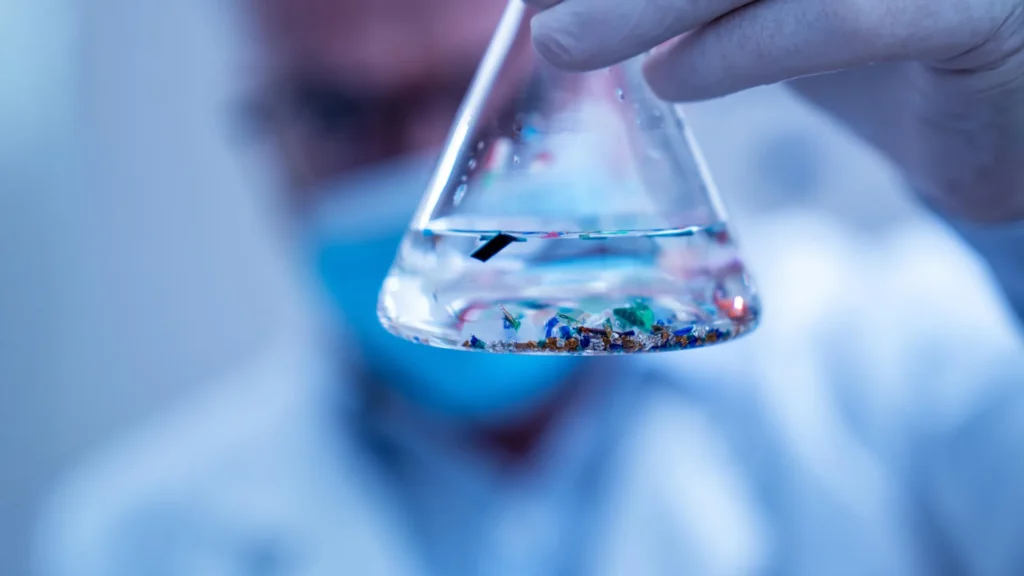
In a significant advancement for the field of chemical upcycling, researchers at the Department of Energy’s Oak Ridge National Laboratory (ORNL) have pioneered a novel method to convert polyethylene, the world’s most ubiquitous plastic, into high-quality liquid fuels such as gasoline and diesel. This breakthrough, detailed in a recent publication in the Journal of the American Chemical Society, utilizes a specialized molten salt system that functions at temperatures significantly lower than conventional plastic-to-fuel technologies. By leveraging the unique properties of aluminum chloride-based molten salts, the team has successfully demonstrated a process that is not only more energy-efficient but also eliminates the need for expensive catalysts and high-pressure hydrogen environments.
Polyethylene is the primary component of a vast array of consumer products, including single-use shopping bags, food packaging, and industrial-grade cutting boards. Despite its utility, it represents one of the most significant challenges in waste management. Because of its stable carbon-carbon bonds, polyethylene is notoriously difficult to break down chemically. Current mechanical recycling methods often result in "downcycling," where the plastic is repurposed into lower-value products like park benches or plastic lumber. The ORNL team’s approach shifts the paradigm toward "upcycling," transforming what is essentially a waste stream into a high-value commodity that could bolster U.S. energy security and industrial competitiveness.
The Chemistry of Molten Salts: A Dual-Purpose Solution
At the heart of this innovation is the use of molten salts—specifically mixtures containing aluminum chloride—which serve a dual role in the reaction. In most chemical processes, a reaction requires a medium (a solvent) and a catalyst (a substance that speeds up the reaction without being consumed). The ORNL method identifies molten salts as a medium that also possesses inherent catalytic properties.
To understand the mechanism behind this conversion, the research team utilized a suite of advanced analytical tools. By employing soft X-ray spectroscopy and nuclear magnetic resonance (NMR), scientists were able to observe the behavior of aluminum atoms within the salt. They discovered that charged aluminum atoms bind with three other atoms to create highly acidic catalytic sites. These sites are exceptionally aggressive, capable of attacking the long, stable molecular chains of polyethylene and cleaving them into smaller, manageable hydrocarbon molecules.
Unlike traditional pyrolysis, which uses extreme heat to indiscriminately shatter molecular bonds, this molten salt process is remarkably selective. Through experiments involving isotopic labeling and neutron scattering, the researchers found that the architecture of the starting polymer dictates the final product. Simpler, linear polymer chains typically yield gasoline-like compounds, whereas more complex, branched chains are more likely to generate diesel-like fuels. This level of control allows for a tailored approach to fuel production, potentially maximizing the yield of the most in-demand hydrocarbons.
Breaking the Temperature Barrier: Efficiency at 200 Degrees Celsius
One of the most transformative aspects of the ORNL study is the temperature at which the reaction occurs. Historically, converting polyethylene into gasoline has relied on pyrolysis—a thermal decomposition process conducted in the absence of oxygen. Pyrolysis typically requires temperatures ranging from 450 to 500 degrees Celsius (approximately 840 to 932 degrees Fahrenheit). Such high energy requirements often make the process economically unfeasible and environmentally taxing.
The new ORNL method, however, achieves a gasoline yield of approximately 60 percent at temperatures below 200 degrees Celsius (392 degrees Fahrenheit). For perspective, this is lower than the standard operating temperature of a conventional household oven. By reducing the thermal threshold by more than half, the researchers have opened a pathway toward a significantly more sustainable and cost-effective industrial process.
Zhenzhen Yang, an ORNL staff scientist and co-corresponding author, emphasized the distinct advantages of this approach. "Unlike traditional techniques for converting polymer to fuel, the new process did not require noble-metal catalysts, organic solvents, or external hydrogen," Yang noted. The absence of noble metals like platinum or palladium—which are rare, expensive, and subject to volatile global supply chains—represents a major leap forward for the economic viability of plastic upcycling. Furthermore, the lack of external hydrogen requirements simplifies the reactor design and reduces the safety risks associated with high-pressure hydrogen storage.
A Legacy of Innovation: ORNL’s History with Molten Salts
The application of molten salts in this context is a modern extension of a long-standing research tradition at Oak Ridge National Laboratory. During the 1960s, ORNL was the site of the Molten Salt Reactor Experiment (MSRE), which proved that molten salt mixtures could safely and effectively serve as both nuclear fuel and coolant in power reactors.
Decades later, Sheng Dai, an ORNL Corporate Fellow and section head for separations and polymer chemistry, proposed that this stable chemical medium could be repurposed for the environmental challenge of plastic waste. Molten salts are inorganic compounds that remain stable under harsh conditions, making them ideal for long-term industrial use.
"The ORNL system solves two fundamental issues," Dai explained. "One, for a stable system, the process can be radically easier to scale up. Two, the previous system needed an initiator to kick off catalytic reactions. However, the ORNL system does not need one." By eliminating the need for a chemical initiator, the researchers have streamlined the process, reducing both the cost and the complexity of the chemical "recipe" required for conversion.
Advanced Analytics: Tracking the Reaction Atom by Atom
The success of the project relied on a multidisciplinary team and the use of some of the world’s most advanced scientific facilities. At ORNL, the Spallation Neutron Source (SNS) was used to monitor the movement of hydrogen within the system. Because neutrons are particularly sensitive to light elements, they provided a clear view of how hydrogen atoms shifted as the polyethylene chains were dismantled.
In tandem with neutron scattering, researchers at the Advanced Light Source at Lawrence Berkeley National Laboratory used soft X-rays to examine the electronic interactions between the aluminum catalyst and the plastic. This revealed a shift in the aluminum’s electron density, confirming the formation of electron-rich intermediates. This data provided the "smoking gun" evidence that the aluminum sites were actively and efficiently driving the chemical transformation.
Complementary work was performed using gas chromatography-mass spectrometry to identify the specific hydrocarbon products, while computer simulations at the Center for Nanophase Materials Sciences modeled the energy changes throughout the reaction. This comprehensive "atom-by-atom" tracking ensured that the researchers understood not just that the process worked, but exactly why it worked.
Economic Implications and the Circular Economy
The global production of polyethylene exceeds 100 million metric tons annually. Despite efforts to improve recycling rates, a staggering percentage of this material ends up in landfills or as environmental pollutants. The ability to convert this waste into gasoline and diesel offers a compelling economic incentive for waste management companies and the petrochemical industry.
From an energy security perspective, the ability to derive transportation fuels from domestic waste streams reduces reliance on imported crude oil. If scaled successfully, this technology could provide a decentralized source of fuel, where plastic waste collected at the municipal level is converted on-site or at regional facilities into usable energy products.
Furthermore, the process aligns with the principles of a "circular economy," where materials are kept in use for as long as possible, and waste is designed out of the system. By transforming a low-value waste product into a high-value energy source, the ORNL team is helping to create a closed-loop system for polymers.
Challenges and Future Research: The Path to Industrial Scaling
While the results are promising, the researchers acknowledge that significant hurdles remain before the technology can be deployed at an industrial scale. One primary concern is the hygroscopic nature of the aluminum chloride-based molten salts. These salts readily absorb moisture from the atmosphere, which can degrade their stability and reduce their catalytic effectiveness over time.
Future research will focus on methods to "confine" or protect the molten salts. The team is exploring the use of halogens or carbon-based materials to create a barrier that prevents moisture absorption while allowing the plastic-to-fuel reaction to proceed. Improving the stability and recyclability of the salt medium will be critical for ensuring that the process can run continuously in a commercial setting.
Additionally, the team plans to investigate how the process handles "real-world" plastic waste, which is often contaminated with food residue, dyes, and other types of polymers. Determining the tolerance of the molten salt system to these impurities will be a vital step in moving from the laboratory to a pilot plant.
Conclusion: A New Frontier for Plastic Waste
The research conducted at Oak Ridge National Laboratory represents a pivotal moment in the fight against plastic pollution. By combining historical expertise in molten salts with cutting-edge analytical techniques, the team has discovered a "mild" yet powerful way to dismantle one of the most durable materials ever created by humans.
"Polymer source material is abundantly available from consumer waste, and our catalyst system, aluminum molten salts, is very cheap," said Liqi Qiu, a postdoctoral researcher who performed much of the experimental work. "This advance may be promising for industry."
As the world grapples with the environmental consequences of the plastic age, the ability to view a discarded shopping bag not as trash, but as a source of high-quality fuel, offers a glimpse into a more sustainable industrial future. With continued refinement and successful scaling, the ORNL molten salt process could become a cornerstone of the global effort to manage plastic waste while meeting the energy demands of the 21st century.