Artificial intelligence has undeniably reshaped the landscape of software engineering, with generative AI and large language models (LLMs) capable of producing vast quantities of code and documentation, while machine learning algorithms excel at performance monitoring and security vulnerability detection. However, a critical question remains: can these AI tools deliver a similarly transformative impact when tasked with the complex endeavor of conceiving, designing, and fabricating intricate physical systems, such as a jet engine? This past semester, the JARVIS Challenge—an acronym for Jet-engine AI Research and Validation Intensive Sprint—was conceived to address this very question, aiming to determine if AI could significantly compress the traditional design-build-test cycle and empower MIT undergraduates to build faster and better.
Unveiling the JARVIS Challenge: A New Frontier in Engineering Education
The JARVIS Challenge, held over a rigorous four-week period, presented a formidable task to MIT undergraduates: to design, fabricate, assemble, and rigorously test a small gas turbine aero engine. The core objective was to build a "JARVIS-class" single-spool jet engine capable of producing between 50 and 100 pounds of thrust, fueled by Jet-A, and successfully completing five 60-second operational runs. Participants were granted complete autonomy over their design choices, material selection, and fabrication processes, fostering an environment of innovation and independent problem-solving.
The participating students, representing a diverse cross-section of MIT’s School of Engineering, numbered 31 and were organized into seven distinct teams. This cohort spanned the academic spectrum, from first-year students with nascent engineering knowledge to senior-laden groups possessing more advanced theoretical backgrounds. A significant portion of the competitors began the challenge with limited prior experience in specialized fields such as turbomachinery, compressible flows, or even fundamental thermodynamics, particularly among the younger participants. Many had never encountered the internal workings of a gas turbine before committing to its construction.
The Arsenal of Innovation: Tools and Resources at Hand
To equip these ambitious teams, MIT provided access to its state-of-the-art machine shops and a network of trusted manufacturing vendors. Furthermore, participants had at their disposal a suite of sophisticated commercial software, including industry-standard tools like Concepts NREC for aerodynamic design, SolidWorks for 3D modeling, and ABAQUS for finite element analysis. Specialized test rigs were also available for the precise characterization and assembly of individual engine components.
A pivotal element of the JARVIS Challenge was the integration of MIT Parley, a newly launched platform designed to aggregate a diverse range of frontier large language models through a unified interface. This innovative tool provided the JARVIS leadership team with unprecedented visibility into the students’ AI utilization, including detailed records of their prompts, the associated costs per prompt, the specific LLMs being employed, and other critical operational data. The JARVIS leads proactively secured early access to Parley for all participants. Bolstered by substantial financial backing from MIT Lincoln Laboratory, the Department of Mechanical Engineering, and a consortium of corporate sponsors—Safran, Voyager Technologies, Beehive Industries, and Boom Technology—the students enjoyed virtually unlimited access to AI resources throughout the competition.
The sponsorship of this initiative was driven by a dual motivation: a keen interest in student recruitment and a genuine curiosity about AI’s potential to fundamentally reshape engineering workflows. Ryan (Hal) Hefron of Voyager Technologies underscored this sentiment, stating to the students, "We see this as the future of engineering. You’re honing skills that are not just nice to have—they’re going to be the future baseline in the engineering workforce."
Vincent Garnier, managing director of Safran Tech, observed the competition with keen interest, remarking, "JARVIS was a genuine experiment, a learning endeavor. We frankly didn’t know what to expect, from the students or from the AI models. What struck me coming from the students was: first, the enthusiasm to explore; then, as the project developed, they all came to the cool-headed realization of what AI could or could not help them with, and then almost instantly adapted for that. It makes me confident that this generation of leading engineers will probably not fall prey to easy and shortsighted use of AI, and will do so by keeping ever more in contact with experiments—physical or thought experiments."
The academic leadership for the challenge comprised Professors Zachary Cordero, Zolti Spakovsky, Masha Folk, and Andreea Bobu from the Department of Aeronautics and Astronautics, alongside engineers from MIT Lincoln Laboratory and a dedicated team of teaching assistants. Their paramount responsibility was to ensure the safety of the experimental process. During weekly progress reviews, they meticulously evaluated student advancements and critically assessed the integration and application of AI tools by the teams.
Professor Zolti Spakovsky, director of the MIT Gas Turbine Laboratory and a driving force behind the challenge, developed a refined methodology for guiding teams. This approach focused on steering students toward productive avenues of inquiry without directly providing solutions or prescriptive assistance. Following a team’s presentation, Spakovsky might pose a probing question, such as, "Do you know what a rabbet fit is? Take in the comment," encouraging critical thinking and independent research.
Navigating the AI Landscape: Where It Shines and Where It Falters
By the conclusion of the first week, one team had withdrawn from the competition. The remaining teams, with varying degrees of success, had formulated initial designs for their gas turbines. AI proved instrumental in a multitude of tasks for these teams. It was employed to summarize technical literature, provide tutorials for design software, identify potential vendors, generate complex Excel spreadsheets for data analysis, answer specific technical queries, locate relevant research references, and conduct comparative analyses between design alternatives. One particularly innovative team even developed an AI agent within Parley, tasking it with the role of their project manager.
As the competition progressed into week two, teams shifted their focus to the development of detailed CAD designs, the procurement of components, and the prototyping of critical engine elements such as combustors. It was at this juncture that the limitations of AI in complex physical design began to surface. While LLMs like Claude and ChatGPT demonstrated efficacy in proposing design variations and bridging knowledge gaps, the well-documented tendencies of generative AI—including factual inaccuracies (hallucinations), overly agreeable responses (sycophancy), and a general lack of intuitive understanding of physical principles—started to erode student confidence and introduce delays.
Elizabeth Tupaj, a member of the "811 Crew" team, articulated this sentiment clearly: "AI is a helpful tool, great at finding information, helping organize things, and can write well, but it can’t do design. The moment the engineer doesn’t know what is going on and the AI is in charge is the moment the design becomes unreliable, at least with AI at its present capabilities."
Teaching assistant John Zhang observed a critical pedagogical insight: "Seeing this firsthand with the students reminded me how much first impressions matter. If the students couldn’t get answers from the AI early on, they quickly grew frustrated and formed a lasting opinion that precluded them from using it later." This highlights the importance of early successes and reliable AI outputs in fostering trust and sustained adoption.
The final weeks of the challenge presented an obstacle that no AI could surmount: the intricate and often unpredictable realm of vendor interactions. Students reported, "AI searches found vendors we had no rapport with, who had no interest in our tight timeline. The vendors who came through were the ones our team had personal relationships with." This underscores the enduring value of human networking, negotiation skills, and established business relationships in practical engineering endeavors.
Of the three teams that reached the finals, only "Fast and Fractured" achieved first-attempt ignition of their mini-combustor. This team had extensively utilized AI for trade studies and architectural comparisons, enabling them to arrive at a viable design despite having no prior gas turbine experience.
Masha Folk, the Charles Stark Draper Career Development Professor of Aeronautics and Astronautics, reflected on the achievement: "The JARVIS Challenge showed what’s possible when you combine AI-enabled design with motivated students and a culture of rapid experimentation. The moment that stood out most was when the first student-designed combustor was installed on the test stand. It ignited flawlessly, ramped to full power, transitioned to dual-fuel operation, and then sustained stable combustion on 100 percent Jet-A fuel. This was proof that we can dramatically accelerate the cycle of design, build, and test while giving students hands-on experience with a real engineering challenge."
Forging Ahead: The Vanguard of AI-Native Engineering
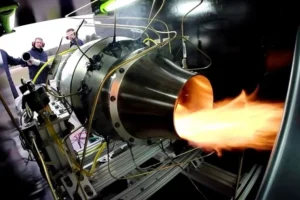
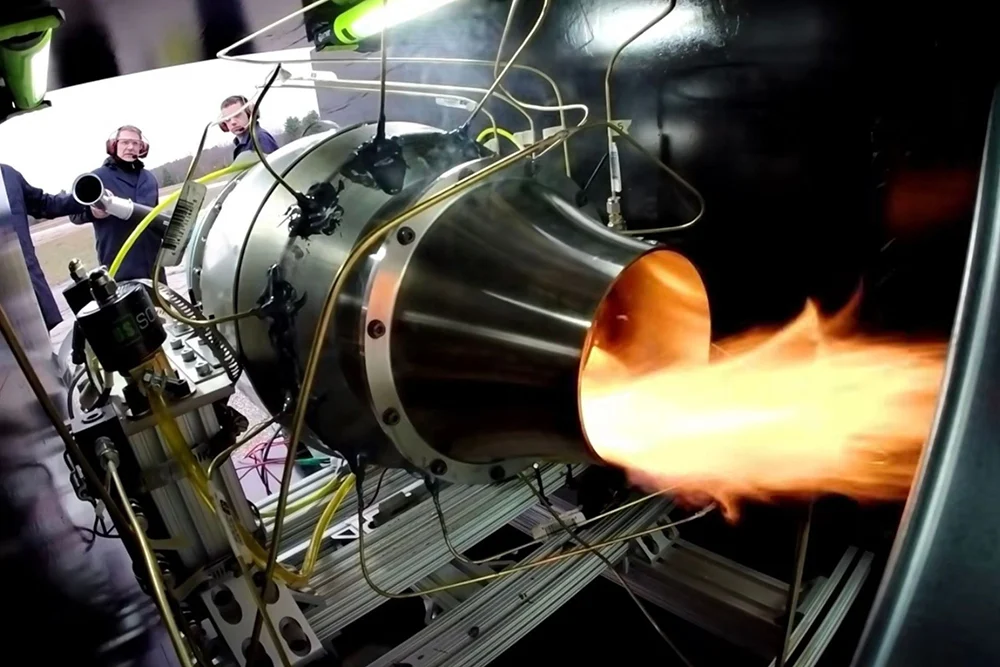
By the end of May, two of the more senior teams, "Fast and Fractured" and "811 Crew," successfully completed full engine tests. "Fast and Fractured," despite their AI-assisted design prowess, faced significant delays due to vendor issues. Ultimately, their hot fire test was cut short by a rotor rub and subsequent seizure against the stationary housing. The "811 Crew" team, however, which possessed greater prior exposure to turbomachinery and propulsion concepts, emerged as the victorious contender. Their engine successfully started, transitioned to Jet-A fuel, and generated net thrust, marking a significant accomplishment.
PhD student Joe Chiapperi described the electrifying atmosphere: "As we stood there with the air-starter, hearing their engines spool up and watching them spit fire, it felt like my heart was racing out of my chest. There were so many ways it could go wrong! What these students accomplished in such a short time span is nothing short of amazing."
Interestingly, the "811 Crew" had initially exhibited a degree of resistance to utilizing AI throughout the competition, preferring to rely on their fundamental engineering knowledge and robust teamwork. Tupaj elaborated, "We had people who were at least somewhat familiar with the design software, mechanical engineers who knew how to build anything, and aerospace engineers who had taken classes on the design of gas turbine engines specifically." This approach, while perhaps slower initially, allowed them to maintain a strong grasp on the underlying principles.
An interesting observation emerged from the differential use of AI based on experience. Younger students, with less pre-existing knowledge, tended to leverage Parley more frequently and creatively, exploring its capabilities extensively. Conversely, juniors and seniors, drawing on their deeper theoretical backgrounds, integrated AI more selectively to augment their existing expertise.
Professor Andreea Bobu offered a nuanced perspective on the findings: "JARVIS taught me that getting value from AI takes two things: enough expertise to judge what it tells you and catch it when it’s wrong, and enough curiosity to actually lean on it where it could help. The team that moved fastest in the sprint was experienced and leaned heavily on AI to get there. The team that eventually won was more resistant to AI; they had the expertise, but that skepticism made them slower. The sweet spot seems to be knowing enough to stay in charge of the tool, and being eager enough to pick it up in the first place. To me, that’s the real opportunity ahead: training the next generation of engineers who have the judgment to direct these AI tools and the instinct to reach for them."
The Enduring Human Element in a High-Tech Future
The competition’s most salient conclusion reinforced the irreplaceable value of engineering experience, which acts as a powerful multiplier for AI’s capabilities. The human factor remains a vital, indeed decisive, element in complex engineering challenges. A profound mastery of fundamental principles and core concepts cultivates sound engineering judgment, equipping individuals with the ability to navigate intricate decision-making processes amidst incomplete information. Crucially, when it comes to the development and implementation of safety-critical physical systems, the inherent accountability and precision of human hands remain paramount.
Teaching assistant Kyle Woody summarized this key takeaway: "JARVIS has shown that AI copilots can have a multiplicative effect on engineering productivity, with judgment and first-principles thinking serving as the key differentiators among teams."
The broader implications of AI in the aerospace sector are profound. The ability of small, agile teams, empowered by effectively managed AI copilots, to compress design-build-test cycles from years down to mere weeks could trigger substantial shifts in workforce structure, accelerate research and development timelines, and fundamentally alter competitive dynamics within the industry. The students who participated in the JARVIS Challenge stand as some of the earliest engineers to confront these high stakes not as a theoretical exercise, but within the tangible reality of a machine shop, with a jet engine humming on a test stand.
Professor Zachary Cordero, associate director of the MIT Gas Turbine Laboratory, highlighted the broader significance of the experiment: "JARVIS highlighted the power of AI in the design of physical systems. But it also showed that the key to unlocking that power is education, through coursework, internships, and hands-on extracurriculars like MIT Motorsports and Rocket Team. Performance in JARVIS correlated strongly with year in school. My main takeaway is that in the AI era, education is more valuable than ever." This emphasis on education as the bedrock for effectively harnessing AI underscores the ongoing evolution of engineering disciplines in an increasingly technologically sophisticated world.