The European Organization for Nuclear Research, commonly known as CERN, has officially commenced a pivotal phase in the evolution of the Large Hadron Collider (LHC). Engineers and technical crews have begun the delicate process of dismantling and removing the original inner triplet magnets that have served the facility since its inception. This operation, which began with the symbolic cutting of the first magnet interconnection, marks the start of a comprehensive overhaul designed to transform the collider into the High-Luminosity LHC (HiLumi LHC). The upgrade is set to drastically increase the machine’s potential for scientific discovery by significantly boosting the rate of particle collisions within its massive detectors.
Spanning a 27-kilometer circumference beneath the Franco-Swiss border, the LHC is a marvel of modern engineering that relies on a complex array of superconducting magnets to function. Thousands of magnets, including dipoles to bend the beams, quadrupoles to focus them, and various higher-order magnets like sextupoles and octupoles to correct beam trajectories, work in concert to guide protons at near-light speeds. Among these, the inner triplets are perhaps the most critical for the success of the collider’s four primary experiments: ATLAS, CMS, ALICE, and LHCb.
The Critical Role of Inner Triplet Magnets
The inner triplets are specialized groups of three quadrupole magnets positioned on either side of the collision points within the four main detectors. Their primary function is "final focus" beam optics. As particle beams circulate in opposite directions around the ring, they are relatively wide. To maximize the probability of collisions, these beams must be squeezed into an incredibly small cross-section—thinner than a human hair—just before they meet inside the experimental caverns.
This process of compression is directly linked to "luminosity," a fundamental metric in particle physics that measures the number of potential collisions per unit area per unit time. In the world of high-energy physics, data is king. Higher luminosity translates to a greater volume of data, which in turn allows researchers to observe rare subatomic processes that remain invisible at lower collision rates. The existing inner triplets, which were installed between 2005 and 2007, have performed remarkably well, facilitating the 2012 discovery of the Higgs boson and subsequent measurements of the Standard Model. However, to push the boundaries of physics into the next decade and beyond, a more powerful generation of hardware is required.
Technological Leap: From Niobium-Titanium to Niobium-Tin
The centerpiece of the HiLumi LHC upgrade is the transition from niobium-titanium (Nb-Ti) superconducting technology to the more advanced niobium-tin (Nb3Sn). While Nb-Ti has been the workhorse of superconducting magnets for decades, it has physical limitations regarding the maximum magnetic field it can generate before losing its superconducting state.
The new inner triplets utilize Nb3Sn coils, a material that is significantly more difficult to manufacture because it is brittle and requires precise heat treatment. However, the scientific payoff is substantial. These new magnets are capable of generating magnetic fields of approximately 11.3 tesla, a nearly 40% increase over the roughly 8 tesla produced by the current LHC magnets. This increased strength allows for a much tighter focus of the proton beams, which is the primary driver behind the projected tenfold increase in the total integrated luminosity of the collider.
The logistical scale of this replacement is immense. Jean-Philippe Tock, Head of the Long Shutdown 3 (LS3) Coordination Team, noted that the project involves the installation of 16 cryostats and 28 cryo-assemblies. These units are not merely magnets; they are sophisticated cryogenic systems designed to maintain the superconducting coils at temperatures as low as 1.9 Kelvin (-271.3°C), colder than outer space.
Chronology of the Upgrade and Long Shutdown 3
The removal of the old magnets is part of the third long shutdown (LS3) of the LHC, a planned period of maintenance and upgrades that began following the conclusion of Run 3. The timeline for this transition is meticulously planned to ensure that the facility can return to operation with its new capabilities by the end of the decade.
The current phase began in earnest on September 7, when teams started the physical dismantling of sections of the collider flanking the ATLAS and CMS detectors. These two experiments are the primary beneficiaries of the HiLumi upgrade, as their physics programs are designed to study the Higgs boson and search for dark matter and other phenomena that require massive datasets.
According to the current schedule, the removal of the 28 original superconducting magnets will continue through the coming months. The tunnel will then undergo significant infrastructure modifications to accommodate the new, larger, and more powerful hardware. The first of the new Nb3Sn quadrupole magnets is expected to be lowered into the tunnel at the start of 2029. Following a rigorous period of installation, testing, and hardware commissioning, the HiLumi LHC is slated to begin its first physics run, marking a new era of exploration.
Official Reactions and Scientific Significance
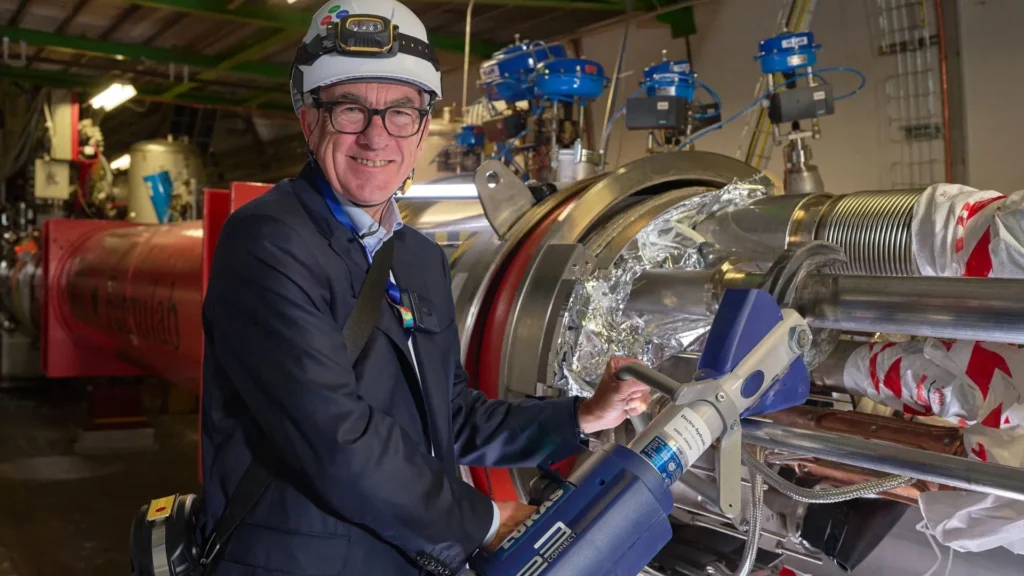
The commencement of the removal operation was attended by CERN Director-General Mark Thomson, who visited LHC Point 1—the site of the ATLAS experiment—to witness the first cut. The event served as a symbolic bridge between the LHC’s historic achievements and its future potential.
Markus Zerlauth, the HiLumi LHC Project Leader, emphasized the generational shift represented by this milestone. "The current inner triplets date back to the LHC construction phase," Zerlauth stated. "After nearly twenty years of operation, they will give way to a new generation of even more powerful magnets. It’s truly remarkable to witness such a handover from one generation of innovation to the next."
While ATLAS and CMS are receiving the most significant hardware changes, the ALICE and LHCb experiments are also being integrated into the upgrade strategy. These experiments focus on different areas of physics—heavy-ion collisions and "flavor" physics involving bottom quarks, respectively. While they do not require the same level of instantaneous luminosity as ATLAS and CMS, their existing inner triplets will still be upgraded to ensure they can handle the overall increase in beam intensity across the entire LHC ring.
Broader Implications for Particle Physics
The transition to the High-Luminosity LHC is not merely a technical upgrade; it is a strategic necessity for the global physics community. The "Standard Model" of particle physics, while incredibly successful, is known to be incomplete. It does not account for gravity, dark matter, dark energy, or the matter-antimatter asymmetry in the universe.
By increasing the luminosity, the HiLumi LHC will allow physicists to:
- Perform Precision Measurements of the Higgs Boson: Researchers will be able to observe how the Higgs boson interacts with lighter particles, providing a stricter test of the Standard Model.
- Search for Rare Decays: Processes that occur only once in a trillion collisions may hold the key to "New Physics."
- Detect Supersymmetry or Dark Matter Candidates: The increased data rate improves the statistical significance of any potential anomalies that could signal the existence of previously unknown particles.
Furthermore, the development of Nb3Sn magnet technology has implications beyond high-energy physics. The engineering breakthroughs achieved at CERN often find their way into medical imaging (MRI), energy storage, and transportation sectors, where high-field superconductivity is a critical component.
Engineering Challenges and Civil Works
The replacement of the inner triplets is accompanied by a massive civil engineering project. To support the HiLumi LHC, CERN has had to construct new underground galleries, service tunnels, and shafts to house the new power converters, cryogenic plants, and cooling and ventilation systems. This separation of the power equipment from the main tunnel is essential to protect the electronics from the increased radiation levels that will result from the higher collision rates.
The physical removal of the 28 magnets is a high-stakes operation. Each magnet assembly is several meters long and weighs dozens of tons. Navigating these through the narrow 27-kilometer tunnel requires specialized robotic transport vehicles and a highly skilled workforce. Each connection must be precisely severed, and the radioactive environment—a natural byproduct of years of high-energy collisions—requires strict safety protocols and remote handling where necessary.
As the original inner triplets are hoisted out of the tunnel, they leave behind a legacy of unprecedented scientific achievement. Their removal is the final act of the LHC’s first chapter and the opening of a decade-long endeavor to unlock the deepest secrets of the universe. With the first cut made, the path toward the High-Luminosity LHC is now a physical reality, promising a future where the boundaries of human knowledge are pushed further than ever before.