A mathematical discovery that resolved a decades-old enigma in geometry is now catalyzing a breakthrough in the field of optical physics. Researchers from the Institute of Industrial Science at the University of Tokyo, in collaboration with several international institutions, have successfully demonstrated that the "Smith hat"—the world’s first known aperiodic monotile—can be utilized to create complex optical structures that manipulate light in unprecedented ways. By etching the unique geometry of the hat tile onto nanoscale films, the team has observed the emergence of chiral diffraction patterns, a phenomenon that suggests a profound link between abstract geometric theory and the physical behavior of photons. This research, recently published in the prestigious journal Nature Communications, marks a significant milestone in the study of quasicrystalline materials and their potential applications in next-generation optical technologies.
The Resolution of the Einstein Problem
To understand the significance of this physical breakthrough, one must first look at the mathematical foundation upon which it is built. For over half a century, mathematicians were haunted by the "Einstein problem." The term does not refer to Albert Einstein, but rather to the German phrase "ein stein," meaning "one stone." The challenge was to find a single shape—a monotile—that could cover an infinite plane without ever repeating its pattern. While common shapes like squares, triangles, and hexagons can tile a surface, they do so periodically, meaning the pattern repeats at regular intervals.
In the 1970s, Sir Roger Penrose famously discovered a set of two shapes that could tile a surface aperiodically, creating the world-renowned Penrose tilings. However, the search for a single shape that could achieve this feat remained unsuccessful until early 2023. David Smith, a retired print technician and tiling enthusiast from the United Kingdom, discovered a 13-sided polygon nicknamed "the hat." Alongside a team of mathematicians—Joseph Samuel Myers, Craig S. Kaplan, and Chaim Goodman-Strauss—Smith proved that this shape was indeed the long-sought aperiodic monotile.
The Smith hat is a "polykite," constructed from smaller kite-shaped units. Its unique property lies in its ability to fill space in a way that is ordered but never periodic. This discovery sent shockwaves through the mathematical community, but its implications for the physical sciences remained largely theoretical until the University of Tokyo team decided to translate this geometric curiosity into a physical experiment.
From Geometry to Nanophotonics: The Experimental Framework
The research team, led by Yuto Moritake and Masaya Notomi, sought to determine if the mathematical "aperiodicity" of the Smith hat could influence the way light interacts with matter. To investigate this, they employed advanced nanofabrication techniques to create physical representations of the hat tiling.
Using electron beam lithography, the researchers etched the Smith hat pattern onto thin films of silicon nitride. These structures were created at the nanoscale, where the dimensions of the tiles are comparable to the wavelengths of light. Silicon nitride was chosen for its high refractive index and low absorption in the visible spectrum, making it an ideal medium for observing optical diffraction.
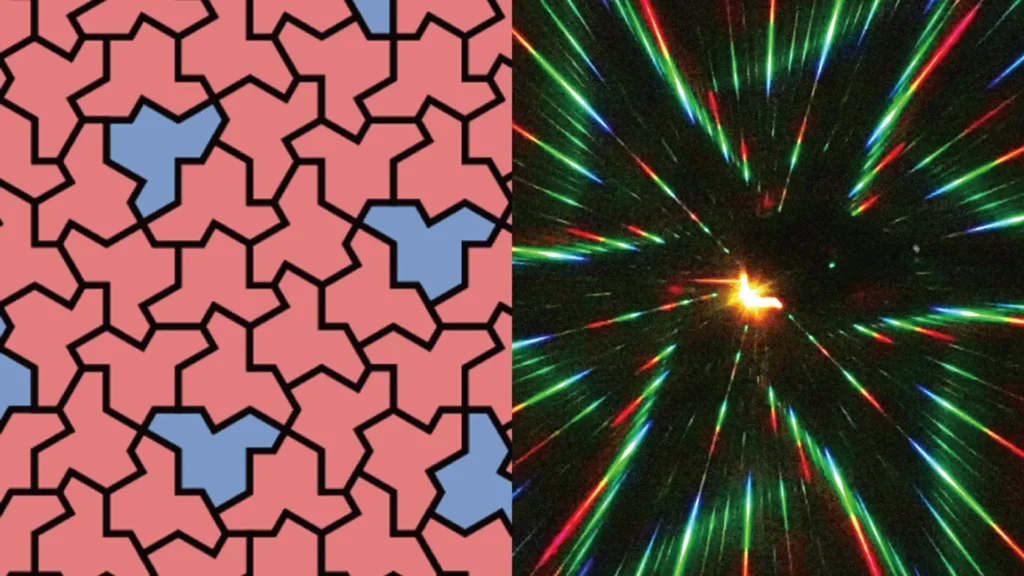
The experimental setup involved directing a laser beam at these patterned films. In traditional crystals, which have a periodic structure, light diffracts into a series of discrete, highly ordered points known as Bragg peaks. In quasicrystals—materials that possess order but lack translational symmetry—the diffraction patterns are more complex but still exhibit a high degree of symmetry. However, the Smith hat pattern produced something entirely different: a series of pinwheel-like diffraction shapes that shifted and transformed based on the characteristics of the incoming light.
Chirality and the Pinwheel Effect
The most striking observation made by the Tokyo team was the chiral nature of the resulting light patterns. Chirality, or "handedness," is a property of an object that cannot be superimposed on its mirror image. A classic example is the human hand; the left hand is a mirror image of the right, but they cannot be perfectly aligned on top of one another.
In the context of the Smith hat, chirality is an inherent feature of the tiling process. To cover a plane aperiodically, some of the "hat" tiles must be flipped over to their mirror-image form. This mixture of original and reflected shapes creates a global structure that lacks mirror symmetry. When the researchers illuminated this structure, the light responded to this lack of symmetry by forming chiral diffraction patterns.
"We found that the diffraction patterns themselves become chiral because the structure lacks mirror symmetry," explains senior author Masaya Notomi. This "pinwheel" effect is not merely a visual curiosity; it represents a new way of controlling the angular momentum and polarization of light. The experiment demonstrated that the optical response was intrinsically tied to the geometry of the tiling. When the physical structure was mirrored in the fabrication process, the resulting optical behavior reversed as well, confirming that the symmetry of the pattern was the primary driver of the light’s behavior.
A Chronology of Aperiodic Discovery
The journey from the theoretical concept of aperiodicity to the recent optical experiments in Tokyo spans several decades of scientific evolution:
- 1961: Hao Wang proposes that sets of tiles can be used to model the behavior of computational systems, leading to the question of whether aperiodic sets of tiles exist.
- 1966: Robert Berger discovers the first aperiodic set of tiles, consisting of 20,426 distinct shapes.
- 1974: Roger Penrose reduces the number of shapes required for aperiodic tiling to just two (the "kite" and "dart").
- 1982: Dan Shechtman discovers quasicrystals in a metallic alloy, proving that aperiodic order can exist in physical matter. This discovery eventually earned him the 2011 Nobel Prize in Chemistry.
- March 2023: David Smith and his collaborators announce the discovery of the "hat" tile, the first true aperiodic monotile.
- May 2023: The same team discovers the "Spectre" tile, a shape that tiles aperiodically without requiring mirror-image reflections.
- 2024: The University of Tokyo team publishes their findings in Nature Communications, successfully bridging the gap between the Smith hat geometry and chiral nanophotonics.
Technical Data and Symmetry-Controlled Behavior
The data gathered during the University of Tokyo study highlights the sensitivity of the Smith hat structures to the properties of incoming light. The researchers analyzed the diffraction efficiency and the intensity distribution of the "pinwheel" patterns under various conditions.
- Polarization Sensitivity: The diffraction patterns changed significantly when the polarization of the laser light was rotated. This suggests that Smith hat-based surfaces could be used to create highly sensitive polarization filters or sensors.
- Directional Dependence: The optical response was found to be dependent on the angle of incidence. By tilting the sample relative to the laser source, the researchers could "tune" the chiral response, offering a level of control that is difficult to achieve with standard periodic gratings.
- Spectral Analysis: The team observed that the unique geometry of the monotile suppresses certain types of scattering while enhancing others, leading to a "cleaner" chiral signal than what is typically observed in more chaotic or purely random aperiodic structures.
These findings suggest that the Smith hat provides a middle ground between the rigid order of crystals and the complete disorder of amorphous materials. This "quasiperiodic" order allows for the emergence of physical phenomena that are mathematically predictable yet physically novel.
Implications for Future Technology
The transition of the Smith hat from a mathematical puzzle to a tool for optical physics has broad implications for several high-tech industries. The ability to manipulate light through geometry rather than material composition alone opens up a new realm of "topological photonics."
Optical Computing and Communication
As the demand for faster data processing grows, the limitations of electronic circuits are becoming more apparent. Optical computing, which uses photons instead of electrons, offers the potential for much higher speeds and lower energy consumption. The Smith hat’s ability to control light polarization and directionality could lead to the development of new optical switches and logic gates that are smaller and more efficient than current designs.
Advanced Sensors
The chiral response observed in the Tokyo experiments is highly sensitive to the environment. This makes monotile-inspired structures excellent candidates for chemical and biological sensors. Many biological molecules, such as DNA and proteins, are chiral. By using Smith hat-based optical surfaces, researchers could potentially develop sensors that detect minute changes in the chirality of a sample, leading to faster and more accurate medical diagnostics.
Metamaterials and Stealth Technology
Metamaterials are engineered surfaces designed to have properties not found in nature, such as the ability to bend light around an object. The aperiodic nature of the Smith hat allows for the creation of surfaces that do not have a single "signature" reflection, which could be useful in developing advanced coatings for stealth technology or specialized lenses that eliminate traditional optical aberrations.
Expert Perspectives and Academic Reaction
The scientific community has reacted with enthusiasm to the fusion of tiling theory and nanophotonics. While the discovery of the hat tile was initially seen as a triumph for "pure" mathematics, the Tokyo study demonstrates its "applied" potential.
"What is especially fascinating about the hat tile is that, although the resulting pattern appears irregular at first glance, it is actually constructed from the honeycomb lattice," notes lead author Yuto Moritake. This connection to the honeycomb lattice—a staple of materials science and the basis for graphene—suggests that there may be even deeper physical properties waiting to be discovered in the electronic or thermal behavior of monotile structures.
Other experts in the field of quasicrystals have noted that the Smith hat provides a "pure" platform for study. Unlike previous quasicrystals that required multiple types of atoms or shapes, the monotile allows researchers to isolate the effects of aperiodicity itself. This simplification is expected to lead to more precise models of how waves—whether they be light, sound, or electrons—travel through non-repeating media.
Conclusion: A New Era of Geometric Physics
The discovery of the Smith hat was a milestone in the history of geometry, answering a question that had remained open for decades. However, as the research from the University of Tokyo shows, the resolution of the Einstein problem was not an end, but a beginning.
By proving that a single aperiodic shape can fundamentally alter the behavior of light, Moritake, Notomi, and their colleagues have turned an abstract mathematical curiosity into a tangible physical tool. The "pinwheel" patterns observed in their laboratory are a visual testament to the power of geometry to shape the physical world.
As researchers continue to explore the "Spectre" tile and other variations of aperiodic monotiles, the boundary between mathematics and physics will likely continue to blur. The Smith hat has moved from the pages of mathematical journals into the cleanrooms of nanotechnology labs, and in doing so, it has opened a new chapter in our understanding of the universe’s hidden symmetries. The interplay of symmetry, chirality, and aperiodicity now stands as a promising frontier, offering a new toolkit for the scientists and engineers of the 21st century to manipulate the very fabric of light.