Artificial intelligence is already playing a major role in helping cosmologists study the universe. Now, new research suggests a machine learning technique called transfer learning could make the search for new physics much faster and less expensive. However, the study, published in the Journal of Cosmology and Astroparticle Physics (JCAP), also uncovered a surprising downside: AI can sometimes become so dependent on what it has already learned that it struggles to recognize something truly new, a phenomenon dubbed "negative transfer." This discovery highlights both the immense promise and the inherent challenges of deploying advanced AI methodologies in the quest to unravel the universe’s deepest secrets.
The Universe’s Unfinished Story: Beyond Lambda-CDM
For decades, the standard cosmological model, known as Lambda-Cold Dark Matter (ΛCDM), has served as the bedrock of our understanding of the cosmos. This model posits a universe dominated by dark energy (Λ), responsible for its accelerating expansion, and cold dark matter, an invisible substance that provides the gravitational scaffolding for galaxies and large-scale structures. ΛCDM has been remarkably successful in explaining a vast array of cosmological observations, from the distribution of galaxies across vast cosmic webs to the subtle anisotropies in the Cosmic Microwave Background (CMB) radiation, the afterglow of the Big Bang. Its predictive power has been validated by missions like NASA’s WMAP and ESA’s Planck satellite, providing unprecedented precision in measuring fundamental cosmological parameters.
Yet, despite its triumphs, ΛCDM is not considered the final answer. A growing body of evidence and persistent anomalies hint at physics beyond this standard framework. Scientists grapple with fundamental questions it cannot fully address: What is the nature of dark energy? What precisely constitutes dark matter, and why is it so abundant? What drove the initial inflationary epoch of the universe? Moreover, recent observations have exacerbated certain tensions, most notably the "Hubble tension," a significant discrepancy between the expansion rate of the universe measured from the local universe and that inferred from the early universe’s CMB. Other puzzles include the precise mass of neutrinos, the potential for modified gravity theories, and the possibility of evolving dark energy. These open questions motivate a relentless search for "new physics" that could extend or even fundamentally alter our current cosmological paradigm.
The Computational Bottleneck in Cosmological Exploration
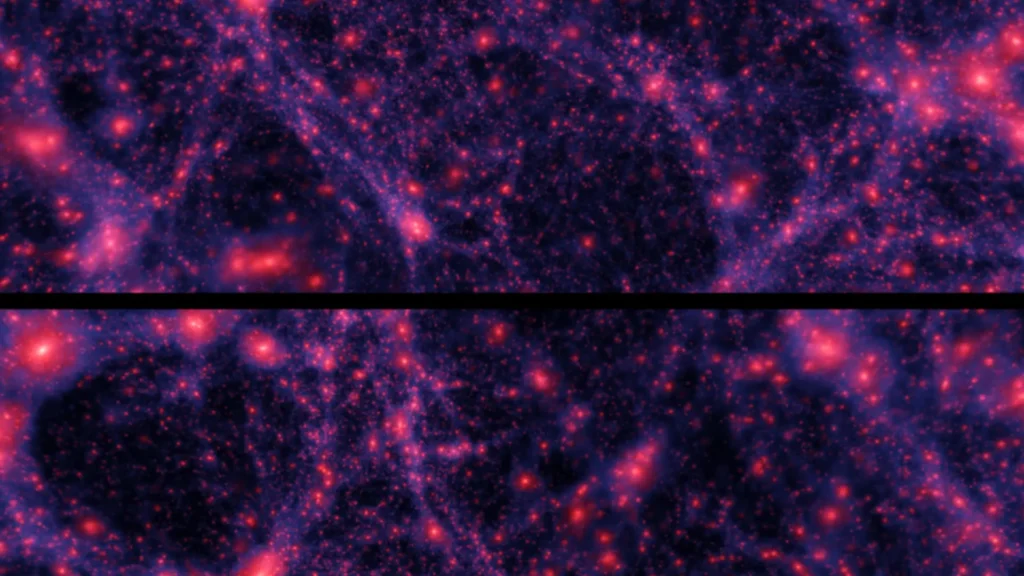
Exploring these myriad possibilities requires researchers to generate enormous numbers of detailed computer simulations. Each simulation represents a virtual universe, built from the ground up using different physical assumptions and varying cosmological parameters. These "mock universes" allow scientists to test theoretical predictions against observational data, probing how different physical laws would manifest in the cosmos we observe. For instance, simulating the effects of massive neutrinos on large-scale structure or modeling the clustering of galaxies under a modified gravity theory demands immense computational power.
These simulations are not trivial undertakings. They involve tracking the gravitational interactions of billions of particles over billions of years of cosmic evolution, often incorporating complex astrophysical processes like gas dynamics, star formation, and feedback from supermassive black holes. A single high-resolution cosmological simulation can require hundreds of thousands to millions of CPU (Central Processing Unit) hours on supercomputers, consuming vast amounts of energy and generating petabytes of data. This computational expense creates a significant bottleneck, limiting the number of theories and parameter spaces that researchers can thoroughly investigate. The sheer scale of the problem necessitates more efficient methods to bridge the gap between theoretical models and observable reality.
AI’s Growing Footprint in Cosmic Discovery
In recent years, artificial intelligence and machine learning have emerged as powerful tools to tackle these computational challenges. AI algorithms are increasingly deployed across various scientific disciplines, from drug discovery to climate modeling, and cosmology is no exception. AI systems are already assisting cosmologists in tasks such as classifying galaxies from astronomical images, identifying anomalies in CMB data, and accelerating the analysis of complex datasets. The burgeoning field of "AI for science" promises to revolutionize the pace and scope of scientific discovery.
The JCAP study focuses on a specific machine learning technique called transfer learning. Transfer learning allows an AI system to apply knowledge gained from one task to another related task, rather than starting from scratch each time. This concept mirrors human learning: a student who has learned algebra can more easily grasp calculus than someone without any prior mathematical training. In the context of cosmological simulations, this means an AI trained on a simpler, well-understood model of the universe could potentially adapt its knowledge to interpret more complex models incorporating new physics, thereby reducing the need for extensive, time-consuming retraining.
Leveraging Transfer Learning to Slash Simulation Costs
The research team, led by first author Veena Krishnaraj, an undergraduate student at Princeton University, and co-author Adrian Bayer, a cosmologist at the Flatiron Institute and Princeton University, investigated whether transfer learning could make the simulation process more efficient. Their innovative approach involved a two-stage training process for their neural network.
Instead of training the AI directly on the most complex and computationally costly simulations, the team first "pretrained" it on simpler, less expensive simulations based on the well-established ΛCDM model. This initial phase provided the AI with a foundational understanding of the universe’s basic structure and evolution under standard physics. "It’s basically a shortcut," explains Adrian Bayer. "Usually people train the AI directly on the most computationally expensive simulations. What we do instead is first use simpler and less expensive ΛCDM simulations to give the AI an idea of what’s happening, and only afterward move to the more complex models."
Bayer compares this approach to learning from textbooks: "You first read a basic book to get an idea of the knowledge, and then move to the really complicated book." According to Krishnaraj, this strategy prevents the AI from having to "digest everything at once." By leveraging existing knowledge, the AI can then more efficiently learn the nuances introduced by new physical theories, such as the effects of massive neutrinos or modified gravity.
The results of this strategy were striking. The study demonstrated that in some cases, transfer learning reduced the number of expensive simulations required to train the AI by more than a factor of ten. This substantial reduction translates directly into significant savings in computational resources, energy consumption, and researcher time. For example, a task that might have previously demanded months of supercomputer time could potentially be completed in weeks or even days, dramatically accelerating the pace at which new physical theories can be explored and validated against observational data. Such efficiencies are crucial as cosmologists prepare for an unprecedented deluge of data from upcoming observational surveys.
The Paradox of Prior Knowledge: Negative Transfer
While the efficiency gains were impressive, the study also revealed a less obvious but critical challenge: the phenomenon of "negative transfer." This occurs when prior knowledge, instead of facilitating new learning, actually hinders it. Using Bayer’s textbook analogy, imagine a medical student who has extensively studied common diseases. If they then encounter a rare disease that presents with symptoms strikingly similar to a common ailment, their ingrained knowledge might lead them to misdiagnose the rare condition, encouraging the wrong conclusion.
The same issue can arise in AI systems. The researchers observed that in certain scenarios, the subtle "signatures" of new physics closely resembled patterns that the AI had already strongly associated with the standard cosmological model. When faced with such ambiguous information, the pretrained neural network, relying heavily on its established understanding, struggled to interpret the unfamiliar data correctly. It tended to filter the new information through the lens of what it already knew, making it harder to recognize genuinely novel effects.
This effect was particularly evident when the team studied simulations that included massive neutrinos. Neutrinos, once thought to be massless, are now known to possess a tiny but non-zero mass. This mass has subtle but measurable effects on the large-scale structure of the universe. However, some of the observational signatures linked to neutrino mass closely resemble changes associated with an existing ΛCDM parameter called σ8 (sigma-8). Sigma-8 measures how strongly matter clusters throughout the universe, and its variations can produce similar patterns in cosmic structure as massive neutrinos. Because of this inherent physical degeneracy – where different physical processes can produce very similar observable outcomes – the pretrained neural network initially had difficulty distinguishing between the two effects.
"The negative transfer is not random. It is driven by underlying physical degeneracies in the model," explains Veena Krishnaraj. In essence, the universe itself can be ambiguous, with multiple pathways leading to similar observable phenomena. This inherent complexity poses a formidable challenge for AI, which, without careful design and validation, might simply reinforce existing biases rather than discovering truly novel physics. "So this is something we need to be aware of and try to mitigate," she concludes, emphasizing the critical need for researchers to understand and account for these limitations.
Contextualizing the Research: AI and the Evolving Scientific Method
This research holds broader implications for the application of AI, particularly "foundation models" – large AI models trained on vast amounts of data that can be adapted to a wide range of downstream tasks – to scientific discovery. These approaches are conceptually similar to the techniques underpinning modern generative AI systems and large language models (LLMs) that have captured public attention. While foundation models offer unparalleled capabilities in pattern recognition and data synthesis, the phenomenon of negative transfer serves as a crucial reminder that these powerful tools are not infallible.
The study underscores that AI in science is not a replacement for human intellect but a sophisticated augmentation. Scientists must remain vigilant, critically evaluating AI’s output and understanding its potential biases and limitations. The "black box" nature of many neural networks means that deciphering why an AI makes a particular prediction or misinterpretation is often as challenging as the initial problem itself. Therefore, developing explainable AI (XAI) techniques and robust validation protocols becomes paramount, especially when the stakes are as high as discovering new fundamental laws of nature. The interplay between human intuition, theoretical modeling, and AI-driven data analysis is evolving the very fabric of the scientific method.
Looking Ahead: From Simulations to Sky Surveys
So far, the transfer learning approach has only been tested using simulations. The next crucial step will be applying it to real astronomical observations. This transition presents its own set of challenges, including dealing with observational noise, instrumental biases, and incomplete data. However, the potential rewards are immense.
The team believes that transfer learning could become an indispensable tool for upcoming cosmological surveys, which are poised to collect unprecedented amounts of high-precision data about the universe in the years ahead. Missions like the European Space Agency’s Euclid mission, the Vera C. Rubin Observatory’s Legacy Survey of Space and Time (LSST), NASA’s Nancy Grace Roman Space Telescope, and the Square Kilometre Array (SKA) will generate petabytes of data, mapping billions of galaxies and probing the universe with exquisite detail. For instance, LSST alone is expected to image the entire visible southern sky every few nights for a decade, producing a staggering 500 petabytes of data.
Analyzing such vast and complex datasets within a reasonable timeframe will be impossible without highly efficient, AI-driven methodologies. Tools like transfer learning, capable of rapidly processing and interpreting this data, will be critical for extracting meaningful scientific insights and, crucially, for identifying the subtle signatures of new physics that might otherwise remain buried within the noise. The ability to quickly test theoretical models against real-world observations will accelerate the pace of discovery and help cosmologists pinpoint which "new physics" theories are most consistent with reality.
Broader Implications and Future Directions
The findings of Krishnaraj, Bayer, and their colleagues highlight a fundamental tension in AI-assisted scientific discovery: the trade-off between efficiency and openness to truly novel phenomena. While pretraining can dramatically speed up inference and analysis, it "may also hinder learning new physics," as the researchers note in their paper. This implies that future AI development for scientific applications must not only focus on raw computational power but also on robustness against negative transfer and the ability to detect and highlight truly anomalous, unexpected results.
The ability to optimize computational resources has broader implications beyond cosmology. It could democratize access to cutting-edge research, allowing more scientists and institutions to participate in high-end data analysis without needing exclusive access to the largest supercomputing facilities. However, this must be balanced with rigorous validation protocols to ensure that AI-driven discoveries are not merely reflections of pre-existing biases or assumptions embedded in the training data.
The ongoing dialogue about the promise and peril of AI in science will continue to shape how humanity explores the cosmos. The JCAP study serves as a timely reminder that while AI offers powerful shortcuts on the path to discovery, the journey demands careful navigation, with human oversight remaining indispensable for interpreting the universe’s most enigmatic signals.
The paper, "Transfer Learning Beyond the Standard Model" by Veena Krishnaraj, Adrian E. Bayer, Christian Kragh Jespersen, and Peter Melchior, is now available in JCAP.