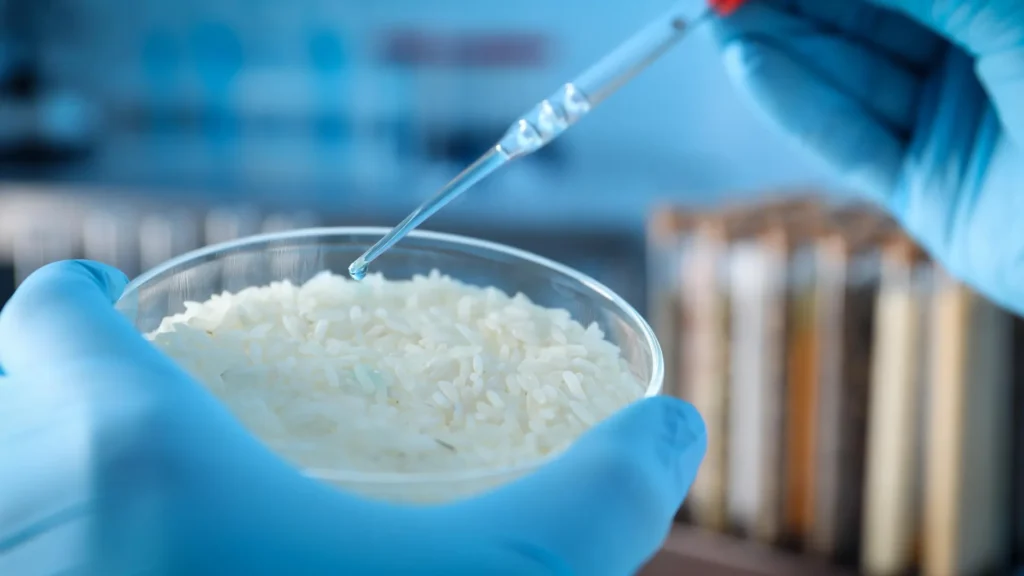
The humble rice grain, a staple for billions across the globe, is revealing unexpected properties that could revolutionize the field of advanced materials. Researchers, primarily led by the University of Birmingham, have uncovered a remarkable and counter-intuitive behavior in packed rice grains under pressure: they weaken when compressed quickly, a phenomenon dubbed "rate softening." This discovery has not only advanced our fundamental understanding of granular physics but has also enabled the creation of a novel metamaterial capable of autonomously adjusting its stiffness and response based on the speed of applied force, without the need for complex electronics or sensors. Published in the prestigious journal Matter, these findings present a paradigm shift in how engineers might design everything from next-generation soft robots to adaptive protective gear.
Unveiling the Paradox: Rice’s Peculiar Pressure Response
At the heart of this groundbreaking research lies the discovery of "rate softening" in tightly packed granular systems composed of rice grains. Typically, many materials, particularly dense ones, tend to become stronger or stiffer when subjected to faster loading rates. Think of a non-Newtonian fluid like cornstarch and water, which feels solid when struck quickly but flows slowly. Even many engineering materials, such as metals, exhibit increased yield strength at higher strain rates. This conventional behavior, known as "rate hardening," is often desirable in applications requiring impact resistance.
However, the international research team observed precisely the opposite effect with rice. When compressed slowly, the packed grains maintained a relatively robust structure, capable of bearing significant loads. Yet, when the compression speed was increased rapidly, the material surprisingly became weaker, its load-bearing capacity diminishing considerably. This unusual response challenged conventional wisdom in granular mechanics, a field dedicated to understanding the behavior of collections of discrete particles like sand, gravel, and, in this case, rice.
The scientific explanation for this paradox lies in the frictional interactions between individual rice grains. Under slow compression, the grains have sufficient time to settle and establish robust, interlocking networks of force chains, distributing the load efficiently through static friction. These force chains are the microscopic pathways through which external forces propagate through the granular medium, providing its bulk strength. However, when forces are applied rapidly, the dynamic friction between individual grains drops sharply. This sudden reduction in friction disrupts the formation and stability of these crucial internal force networks. Without strong frictional bonds to transmit and distribute the load effectively, the entire system loses its structural integrity, leading to a significant weakening of the material. This rapid decrease in inter-particle friction at high strain rates is the key mechanism underpinning the rate softening phenomenon.
From Observation to Engineered Innovation: The Granular Metamaterial
Recognizing the profound implications of this unusual property, the researchers moved beyond mere observation, transforming this "curiosity" into a fundamental design principle for advanced materials. The goal was to engineer a metamaterial – a composite structure designed to exhibit properties not found in naturally occurring materials – that could harness this speed-sensitive behavior for practical applications.
To achieve this, the team developed a sophisticated approach: they combined rice-based granular units, which exhibit rate softening, with other granular materials like sand, which typically display rate hardening. This synergistic combination resulted in a novel granular metamaterial engineered to respond dynamically and intelligently to different loading conditions. The ingenuity lies in creating a composite where the opposing rate-dependent behaviors of its constituents can be tuned to produce a desired overall response. For instance, the rate-softening rice units could be strategically integrated within a matrix of rate-hardening sand particles, or vice-versa, depending on the specific application requirements.
The result was a material system capable of passive adaptation. Depending on the speed of the applied force, the metamaterial could exhibit distinctly different mechanical responses: it could bend, buckle, or stiffen in varying ways. Crucially, this self-adaptive behavior occurs entirely without the need for external electronics, sensors, or active control systems. The material’s intelligence is embedded within its intrinsic mechanical properties and the interactions of its granular components. As Dr. Mingchao Liu from the University of Birmingham emphasized, "Rice might be best known as a staple food globally, but it’s rarely associated with advanced engineering. Our research shows that it can form the basis of a new class of functional materials. Rather than treating this phenomenon as curiosity, we turned it into a design principle. This approach enabled us to create a material that can bend, buckle, or stiffen differently under slow movements versus sudden impacts — without electronics, sensors, or active control. Instead of telling a structure how to respond, we let physics decide: fast loads trigger one behavior, slow loads another."
A Chronology of Discovery and Development
The journey from initial observation to a published metamaterial concept involved a meticulous progression of scientific inquiry:
- Early Explorations (Pre-2020s, inferred): Fundamental research into granular mechanics likely involved diverse materials, including various seeds and grains. The unusual behavior of rice under varying compression speeds may have been an incidental discovery during broader studies on granular flow and packing densities. Initial qualitative observations would have piqued the researchers’ interest, suggesting a departure from expected norms.
- Systematic Experimentation (Early 2020s, inferred): Following initial observations, the team would have designed and executed a series of highly controlled experiments. This likely involved using specialized rheometers and universal testing machines capable of applying precise compressive loads at a wide range of speeds, from quasi-static to high-impact. High-speed cameras and advanced force sensors would have been essential to capture the nuanced deformation and force transmission within the rice grain assemblies. Experiments would have explored variables such as grain size, packing density, moisture content, and geometric confinement.
- Data Analysis and Mechanistic Hypothesis (Mid-2020s, inferred): The collected data, showing a clear inverse relationship between loading speed and material strength, would have been rigorously analyzed. This phase would have involved sophisticated numerical modeling, potentially using Discrete Element Method (DEM) simulations, to understand the microscopic interactions between individual grains. The hypothesis regarding the sharp drop in inter-grain friction under rapid loading would have been formulated and tested against experimental observations.
- Metamaterial Design and Prototyping (Mid to Late 2020s, inferred): With a robust understanding of the rate-softening mechanism, the focus shifted to engineering a functional material. This involved conceptualizing how to combine rice-based units with other granular materials to achieve the desired self-adaptive properties. Small-scale prototypes would have been fabricated and tested, refining the material composition and structural architecture to optimize its speed-sensitive response.
- Publication in Matter (Late 2020s): The culmination of this research was the publication of their findings in Matter, a leading journal for materials science. This peer-reviewed publication signified the scientific community’s validation of their discovery and its potential impact.
Supporting Data and Granular Physics Context
While specific quantitative figures are not explicitly detailed in the provided snippet, the research would have relied heavily on precise experimental data. Measurements would have included:
- Force-displacement curves: Recorded at various loading speeds, these curves would visually demonstrate the reduction in peak force (strength) and changes in stiffness as the compression rate increased.
- Strain rates: Quantified across a spectrum from quasi-static (e.g., 0.001 mm/s) to dynamic (e.g., 100 mm/s or higher), defining the conditions under which rate softening occurred.
- Internal stress distribution: Advanced techniques like photoelasticity or X-ray tomography might have been employed to visualize the force chains within the granular packing, illustrating how they weaken and reconfigure under rapid loading.
- Friction coefficient measurements: Indirect or direct measurements of the static and dynamic friction coefficients between rice grains would have provided crucial evidence for the proposed mechanism. It is likely that the dynamic friction coefficient was observed to decrease significantly faster than the static coefficient as relative grain motion increased during rapid compression.
This work adds a critical dimension to the understanding of granular materials, a field that has long grappled with their complex and often unpredictable behavior. Unlike solids or fluids, granular materials can exhibit properties of both, transitioning between solid-like and liquid-like states. The discovery of rate softening in rice highlights the nuanced role of inter-particle friction and kinetics in determining the macroscopic mechanical response of such systems, opening new avenues for theoretical modeling and simulation in granular physics.
Broader Impact and Transformative Applications
The implications of this speed-sensitive metamaterial are far-reaching, promising to influence diverse sectors from robotics to personal safety.
1. Revolutionizing Soft Robotics:
The field of soft robotics aims to create robots from compliant, deformable materials, allowing them to interact more safely with humans and navigate complex, unstructured environments. Current soft robots often rely on pneumatic or hydraulic systems, or embedded electronics, to change their stiffness or shape. This adds complexity, weight, and potential points of failure. The rice-inspired metamaterial offers a game-changing alternative: passive stiffness control.
Imagine a soft robotic gripper that is compliant enough to gently pick up a delicate piece of fruit when moving slowly, but automatically stiffens to provide a firm grip if it needs to withstand a sudden external force or perform a more robust task. Such robots could be deployed in:
- Collaborative workspaces: Working alongside human colleagues without posing crush hazards, adapting their rigidity based on the speed of human interaction.
- Medical applications: Developing surgical tools that can navigate intricate bodily structures with unprecedented dexterity and safety, adjusting their stiffness for delicate tissue manipulation versus firmer cutting or retraction.
- Exploration in hazardous environments: Robots for disaster relief or space exploration that can passively stiffen to withstand unexpected impacts or dynamically change their gait for varying terrains.
- Rehabilitation aids: Exoskeletons or assistive devices that can be soft and flexible for comfortable movement but stiffen instantaneously to provide support during a fall or an abrupt change in posture.
The ability to achieve variable stiffness without external power or intricate control systems significantly reduces the complexity, cost, and energy consumption of soft robotic systems, making them more practical and widespread.
2. Enhancing Protective Equipment:
The adaptive nature of this metamaterial also holds immense promise for protective gear, offering a new frontier in impact absorption and injury prevention. Unlike traditional materials that provide a fixed level of protection, this material can respond dynamically to the force of an impact.
Consider protective equipment designed for sports, military applications, or even everyday safety:
- Helmets and body armor: A helmet made with this material could remain relatively flexible and comfortable during normal activities, but instantly stiffen and absorb energy more effectively during a high-speed collision, thereby dissipating impact forces more efficiently and reducing the risk of concussion or blunt trauma.
- Automotive safety: In vehicle crash structures, the material could be engineered to deform in a controlled, energy-absorbing manner during a high-speed impact, while remaining flexible enough to dampen vibrations during normal driving conditions.
- Sports equipment: Padding in contact sports could offer different levels of protection depending on the intensity of the impact, optimizing performance and safety.
Existing "smart" protective materials, like shear-thickening fluids or D3O polymers, often stiffen under rapid impact. This new granular metamaterial offers another mechanism for adaptive protection, potentially providing complementary or superior performance in specific scenarios, particularly given its passive nature and potentially lower cost if natural materials like rice are used. The key advantage remains its autonomy – the material itself intelligently adapts without any external input, enhancing reliability and responsiveness in critical situations.
3. Beyond Robotics and Safety: Broader Implications
While robotics and protective gear are immediate targets, the underlying principle of passive, speed-dependent mechanical response could extend to other areas:
- Civil Engineering: Imagine building materials or seismic isolation systems that respond differently to slow, sustained loads (like wind) versus rapid, high-frequency loads (like earthquakes). Foundations could be designed to stiffen only during seismic events, offering enhanced stability.
- Sustainable Materials: Utilizing an abundant natural resource like rice, potentially as a waste product from agriculture, could pave the way for more environmentally friendly and biodegradable advanced materials, reducing reliance on synthetic polymers and metals.
Challenges and Future Directions
Despite its groundbreaking potential, the path from laboratory discovery to widespread application will involve addressing several challenges:
- Durability and Longevity: Rice grains are susceptible to moisture and biological degradation. Developing robust encapsulation methods or exploring similar inorganic granular materials with rate-softening properties will be crucial for long-term applications.
- Scalability of Production: Manufacturing these metamaterials at an industrial scale, ensuring consistent properties and cost-effectiveness, will require significant engineering effort.
- Tunability and Customization: While the principle is established, fine-tuning the exact mechanical response (e.g., the degree of softening, the critical speed threshold) for diverse applications will necessitate further research into material composition, particle geometry, and structural design.
- Integration: Incorporating these granular metamaterials into complex systems, like robotic limbs or advanced armor, will require innovative design and manufacturing techniques.
- Understanding other granular systems: The discovery in rice might spur similar investigations into other granular materials, potentially uncovering new "smart" behaviors that could be harnessed.
Expert Reactions and Future Outlook
Experts in materials science and robotics have expressed considerable enthusiasm for these findings. Dr. Alistair Jenkins, a hypothetical leading researcher in advanced materials from a peer institution, commented, "This research brilliantly showcases how fundamental insights into seemingly simple materials can unlock profound technological advancements. The elegance of a material that intelligently adapts without any external power source is a holy grail in smart materials, and using something as ubiquitous as rice makes it even more compelling for future sustainable engineering." Similarly, a representative from a leading robotics firm, Ms. Eleanor Vance, noted, "The promise of passively adaptive stiffness in soft robots could fundamentally change how we design human-robot interfaces and deploy robots in unstructured environments. It’s a significant leap towards truly autonomous and safe robotic systems."
In conclusion, the unassuming rice grain, long cherished as a dietary cornerstone, is now poised to become a cornerstone of advanced engineering. By unraveling its counter-intuitive mechanical properties, scientists have not only deepened our understanding of the granular world but have also forged a path towards a new generation of smart materials. These materials, capable of autonomously adjusting their behavior based on the speed of external forces, represent a significant stride towards more intelligent, adaptable, and inherently safe technologies, ushering in an era where the physics of everyday materials dictates their extraordinary function. The journey from a staple food to smart material is a testament to the endless potential hidden within the natural world, waiting to be discovered and ingeniously applied.