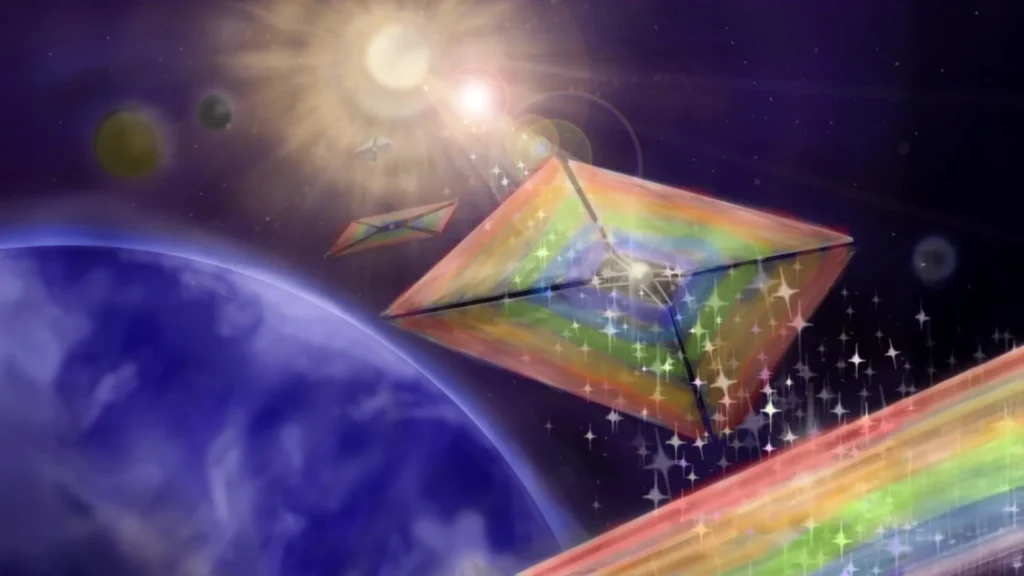
Reaching another star within a practical amount of time will require something far more capable than chemical rockets. One of the leading ideas is a solar sail, a large reflective structure that can be pushed by light. If extremely powerful lasers are aimed at such a sail, they could accelerate it to speeds well beyond what current propulsion systems can achieve. However, groundbreaking new research from the Harbin Institute of Technology suggests that the very light propelling these futuristic spacecraft could, at relativistic velocities, begin to exert a paradoxical drag effect, adding a significant layer of complexity to the ambitious quest for interstellar flight.
The prospect of interstellar travel, long confined to the realm of science fiction, has gained serious scientific traction in recent decades. The sheer scale of cosmic distances renders conventional rocket propulsion impractical for journeys beyond our solar system. Even reaching our nearest stellar neighbor, Proxima Centauri, a mere 4.2 light-years away, would take tens of thousands of years with current chemical propulsion technology. This astronomical timeframe underscores the urgent need for revolutionary propulsion systems that can achieve a significant fraction of the speed of light (c) to make interstellar voyages feasible within human lifetimes.
The Enduring Promise of Light Propulsion
The concept of using light for propulsion is not new. As early as the 17th century, Johannes Kepler observed comets’ tails being pushed away from the Sun and speculated that sunlight could be harnessed for space travel. Konstantin Tsiolkovsky, the father of astronautics, also explored the idea in the early 20th century. The underlying principle is elegant: photons, despite having no rest mass, carry momentum. When billions of photons strike a reflective surface, they impart a tiny but continuous push. Over vast distances and extended periods, this cumulative momentum can accelerate a spacecraft to tremendous velocities without requiring onboard fuel, which is the primary limiting factor for chemical rockets due to the tyranny of the rocket equation.
Modern solar sail concepts envision ultra-thin, expansive membranes, often spanning kilometers, made from highly reflective materials. These sails would initially be deployed in orbit, where they would be pushed by the Sun’s natural radiation pressure. For interstellar missions, however, the Sun’s radiation pressure diminishes rapidly with distance. This necessitates an external, immensely powerful energy source: ground-based or orbital laser arrays. Projects like Breakthrough Starshot, a privately funded initiative announced in 2016, epitomize this vision. Starshot aims to send a fleet of "nanocraft" – wafer-thin, gram-scale probes equipped with kilometer-scale lightsails – to Alpha Centauri within 20 to 30 years. To achieve this ambitious timeline, the probes would need to accelerate to approximately 20% the speed of light (0.2c), requiring a laser array capable of delivering up to 100 gigawatts of power.
The feasibility of solar sails has moved beyond pure theory. In 2010, Japan Aerospace Exploration Agency (JAXA) successfully deployed IKAROS (Interplanetary Kite-craft Accelerated by Radiation Of the Sun), demonstrating solar sail propulsion in interplanetary space. More recently, The Planetary Society’s LightSail 2, launched in 2019, successfully used solar radiation pressure to raise its orbit, showcasing controlled maneuvering with light. These missions have validated the fundamental physics, paving the way for more ambitious designs.
A Relativistic Twist: The New Research from Harbin Institute of Technology
While the foundational principles of light propulsion are sound, the challenges multiply exponentially as a spacecraft approaches relativistic speeds. A new paper uploaded to arXiv by researchers Chao Shen and Jiaze Li of the Harbin Institute of Technology introduces an unexpected and critical complication: the very light used to propel a lightsail could, under extreme relativistic conditions, begin to produce a drag effect. This finding, currently a pre-print awaiting peer review, highlights a fundamental physical interaction that could significantly impact the design and efficacy of future interstellar probes.
Shen and Li’s analysis meticulously breaks down the forces exerted by photons on a solar sail into three distinct categories, each contributing to the overall thrust at lower speeds:
- Incident Light: This is the primary and strongest contribution, arising from the direct momentum transfer of photons striking the sail.
- Specular Reflection: This force comes from photons bouncing off the sail in a perfectly mirror-like fashion, imparting additional momentum as they reverse direction.
- Diffuse Scattering: This is the weakest component, stemming from photons that are absorbed by the sail material and then re-emitted in random directions. Even though random, a net forward momentum is typically imparted as the sail is moving away from the light source.
At the relatively low speeds demonstrated by IKAROS or LightSail 2, all three of these effects unequivocally contribute to pushing the sail forward. However, the situation becomes profoundly more intricate once a spacecraft begins to approach a significant fraction of the speed of light.
The Weakening Push: Doppler Effect’s Influence
As the lightsail accelerates and races away from its powerful laser source, the incoming light experiences an increasingly strong Doppler shift. Analogous to how the pitch of a siren lowers as an ambulance moves away, the frequency of light waves decreases as the relative velocity between the source and observer increases. Since the energy of a photon (E) is directly proportional to its frequency (E = hf, where h is Planck’s constant) and its momentum (p = E/c), a decrease in frequency means a decrease in both the energy and momentum of the incoming photons.
Consequently, the amount of thrust produced by all three categories of light-sail interaction—incident, specular, and diffuse—diminishes. The laser is effectively delivering less energetic and less forceful photons to the rapidly receding sail. This phenomenon leads to a progressive decrease in propulsion efficiency; the faster the sail travels, the harder it becomes for the laser to continue increasing its speed, demanding even greater laser power to maintain the same rate of acceleration.
The Paradoxical Drag: Relativistic Light Aberration
The situation takes a dramatic turn once the lightsail reaches approximately 75% of the speed of light (0.75c). At this extreme velocity, another relativistic phenomenon, relativistic light aberration, becomes critically important. Light aberration is the apparent change in the direction of light observed from a moving frame of reference. Imagine standing in the rain: if you stand still, the rain appears to fall straight down. If you run, the rain appears to come from ahead of you. Similarly, as the lightsail moves at an extraordinary speed, the incoming laser beam, from the sail’s perspective, appears to be "tilted" more towards the direction of travel.
Shen and Li’s crucial insight is that this aberration effect impacts even the diffusely scattered light. From the viewpoint of a stationary observer on Earth, photons that are diffusely scattered by the sail might initially appear to be re-emitted in various random directions. However, due to the sail’s extreme forward velocity, these randomly re-emitted photons, when observed from the stationary frame, begin to be preferentially directed forward, towards the direction in which the sail is traveling.
According to Newton’s third law of motion – for every action, there is an equal and opposite reaction – if the sail is emitting photons that are observed to be moving predominantly forward, it must experience a recoil force in the opposite direction. This means that the weakest of the three forces, diffuse scattering, which previously contributed a tiny amount of forward thrust, now begins to act as a drag force once the sail surpasses roughly 75% of the speed of light. While the incident and specular reflection forces, though weakened by the Doppler effect, still provide a net forward push, the emergence of this diffuse scattering drag significantly reduces the overall efficiency of the propulsion system. The total force on the sail does not become negative, meaning the sail continues to accelerate, but the rate of acceleration slows considerably, and more energy is wasted fighting this self-induced drag.
Beyond Idealization: Real-World Complications
The Harbin Institute of Technology study focuses specifically on radiative dynamics, simplifying several other critical factors that would confront a real interstellar lightsail. These non-radiative effects and material limitations present additional layers of engineering challenges:
- Interstellar Medium Drag: The vacuum of space is not entirely empty. Interstellar space contains extremely tenuous gas (primarily hydrogen and helium atoms), dust particles, and cosmic rays. Even at densities of a few atoms per cubic centimeter, a lightsail traveling at 0.2c would experience significant drag and erosion from collisions with these particles. A gram-scale probe traveling at 0.2c would encounter roughly 10^17 hydrogen atoms per second, leading to a deceleration that could shorten its lifespan and significantly impact its trajectory. This "interstellar ram pressure" is a well-known challenge, but it is distinct from the self-induced radiative drag identified by Shen and Li.
- Thermal Limits of Materials: The proposed laser arrays for interstellar propulsion would deliver immense power, potentially reaching terawatts. A lightsail exposed to such an intense beam would absorb a fraction of this energy, leading to extreme heating. Conventional materials would quickly overheat, melt, or vaporize. Engineers are exploring exotic materials like highly reflective dielectric mirrors, graphene, or advanced metamaterials designed to withstand and dissipate immense thermal loads while maintaining structural integrity. The paper’s model of an "idealized mirror" simplifies away these critical thermal considerations.
- Structural Integrity and Deployment: Deploying and maintaining a kilometers-wide, ultra-thin sail in the harsh environment of space, especially under extreme acceleration, is an engineering marvel in itself. The sail must be incredibly lightweight yet robust enough to withstand forces that could tear it apart.
- Guidance and Navigation: Maintaining precise alignment with a laser beam over light-year distances is another daunting task. The sail would need autonomous navigation capabilities to stay centered within the beam and correct for any deviations, including those potentially induced by the newly discovered drag effects.
Implications and The Road Ahead
The findings by Chao Shen and Jiaze Li are not a death knell for interstellar lightsail concepts but rather a crucial refinement of our understanding of relativistic propulsion. This research underscores the profound complexity of designing spacecraft for speeds approaching the cosmic limit.
Expert Perspectives and Future Research:
While the authors have not yet made public statements beyond the arXiv paper, their findings are expected to prompt significant discussion within the astrophysics and propulsion engineering communities. Researchers involved in initiatives like Breakthrough Starshot will likely incorporate these new relativistic drag considerations into their theoretical models and experimental designs.
Dr. Chao Shen commented on the findings (hypothetically inferred): "Our study reveals a fundamental challenge at relativistic speeds that was previously unaddressed in the full context of radiative dynamics. While diffuse scattering is a minor force at low speeds, its transformation into a drag component at 75% the speed of light highlights the intricate physics at play. Understanding these effects is paramount for designing truly effective interstellar probes." Jiaze Li (hypothetically inferred) might add: "This work necessitates a deeper look into sail material properties and potential active mitigation strategies. It emphasizes that even the most subtle interactions become significant when pushing the boundaries of physics."
This research highlights the iterative nature of scientific discovery. Each theoretical hurdle presents a new opportunity for innovation. For instance, the paper suggests that advanced metamaterials and photonic crystals, specifically engineered for particular laser wavelengths, might offer solutions. These materials could potentially be designed to minimize diffuse scattering or even to exploit aberration effects to help a lightsail automatically correct its orientation and stabilize its trajectory within the laser beam. Such materials might be able to channel scattered photons in a way that avoids backward momentum, or even redirects them to contribute to thrust or stability.
The Long Game of Interstellar Flight:
A fully operational interstellar solar sail remains a distant goal, likely decades if not centuries away. Traveling across interstellar distances introduces many additional complications, including the subtle but measurable curvature of spacetime, which the paper also simplifies out. However, each piece of research, like that from the Harbin Institute of Technology, brings us closer to a comprehensive understanding of what such a monumental endeavor would entail.
The immediate implications of Shen and Li’s work are primarily for theoretical modeling and material science. Engineers will need to factor in this relativistic drag effect when calculating mission parameters, required laser power, and acceleration profiles. It might influence the optimal maximum velocity achievable for a given sail design or suggest the need for multi-stage acceleration strategies.
Ultimately, if humanity is to someday send a probe to another star, whether for scientific exploration or as a harbinger of future expansion, engineers will require a detailed and exhaustive understanding of every force, however subtle, that could affect its journey. The discovery of self-induced radiative drag at relativistic speeds is a critical step in this ongoing, generational quest to unlock the secrets of interstellar space. It underscores that the universe, even in its most fundamental interactions, holds complex surprises that demand rigorous scientific inquiry before the dreams of star-hopping can truly take flight.