When Tudor unveiled the North Flag in 2015, the horological world responded with a mixture of intrigue and bewilderment. This was not merely another iteration of their popular Black Bay or Pelagos divers; instead, Tudor chose this moment to debut its first in-house manufactured movements, a significant milestone for the brand. Yet, the watch itself was a surprising homage to the relatively obscure Ranger II, an integrated bracelet sports watch from the 1970s that few anticipated would see a revival. The North Flag’s design language was distinctly separate from its aquatic counterparts, featuring a distinctive hybrid steel-and-ceramic bezel, a transparent caseback, and, most notably, a power reserve indicator. This last feature remains a singular instance of Tudor incorporating a power reserve onto one of its modern calibers.
The initial reception to the North Flag was decidedly mixed. Tudor, it seemed, was perhaps too far ahead of the prevailing trends. At a time when vintage-inspired dive watches dominated the market, the integrated bracelet sports watch was not yet the phenomenon it would later become. Just six years after its introduction, the North Flag was discontinued, leaving enthusiasts to ponder its unconventional appeal.

Fast forward to the present, and the landscape of the watch industry has dramatically shifted. Integrated bracelet sports watches have not only gained popularity but have become an almost essential category for any serious watchmaker. It feels as though nearly every brand has introduced such a model in the past five years, with price points spanning from a few hundred to hundreds of thousands of dollars. In retrospect, the original North Flag now appears prescient, prompting many to reconsider its initial reception and acknowledge its forward-thinking design.
This evolution in market perception has paved the way for the new Tudor Northflag. While the first iteration was arguably ahead of its time, the 2026 Northflag arrives precisely when the market is primed for it, perhaps even fashionably late. This new iteration is also a GMT, though the designation is subtly absent from its official name. The central question for collectors and enthusiasts is whether Tudor has successfully refined the original’s essence or diluted what made it uniquely interesting.
Case: Refined Aesthetics, Familiar Proportions
At first glance, the 2026 Northflag bears a striking resemblance to its predecessor. It retains the 40mm diameter and the integrated bracelet design characteristic of a sports watch. However, a closer examination reveals a multitude of subtle yet significant alterations. The case no longer features the blunt lug termination of the original. Instead, a gentle curve and a polished chamfer have been introduced, mirroring the design philosophy seen on Tudor’s Royal collection. This refinement lends the new Northflag a more upscale and aesthetically pleasing appearance. The original, by contrast, possessed a utilitarian, tool-watch charm derived from its unadorned, function-first design – a sort of rugged beauty that was inherently cool.

The bezel has also undergone modifications, gaining polished chamfers. However, it has shed the distinctive black ceramic ring that encircled the original’s bezel, a detail that is likely to be missed by many. While the new bezel is impeccably finished, the absence of the ceramic ring diminishes a unique design element that set the first North Flag apart.
Tudor has maintained the tapering crown, a design choice that elicits neither strong approval nor disapproval. It is functional, easy to grip, and unobtrusive, serving its purpose effectively. The tapering H-link bracelet has also received a subtle makeover, now featuring polished chamfers on the center links and a new clasp equipped with Tudor’s highly regarded micro-adjustment system, which enhances wearability and comfort.
Dial: A Balanced Evolution for Enhanced Readability
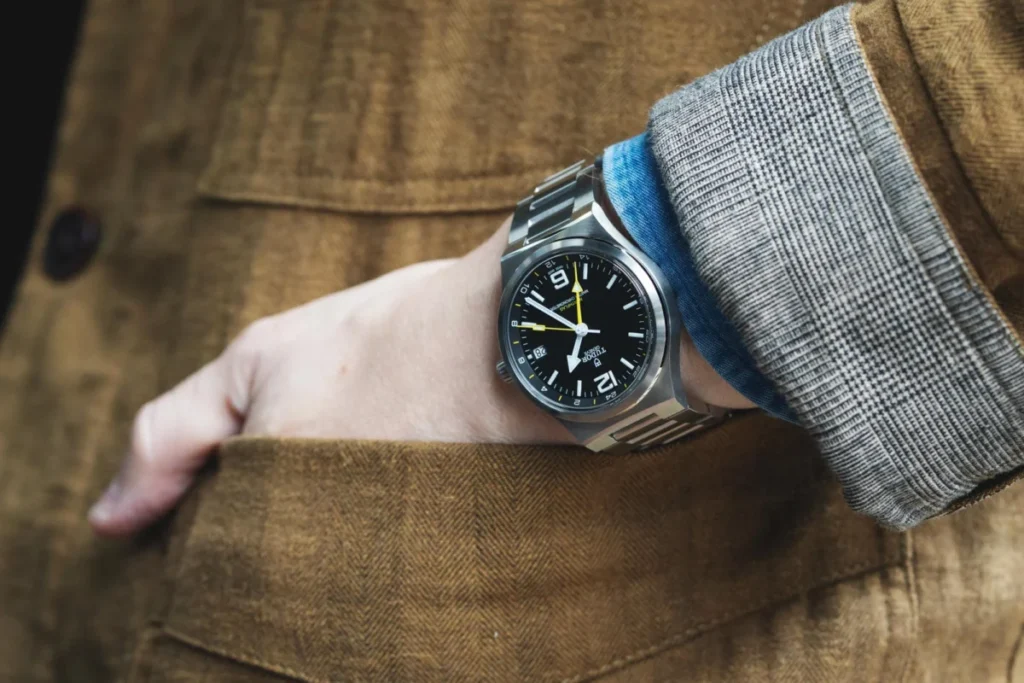
The dial has been the subject of more extensive revisions, though it clearly adheres to the established design language of the North Flag. It is rendered in black with a subtle sunburst finish, featuring prominent geometric numerals at the 12 and 6 o’clock positions, a nod to the Ranger II. Rectangular hour markers are complemented by white hash marks positioned between them.

A significant change is the relocation of these hash marks from the chapter ring to the main dial surface. This adjustment effectively fills the negative space, addressing the perceived openness of the 2015 dial, which some found to be somewhat awkwardly sparse. This alteration also liberates the chapter ring to accommodate the 24-hour GMT index, where white numerals alternate with thin yellow markers. Tudor has further enhanced the dial’s balance by adding a small applied marker next to the date window and a marker at the 9 o’clock position, where the power reserve indicator previously resided, further minimizing any sense of emptiness.
The 2026 dial presents a far more harmonious composition than its predecessor. The proportions of the markers relative to the applied elements, the judicious use of yellow, and the filling of previously empty areas contribute to a cohesive and thoughtfully designed layout. The use of molded ceramic lume further elevates the dial’s appeal.
Tudor has not employed molded ceramic lume since the Black Bay Pro, a feature that was widely praised. The markers on the new Northflag exhibit excellent luminosity from all angles and edge-to-edge, a testament to their thin, shaped design with beveled top edges. This thinness is crucial, as it allows for a denser dial layout without appearing cluttered. Compared to the previous markers, the shift is akin to moving from a bold font to a medium weight, resulting in a cleaner aesthetic that accommodates the increased information on the dial.

The hands retain their familiar silhouette: a white arrow for the hour hand and a straight sword for the minute hand. The luminous section of the seconds hand has been reconfigured into a rectangle instead of a taper, and its yellow coloring now stops at the center, leaving a white counterweight. This design choice likely prevents it from competing visually with the new, entirely yellow GMT hand. The GMT hand itself is long and slender, tapering to a fine point, and features a large luminous triangle. It remains unobtrusive to the other hands, ensuring legibility while maintaining a visual similarity to the GMT hand found on the Black Bay Pro.
Beneath the Tudor branding, the dial displays "NORTHFLAG" in yellow above the 6 o’clock position, with "MASTER CHRONOMETER" printed in white below it. A subtle yet significant branding alteration has occurred: the original was designated "North Flag," a two-word name, while the new model is presented as "Northflag," a single word. Tudor previously held a trademark for "Tudor North Flag" and has now secured "Northflag" specifically for watches. This suggests a deliberate move to establish "Northflag" as a distinct product line, akin to the established "Pelagos" or "Black Bay" nomenclature, potentially indicating future expansion of this collection based on its market performance.
The omission of the power reserve indicator is both understandable and logically justified. While it lent the original model a unique character and highlighted its three-day power reserve with a distinct painted hand on a disk, its absence on the new GMT movement is practical. Including it would likely have added to the already considerable thickness of the GMT caliber and disrupted the balanced aesthetic achieved on the dial. Although it represented a unique signature, its return in a future iteration cannot be entirely ruled out.

Movement: A Pinnacle of Precision and Durability
The "Master Chronometer" designation on the dial signifies a crucial aspect of the MT5652-U movement powering the new Northflag. This caliber undergoes rigorous testing, initially certified by COSC as a chronometer and subsequently subjected to METAS testing as a fully assembled watch head, a standard that signifies exceptional accuracy and robustness.
This is the same movement employed in the Pelagos FXD GMT and appears to be a METAS-certified variant of the caliber found in the Black Bay Pro and Black Bay GMT, as indicated by the "-U" suffix in its reference number. It operates as a "flyer" GMT, meaning the local hour hand jumps when adjusting for time zones, with the date adjustment synchronized by moving the local hand past midnight in either direction. The movement operates at a frequency of 28,800 vibrations per hour, boasts a 65-hour power reserve, features hacking seconds for precise time setting, and incorporates a silicon free-sprung balance wheel for enhanced accuracy and resistance to magnetism.
In a departure from Tudor’s typical practice, the movement is visible through a sapphire crystal caseback, a rare feature for the brand. However, enthusiasts should not expect elaborate haute horlogerie finishing. The movement presents a matte appearance, with a laser-engraved pattern that suggests a minimalist approach to decoration. While not aesthetically displeasing, it indicates that Tudor has not prioritized decorative finishing for this caliber, which might be a point of consideration given the watch’s price point.

On the Wrist: A Comfortable, Modern Fit
The new Northflag measures 12.7mm in thickness, approximately 2mm less than the Black Bay Pro. Despite this reduction, the watch retains a substantial presence on the wrist, characterized by its relatively flat profile. The crystal, lacking significant dome, does little to mitigate the overall height, which is perhaps unsurgiving considering the MT5652-U movement itself exceeds 7mm in thickness.
On a 6.75-inch wrist, the Northflag is perceived as tolerable, though it sits somewhat high. A reduction in overall thickness would undoubtedly enhance its wearability. The 40mm diameter aligns with contemporary sports watch proportions, and while a slightly smaller diameter might appeal to some, the current size is well-balanced. The effective lug-to-lug measurement, a metric that can be challenging to ascertain with integrated bracelet designs, hovers around 48mm.
The wearability of the Northflag is significantly influenced by its bracelet, which is integral to its design. The bracelet starts at 22.6mm at the lug attachment and tapers to 16mm at the clasp. For those who prefer a less substantial feel on the wrist, this taper is beneficial, reducing the surface area against the skin and contributing to a refined aesthetic. Tudor has also incorporated generous spacing between the bracelet links. While some might find these gaps noticeable, they contribute to the bracelet’s flexibility and breathability, and are largely imperceptible when worn.

A notable point of contention is the absence of a secondary strap option at launch, especially considering the original North Flag was offered with one. The integrated bracelet design limits strap compatibility to brand-specific offerings or, eventually, third-party options if the watch gains significant aftermarket traction. The prospect of wearing the watch exclusively on its bracelet might become monotonous for some. Given the retail price of $5,525, the inclusion of an alternative strap would have been a welcome addition, enhancing the perceived value proposition.
Conclusion: A Mature Evolution in a Competitive Market
Priced at $5,525, the new Northflag represents a significant increase over its predecessor, which retailed for approximately $2,000 less. This price jump is largely attributable to the inclusion of Master Chronometer certification, a testament to the movement’s advanced performance and durability. Within Tudor’s GMT offerings, the Northflag occupies a position between the FXD GMT and the Black Bay 58 GMT, both of which also boast Master Chronometer status. This strategic pricing ensures that the new model does not cannibalize its existing GMT lineup but rather creates compelling internal competition. The brand now offers a diverse range of GMT watches, with the Northflag appearing to directly target the segment occupied by the Black Bay Pro.
The original North Flag possessed a certain charming awkwardness, embodying a brand that was still defining its identity and appealing to a more niche audience. The new Northflag, in contrast, projects an image of maturity and confidence, reflecting a decade of accumulated expertise in watchmaking and market engagement. It is, without question, a more successful and refined design. Were it not for the direct comparison with its predecessor, the new Northflag would face little criticism. However, a reduction in thickness, a more compact diameter, a more accessible price point, and enhanced movement finishing would undoubtedly elevate its appeal further. These are, of course, perennial desires for any watch enthusiast.

Ultimately, the Tudor Northflag is a highly accomplished timepiece and a genuine alternative to the dive-centric offerings in Tudor’s GMT and sports watch collections. For existing Tudor patrons, it provides a distinct horological experience. For the burgeoning number of consumers seeking integrated bracelet sports watches, Tudor has finally delivered a compelling and competitive option.
Further Context and Market Implications
The reintroduction of the Northflag under the singular "Northflag" name is a strategic move by Tudor. This branding shift suggests a desire to establish the Northflag as a standalone product line, distinct from the broader "North Flag" moniker. This approach is reminiscent of how Tudor has cultivated its other successful collections, such as the Pelagos and Black Bay, allowing for future diversification and expansion within the Northflag family.
The watch’s positioning within Tudor’s GMT offerings also warrants attention. By placing it between the FXD GMT and the Black Bay 58 GMT, Tudor is not only segmenting its market but also implicitly acknowledging the growing demand for high-performance GMT watches that blend functionality with sophisticated design. The Master Chronometer certification, a standard that exceeds typical chronometer certifications, further underscores Tudor’s commitment to precision, reliability, and robustness. This commitment is crucial in a market where consumers increasingly value verifiable performance metrics.

The absence of a secondary strap option, while a point of critique, also highlights a broader industry trend. Integrated bracelet watches, by their nature, present a challenge for aftermarket strap customization. This scarcity of options can sometimes lead to a perception of limited versatility, particularly at higher price points. The inclusion of a thoughtfully designed rubber or fabric strap, in addition to the bracelet, could have significantly enhanced the Northflag’s value proposition and appeal to a wider audience seeking greater flexibility in wear.
The price increase, while substantial, is justifiable when considering the technological advancements and certifications integrated into the new model. The MT5652-U movement, with its METAS certification, represents a significant leap in performance and durability. This aligns with Tudor’s broader strategy of offering high-quality, in-house manufactured timepieces that deliver exceptional value relative to their price point, positioning them as a formidable competitor to established luxury watch brands.
The Northflag’s success will likely hinge on its ability to capture the imagination of consumers who are increasingly drawn to the aesthetic and functional appeal of integrated bracelet sports watches. Its unique blend of historical inspiration, modern engineering, and distinct design language offers a compelling alternative to the more ubiquitous dive watch offerings, signaling Tudor’s continued evolution as a dynamic and innovative player in the global watch market.