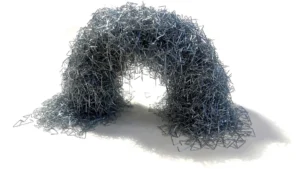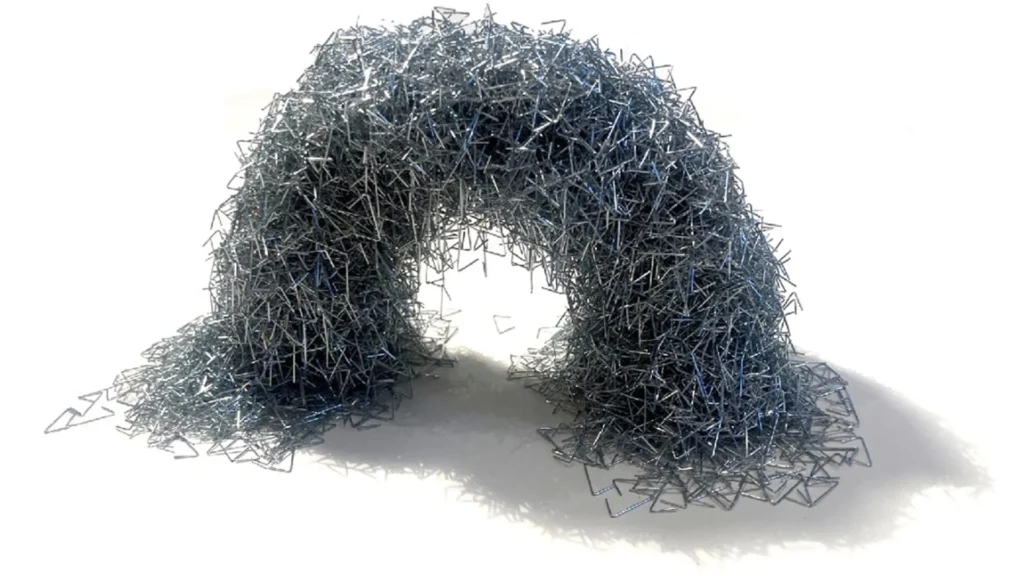
A seemingly mundane office staple, when gathered in a tightly compressed bundle, exhibits a remarkable duality: it can behave with the coherence of a single solid object, resistant to being pulled apart, yet with the right external stimulus, it can rapidly disintegrate into its individual components. This intriguing "staple paradox" has captured the attention of researchers at the Paul M. Rady Department of Mechanical Engineering at CU Boulder, who believe this unusual combination of transient strength and reversibility holds the key to developing a new generation of engineered materials. By meticulously designing particles that mimic the interlocking behavior of staples, their goal is to forge materials that are not only robust and adaptable but also inherently recyclable, addressing some of the most pressing challenges in modern material science and engineering.
The findings, recently published in the prestigious Journal of Applied Physics, detail an innovative approach to material design rooted in the fundamental principles of entanglement. This research marks a significant step forward in the quest for sustainable and versatile materials, offering a glimpse into a future where structures can be assembled, disassembled, and reconfigured with unprecedented ease.
The Entanglement Enigma: Unlocking Nature’s Secrets
At the heart of this groundbreaking research lies the phenomenon of entanglement, a concept familiar throughout the natural world. Entanglement occurs when individual components become intertwined, forming complex, interconnected networks that impart collective strength and stability. Think of a bird’s nest, where a seemingly haphazard collection of twigs and fibers interweaves to create a surprisingly resilient structure capable of withstanding environmental forces. Similarly, the remarkable strength of bones is derived not just from their hard mineral components but also from the intricate entanglement of softer protein fibers within their matrix.
For years, Professor Francois Barthelat, the visionary leader of the Laboratory for Advanced Materials & Bioinspiration at CU Boulder, has been exploring the potential of biomimicry – drawing inspiration from natural designs – to engineer advanced materials. "We’ve been playing around with the idea of building blocks and geometry for many years," Barthelat explained, tracing the lineage of their current work, "but we started looking at interlocking, entangled particles only recently." This pivot towards entangled systems represented a crucial evolution in their research trajectory, spurred by the realization that macroscopic interlocking could offer unique mechanical advantages.
The challenge for the CU Boulder team was to translate these naturally occurring principles into manufactured materials, moving beyond mere observation to active design. Their investigations quickly honed in on one critical, often overlooked, factor: the precise shape of the individual particles themselves.
The Crucial Role of Particle Geometry
Traditional granular materials, such as sand, consist of smooth, convex-shaped particles. As PhD student Youhan Sohn elucidated, "Let’s take sand as an example. Sand is smooth and convex-shaped, meaning it cannot interlock from grain to grain." This lack of interlocking capability is precisely why sand behaves as a fluid-like substance, easily flowing and separating. However, the CU Boulder team hypothesized that by fundamentally altering the geometry of these individual grains, they could drastically modify their collective behavior and mechanical properties, particularly their ability to link with one another.
To test this hypothesis, the researchers employed sophisticated computational techniques, specifically Monte Carlo simulations. This method, widely used in physics and engineering, involves running numerous random simulations to model the behavior of complex systems. In this context, it allowed the team to explore how particles of various shapes would interact, tumble, and potentially entangle under different conditions. The objective was clear: to identify a specific particle geometry that would maximize entanglement, thereby enhancing the material’s structural integrity.
The computational phase was intensive, exploring a vast parameter space of particle geometries, from simple spheres and cubes to more complex, multi-faceted designs. Each simulation provided valuable data on how effectively different shapes resisted separation and formed stable connections. This iterative process of design, simulation, and analysis was instrumental in narrowing down the most promising candidates for physical experimentation.
From Simulation to Reality: The Staple-Shaped Breakthrough
Following the rigorous computational screening, the team moved to the experimental phase, conducting a series of "pickup tests" to observe the real-world behavior of the most promising particle designs. These tests involved creating bundles of these engineered particles and then attempting to lift them or pull them apart, carefully measuring the force required and observing the overall coherence of the mass.
The results were striking and unequivocally pointed to a particular geometry: a "two-legged" particle, remarkably resembling an everyday office staple. This staple-like design consistently produced the highest degree of entanglement among all the tested shapes. The interlocking nature of these two "legs" allowed individual particles to hook into one another, creating a robust, interconnected network that resisted disaggregation.
Beyond just maximizing entanglement, the staple-shaped particles offered several unexpected and highly desirable benefits. One of the most significant was their ability to simultaneously achieve high tensile strength and toughness – two properties that are notoriously difficult to combine in conventional materials. Tensile strength refers to a material’s ability to withstand pulling forces without breaking, while toughness describes its capacity to absorb energy and deform plastically without fracturing. Typically, materials are strong but brittle (like ceramics) or tough but less strong (like rubber). "Our entangled granular material using the staple-like particle demonstrates both high strength and toughness at the same time," affirmed PhD student Saeed Pezeshki, highlighting the unique advantage of their discovery. This combination opens up possibilities for materials that are not only durable but also resilient against impact and fatigue.
The Dance of Assembly and Disassembly: Controlled Reversibility
Perhaps the most revolutionary characteristic of these staple-like particles is their inherent reversibility. The researchers discovered that these materials could rapidly coalesce into a strong, unified structure and then, just as quickly, return to a loose collection of individual pieces. This dynamic capability is controlled through the application of specific vibration patterns.
By carefully tuning the frequency and amplitude of vibrations, the team could dictate the material’s state. Gentle, low-energy vibrations encouraged the particles to settle, interlock, and form a strong, cohesive material. Conversely, stronger, higher-energy vibrations caused the intricate network to unravel, separating the particles and allowing the material to become fluid-like again. This precise control over entanglement and disentanglement is what sets this research apart, offering a level of adaptability previously confined to science fiction.
Professor Barthelat captured the essence of this peculiar state: "It’s a strange material because it’s obviously not a liquid. However, it’s also not quite solid. This opens new and intriguing engineering possibilities. Handling a bundle of these entangled particles feels very remote and exotic." This description evokes the qualities of a reconfigurable, programmable matter, challenging traditional definitions of material phases. The ability to switch between a solid-like, load-bearing state and a loose, flowing state offers an unprecedented degree of control over a material’s macroscopic properties.
Transformative Potential: Construction, Robotics, and Beyond
The implications of this breakthrough are far-reaching, with potential applications poised to revolutionize diverse fields, from sustainable construction to advanced robotics.
In the realm of construction, the technology could herald a paradigm shift towards more sustainable building practices. The global construction industry is a major contributor to waste and carbon emissions, with millions of tons of demolition debris generated annually. Imagine bridges, buildings, or other large infrastructure projects constructed from entangled materials that, at the end of their service life, can be easily vibrated apart rather than demolished. The individual staple-like particles could then be readily reused for new structures or fully recycled, drastically reducing waste and promoting a circular economy. This would move beyond current "design for disassembly" concepts by embedding the disassembly mechanism directly into the material’s fundamental properties. Such an approach could significantly lower the environmental footprint of urban development and infrastructure maintenance, offering a tangible solution to the growing crisis of construction and demolition waste.
Beyond civil engineering, the concept holds immense promise for the rapidly evolving field of robotics. The ability of materials to reconfigure on demand is a holy grail for soft robotics and swarm robotics, where individual robotic units work in concert. Pezeshki elaborated on this vision: "I was talking with other students who believe this technology can be used in swarm robotics – where small robots can entangle, do a task and then disentangle when they are done." This would allow robots to change their collective shape, grip objects with variable compliance, or navigate complex environments by transforming from a rigid structure to a fluid mass.
Professor Barthelat took the analogy a step further, drawing inspiration from popular culture: "Yes, kind of like that liquid metal T-1000 in Terminator 2 who can change shape to slide under a door and then transform back to a human’s size on the other side." While acknowledging the significant challenges of cost and scaling, he affirmed, "It’s expensive and scaling up is a challenge, but it’s something that’s on everybody’s mind." This futuristic vision underscores the transformative potential for adaptive machines that can manipulate their physical form and properties to suit a myriad of tasks, from exploration in hazardous environments to intricate surgical procedures. Other potential applications could include adaptive packaging that changes shape to protect contents, deployable structures for space exploration that can be compactly stored and then expanded, or even temporary biomedical implants that can be safely dissolved or reabsorbed after fulfilling their function.
The Road Ahead: Testing Even Stronger Designs
The CU Boulder team is not resting on its laurels. They are already embarking on the next phase of their research, pushing the boundaries of particle design to achieve even more robust entanglement effects. Their latest experiments focus on a new particle design that incorporates additional protruding "legs," moving beyond the simple two-legged staple. The researchers vividly compare this advanced shape to the tenacious, spiky burrs commonly found clinging to shoes and clothing after an outdoor excursion.
The hypothesis is that these added features, by increasing the number of potential interlocking points and creating a more complex interaction geometry, could significantly enhance the strength and stability of the entangled material. This could unlock new possibilities for future materials with even greater load-bearing capabilities, enhanced resilience, or more precise control over their reversible properties. The iterative process of design, simulation, and experimental validation continues, driven by the ambition to harness the full potential of mechanically interlocking granular materials.
The success of this research underscores the power of interdisciplinary collaboration, combining insights from mechanical engineering, materials science, and biomimicry. As the world grapples with the urgent need for sustainable solutions and advanced technological capabilities, the CU Boulder team’s work offers a compelling blueprint for the materials of tomorrow – materials that are not only strong and adaptable but also inherently designed for a circular economy. The humble office staple, once merely a tool for temporary fastening, has now become an unexpected muse, inspiring a new generation of materials that could fundamentally alter how we build, interact with, and recycle the physical world around us.