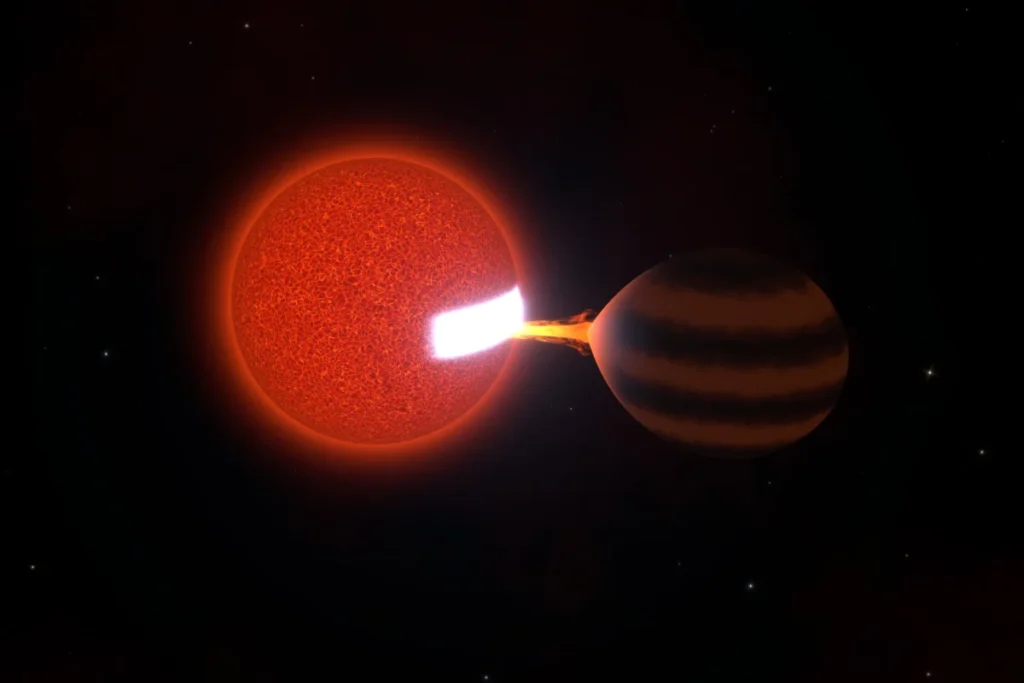
In the vast, clockwork expanse of the Milky Way, the relationship between stars and their orbiting companions is typically defined by a state of detached equilibrium. Most planets and substellar objects maintain stable orbits, circling their host stars at distances that ensure their long-term survival. However, this cosmic harmony is occasionally disrupted when an orbiting body ventures too close to its star’s gravitational well. In these high-stakes encounters, the star often acts as a predator, pulling the planet into its atmosphere and consuming it in a relatively rapid event. While astronomers have witnessed both stable systems and the violent end of engulfed planets, a new discovery by researchers at the Massachusetts Institute of Technology (MIT) has revealed a surprising middle ground: a star that is slowly and steadily "snacking" on a companion over the course of billions of years.
The discovery, centered on a system designated ZTF J0440+2325, represents the first time scientists have observed a low-mass star gradually accreting material from a closely orbiting brown dwarf. Unlike the catastrophic events where a star swallows a planet whole, this system exhibits a measured, long-term cannibalism that challenges previous assumptions about the final stages of binary interactions. The research, published in the journal Nature Astronomy, suggests that this slow-motion consumption could persist for hundreds of thousands, or even billions, of years, providing a new template for understanding how low-mass objects interact in the late stages of their evolution.
The Discovery of ZTF J0440+2325
The system ZTF J0440+2325 is located approximately 300 light-years from Earth within our own galaxy. It was first identified using data from the Zwicky Transient Facility (ZTF), a wide-field sky survey based at the Palomar Observatory in California. The ZTF is designed to detect rapid changes in the night sky, capturing transient events such as supernovae, gamma-ray bursts, and the collisions of neutron stars. By scanning the heavens for fluctuations in brightness, the facility provides a massive repository of "light curves"—graphs that show how an object’s brightness changes over time.
Kevin Burdge, an assistant professor of physics at MIT and the lead researcher on the study, was sifted through this data when he encountered a signal that defied standard classification. While most stellar events produce light curves resembling a bell curve—indicating a gradual brightening followed by a fade—this particular signal manifested as a repeating triangular waveform. The distinct, sharp peaks and troughs suggested a physical process that was both rhythmic and unusual.
Initially, the team suspected the signal might originate from a "black widow binary." In such systems, a highly dense, rapidly spinning neutron star (a pulsar) "preys" upon a companion star, using its intense radiation and gravitational pull to erode the companion. However, further analysis revealed that the ZTF J0440+2325 signal lacked the characteristic "whipping" motion seen in black widow systems. In a typical black widow binary, the massive disparity in weight between the neutron star and its companion causes a visible wobble in the light curve. The signal from ZTF J0440+2325 was far more stable, suggesting a more balanced pair of objects.
Technical Specifications and Orbital Dynamics
To solve the mystery of the triangular light curve, the researchers utilized multiple ground-based telescopes to perform follow-up observations. By measuring the subtle "wobble" or radial velocity of the system, they were able to calculate the masses of the two interacting bodies. The results confirmed that the system was not a high-energy pulsar binary, but rather a pair of low-mass objects.
The host star in the system is relatively small by stellar standards, possessing a mass approximately 85 times that of Jupiter. Its companion is a brown dwarf—a category of celestial objects often referred to as "failed stars" because they are more massive than traditional planets but lack sufficient mass to sustain the hydrogen fusion that powers true stars. This brown dwarf has a mass roughly 25 times that of Jupiter.
Despite their low masses, the two objects are locked in an incredibly tight embrace. The brown dwarf completes a full orbit around the star every 87 minutes. To put this proximity into perspective, the entire orbit of the brown dwarf could fit comfortably within the diameter of our own Sun. It is this extreme closeness that facilitates the transfer of matter between the two bodies.
The Physics of Slow Accretion
In astrophysics, the process of one object pulling material from another is known as accretion. This phenomenon is commonly associated with high-gravity environments, such as the areas surrounding black holes or neutron stars. In those scenarios, the immense gravity pulls gas and dust into an accretion disk, where the material spirals inward and eventually falls into the central object, often releasing massive amounts of X-ray radiation in the process.
However, ZTF J0440+2325 operates on a different physical principle. Because the "predator" in this system is a star rather than a compact point of infinite density like a black hole, the matter does not form a traditional disk. Instead, the gravity of the star pulls a steady stream of material directly from the brown dwarf’s atmosphere. This matter pummels the surface of the star at high velocities, creating a localized "hotspot" or a continuous fireball.
"The matter just pummels directly onto the surface, at very high speeds, like an asteroid hitting the moon," explained Burdge.
The researchers conducted computer simulations to model the behavior of particles within this system. By applying the laws of physics and equations of motion to the known masses and orbital distance, they confirmed that particles from the brown dwarf would indeed fall directly onto the star’s surface. This "fireball" remains fixed on the star, and as the system rotates and the brown dwarf orbits, this hotspot moves in and out of the view of Earth-based telescopes. The triangular shape of the light curve is a direct result of this geometry; the peak of the triangle occurs when the hotspot is facing directly toward the observer.
Quantifying the Cosmic Feast
While the term "cannibalism" suggests a rapid consumption, the rate of accretion in ZTF J0440+2325 is remarkably slow and steady. The MIT team calculated that the brown dwarf is losing approximately one-hundred-thousandth (1/100,000) of an Earth mass every year.
While this sounds like a negligible amount in a cosmic context, the physical scale is staggering. It equates to roughly 40 million dump trucks’ worth of material being stripped away annually. Breaking it down further, the star is consuming approximately 1.3 trillion pounds of matter every second—an amount the researchers humorously compared to 1.3 trillion one-pound burritos.
Despite this massive transfer of mass, the brown dwarf is large enough that it can sustain this loss for an incredible duration. The researchers estimate that the system could remain in this state of "leisurely snacking" for billions of years. This discovery provides a significant alternative to the "swallow-whole" model of stellar evolution. It suggests that many binary systems involving low-mass companions may not end in a sudden collision, but rather in a protracted period of gradual mass transfer.
Broader Implications for Stellar Evolution and Planetary Science
The discovery of ZTF J0440+2325 has profound implications for our understanding of the lifecycle of stars and their companions. For decades, the primary model for the end of a planetary system involved the expansion of the host star into a red giant, followed by the rapid engulfment of nearby planets. This is the predicted fate of Earth when the Sun exhausts its hydrogen fuel in approximately five billion years.
However, the MIT study demonstrates that gravity can facilitate a "third way"—a stable, long-term feeding process that allows a star to survive alongside its companion while slowly absorbing it. This "slow accretion" model may be more common in the universe than previously realized, particularly in systems where both objects have low masses.
The research also sheds light on the nature of brown dwarfs. Often considered the "missing link" between the largest planets and the smallest stars, brown dwarfs are notoriously difficult to study because they are relatively dim. By observing one in the process of being accreted, scientists can gain rare insights into its atmospheric composition and structural integrity.
Future Research and the Search for Similar Systems
The identification of ZTF J0440+2325 has prompted a new wave of searches for similar systems. Aaron Householder, a graduate student in MIT’s Department of Earth, Atmospheric and Planetary Sciences and a co-author of the study, noted that the "triangle" light curve is now a recognized signature for this type of interaction.
"It’s inspiring a lot of new searches on our part," Householder said. "I think we’re going to learn a lot about a different kind of way that planets and brown dwarfs interact with their host stars."
The research team, which included collaborators from Caltech, the University of Hawaii, the Harvard and Smithsonian Center for Astrophysics, and several Spanish institutions, plans to utilize next-generation telescopes to look for more triangular waveforms in galactic surveys. If more of these systems are found, it could lead to a new classification of binary systems—those defined not by stability or destruction, but by a billion-year-long transition.
The study was supported in part by the National Science Foundation, underscoring the importance of long-term sky surveys like the ZTF in uncovering the subtle and unexpected behaviors of the cosmos. As astronomers continue to refine their ability to detect rapid changes in stellar brightness, the "weird triangle" of ZTF J0440+2325 may prove to be just the first of many discoveries revealing the complex, slow-motion drama of stellar cannibalism.