Researchers at the Massachusetts Institute of Technology (MIT) have developed a groundbreaking system, dubbed ShiftLens, that allows for the creation of interactive objects with mechanically switchable surface appearances, eliminating the need for fragile electronic components. This innovative platform promises to revolutionize the fabrication of a wide array of objects, from robust warning signs capable of withstanding harsh environmental conditions to sophisticated packaging that can dynamically alert users to potential issues during transit. The end-to-end system is poised to significantly streamline the rapid prototyping process for adaptable objects across diverse fields including art, architecture, and engineering.
The core innovation of ShiftLens lies in its ability to imbue objects with interactive capabilities through purely mechanical means. "With our system, an object can tell you whether you are using it properly, without the need for sensors or any complicated electronics," explained Yunyi Zhu, a graduate student in the MIT Department of Electrical Engineering and Computer Science (EECS) and the lead author of the paper detailing this platform. "The interactive display is mechanical, so you can create a self-contained, multistate, interactive device that a user can control very intuitively." This approach bypasses the inherent vulnerabilities of electronic circuits when exposed to water, extreme temperatures, or physical stress, opening up new possibilities for durable and responsive designs.
The research team behind ShiftLens comprises a multidisciplinary group of academics. In addition to Zhu, co-authors include Dingning Cao, an MIT undergraduate; Jeremy Mrzyglocki, a graduate student at the Technical University of Munich; Stefanie Mueller, an associate professor in EECS and the Department of Mechanical Engineering at MIT and a member of the Computer Science and Artificial Intelligence Laboratory (CSAIL); and Narjes Pourjafarian, a postdoctoral researcher at Northeastern University. Their findings are scheduled for presentation at the prestigious ACM Symposium on User Interface Software and Technology, a key event for advancements in human-computer interaction.
Mechanically Switchable Surfaces: A New Paradigm in Object Interactivity
The development of ShiftLens addresses a significant limitation in current interactive product design. Many contemporary interactive products rely heavily on embedded screens and complex electronic circuits to alter their appearance or convey information. While effective in many indoor applications, these fragile components are susceptible to damage when exposed to the elements, harsh chemicals, or significant physical impact such as being squished or twisted. This fragility restricts their use in demanding environments or for applications where durability is paramount.
Conversely, existing methods that aim to change an object’s appearance without electronics often utilize static optical techniques. These typically involve static labels, stickers, or specially shaped lenses that create different visual effects based on the user’s viewing angle. While these methods can offer some visual dynamism, their interactivity is fundamentally limited, often providing a single or a few fixed visual states rather than a truly adaptable and responsive interface.
The MIT researchers’ ShiftLens system offers a novel solution by enabling the creation of dynamic, interactive objects that are inherently robust and do not require any electronics. The system’s ingenious design automatically translates a user’s conceptual design into a 3D printer-ready model of an object featuring a mechanically switchable surface. This process bypasses the need for intricate electronic design and fabrication, making interactive object creation more accessible and versatile.
The ShiftLens technology operates by layering two distinct optical components on an object’s surface. The first layer is an array of tiny lenticular lenses. These are precisely curved lenses designed to steer light in different directions depending on the viewer’s angle. Beneath this lens layer lies a patterned backplane. This backplane contains strips of images, each corresponding to a different visual state the object’s surface can display.
The magic of ShiftLens lies in the controlled motion between these two layers. When the user shifts the lens layer relative to the patterned backplane, different sections of the underlying images become visible through the lenses. The curvature of the lenticular lenses then magnifies these visible sections, effectively altering the perceived appearance of the object’s surface. This mechanical manipulation of light and image creates a seamless transition between different visual states, offering a tangible and intuitive form of interactivity.
"The biggest challenge in this project was to make sure all moving parts align," stated Zhu. "We need to make sure that the optical effect, mechanical linkages, and computational graphics align with one another." Achieving this precise alignment was critical to ensuring that the visual transitions were smooth, predictable, and visually appealing, transforming a complex optical and mechanical problem into a user-friendly design tool.
A Streamlined Design and Fabrication Process
To democratize the creation of these mechanically interactive objects, the researchers have developed a user-friendly tool that handles the complex design process behind the scenes. This software automatically generates the necessary ShiftLens structure based on a few key inputs from the user. These inputs include images representing the desired visual states of the object’s surface and the specific shape and curves of the object itself.
"Another challenge is to communicate to users who are not familiar with optics or mechanical structures and let them specify and achieve what they have in mind," Zhu commented on the user experience aspect. The design tool is therefore meticulously crafted to abstract away much of the underlying complexity, allowing individuals with diverse backgrounds to conceptualize and realize their interactive designs.
The team has also paid close attention to clearly communicating the limitations of the ShiftLens design tool to its users. For instance, ShiftLens is not universally applicable to all object designs. Its core functionality relies on a relative shifting motion between the lens and backplane layers to enable interaction. Therefore, users must either incorporate this shifting motion directly into the object’s inherent design, such as the rotational mechanism of a lipstick tube, or integrate an external actuation mechanism. These actuation mechanisms can take various forms, including simple switches, knobs, or rollers, providing users with flexible options for controlling the interactive elements.
"With ShiftLens, users can control what an object looks like while they are using it," Zhu emphasized, highlighting the direct and immediate nature of the interaction. This capability allows for objects to provide real-time feedback or adapt their appearance based on user input or environmental cues, all without a single line of code or an electronic component.
Demonstrating Versatility: From Chemical Safety to Playful Interaction
To showcase the practical applications and versatility of the ShiftLens system, the researchers fabricated a range of innovative interactive objects. These demonstrations vividly illustrated the potential for this technology across various domains.
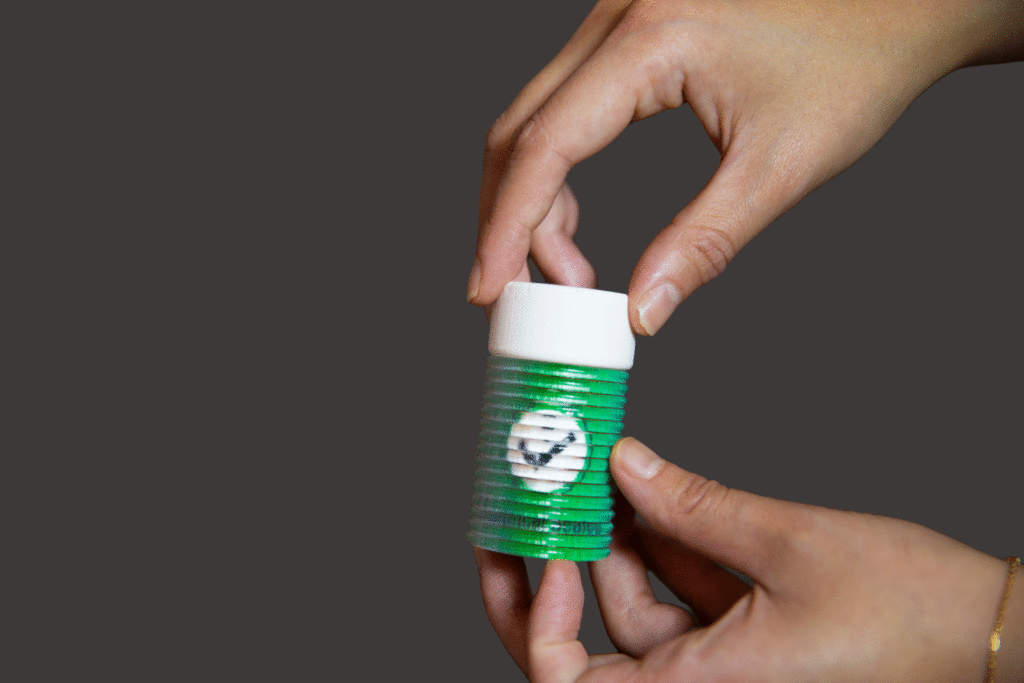
One compelling example was a chemical bottle designed for enhanced safety. This bottle visually signals its status: when the cap is securely tightened, the bottle’s surface turns green and displays a check mark. However, if the cap is found to be loose, the surface transitions to red and displays an exclamation mark. This immediate, at-a-glance warning system could significantly improve safety protocols in laboratories and industrial settings, preventing accidental spills or exposures.
Another engaging demonstration was a tic-tac-toe game. In this implementation, each square on the game board could dynamically display a red ‘X’, a blue ‘O’, or remain blank. The state of each square could be changed by a user turning a small knob associated with it, allowing for an intuitive and tactile gameplay experience. This showcases how ShiftLens can bring interactive elements to traditional games and toys, enhancing engagement and playability.
Beyond these specific examples, the researchers believe that the principles behind ShiftLens have far-reaching implications. While the current ShiftLens tool is optimized for makers and rapid prototyping, the underlying techniques are scalable for commercial and industrial applications. For instance, the technology could be applied to design piping systems where sections can change their appearance to indicate a damaged connection that is leading to a leak. Zhu quipped, "The leaking sink in my apartment would be a lot easier to fix if it could tell me where the leak was coming from," underscoring the practical problem-solving potential of such self-indicating systems.
The implications for manufacturing and product design are substantial. Industries that require durable, interactive elements in challenging environments – such as aerospace, automotive, outdoor signage, and medical devices – stand to benefit immensely. The ability to create self-reporting or self-adjusting components without the risk of electronic failure in extreme conditions represents a significant leap forward. Furthermore, the reduced reliance on complex electronics could lead to lower manufacturing costs and increased product longevity.
Future Directions and Broader Impact
The research team is already looking ahead to the next phases of development for ShiftLens. Future work will focus on exploring a wider array of potential applications, pushing the boundaries of what is possible with mechanically interactive surfaces. A key area of development will be the enhancement of the design algorithm. The researchers plan to develop a more sophisticated algorithm capable of generating ShiftLens structures with even fewer user inputs, further simplifying the design process and making it accessible to an even broader audience.
Additionally, the team aims to expand the capabilities of the design tool by enabling users to incorporate a wider variety of actuation mechanisms. This will provide greater flexibility in how users control the interactive elements of their designed objects, leading to more nuanced and sophisticated interactive experiences.
The development of ShiftLens by MIT researchers marks a significant advancement in the field of tangible and interactive computing. By decoupling interactivity from fragile electronics and leveraging mechanical principles, this system offers a robust, intuitive, and accessible pathway to creating a new generation of responsive objects. As the technology matures and its applications expand, ShiftLens has the potential to reshape how we interact with the physical world, making everyday objects more informative, adaptable, and engaging. The presentation at the ACM Symposium on User Interface Software and Technology is expected to generate considerable interest from both academic and industry professionals, potentially accelerating the adoption of this transformative technology.