Petoi’s entry-level pet robots have captivated enthusiasts and educators alike since the debut of the plywood Nybble, which famously adorned the cover of Make: Volume 70. Building on this legacy, the more recent Bittle X and Nybble Q have earned acclaim as remarkably charming and interactive robotic companions. Now, Petoi has unveiled its latest innovation, Quaddle, a sophisticated yet highly accessible model designed to lower the barrier to entry for aspiring roboticists and casual users alike. This new iteration promises enhanced intelligence, greater durability, and a more intuitive user experience, solidifying Petoi’s commitment to making advanced robotics available to a broader audience.
The Evolution of Petoi Robotics: A Journey Towards Accessibility
Petoi, founded by Dr. Rongzhong Li, has carved a unique niche in the burgeoning field of consumer and educational robotics. The company’s philosophy centers on open-source principles, empowering users to understand, modify, and expand the capabilities of their robotic pets. This approach has fostered a vibrant global community of makers, educators, and hobbyists who share code, designs, and innovations.
The journey began with Nybble, a quadruped robot that could be assembled from laser-cut plywood. Its charm lay not only in its cat-like movements but also in its transparency—users could see every servo, wire, and circuit board, making the learning process inherently engaging. Nybble’s success was a testament to the demand for accessible STEM tools that blend playful interaction with serious educational potential.
Following Nybble, Petoi introduced the Bittle X and Nybble Q, refining the original designs with more robust components and enhanced capabilities. These models transitioned to injection-molded plastic bodies, improving durability and assembly ease while retaining the core open-source ethos. They offered more sophisticated movements, better battery life, and a more polished aesthetic, appealing to a wider demographic including younger learners and those seeking a more ready-to-use experience. The Bittle X, resembling a dog, and the Nybble Q, a cat, became popular choices for introducing fundamental concepts in robotics, programming, and mechanics. Their modular design allowed for easy upgrades and customization, further deepening user engagement.
Quaddle: A Leap Forward in Design and Engineering
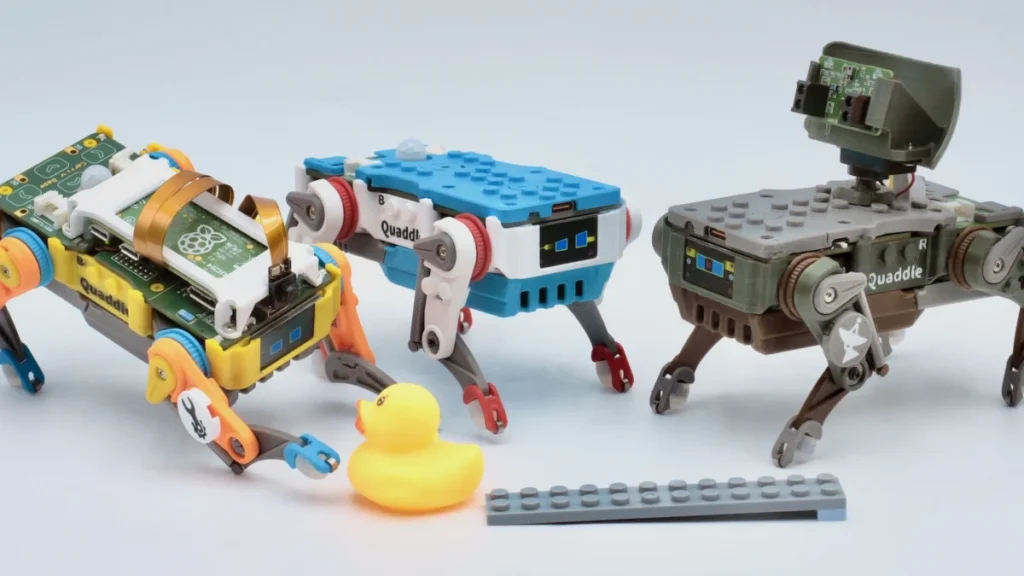
Quaddle represents a significant evolutionary step for Petoi, consolidating years of research, community feedback, and engineering breakthroughs into a single, cohesive platform. It is being launched in three distinct versions—Builder, Buddy, and Scout—each tailored to different levels of user engagement and technical proficiency. This tiered approach ensures that whether a user is a complete novice or an experienced maker, there is a Quaddle model that fits their needs.
One of Quaddle’s most striking innovations is the replacement of the traditional plastic face with an integrated OLED screen. This seemingly minor change has profound implications for user interaction and diagnostic feedback. The OLED screen is capable of displaying a wide range of nuanced expressions, allowing Quaddle to convey emotions and react to its environment in a more sophisticated and endearing manner. Beyond aesthetics, the screen also serves a crucial functional purpose, providing important diagnostic data and operational status updates directly on the robot itself, eliminating the need for an external display or constant connection to a computer for basic troubleshooting.

Furthermore, the sensors, which in previous models were often housed on individual, bone-shaped circuit boards, have now been seamlessly integrated into the robot’s main structure. This integration simplifies assembly, reduces potential points of failure, and streamlines the robot’s overall design, contributing to Quaddle’s enhanced durability and accessibility. The goal, as articulated by Petoi, is to position Quaddle as the definitive entry-point robot for anyone venturing into the dynamic and rewarding world of walking robotics.
The Genesis of Quaddle: A Journey in Engineering and Dedication
The advancements seen in Quaddle did not materialize overnight. They are the culmination of an arduous and dedicated engineering effort, particularly focused on addressing two critical aspects: cost reduction and mechanical simplification without compromising performance. A pivotal decision in Quaddle’s development was the reduction of servos from two per leg to a single servo per leg. This is a radical departure from conventional quadruped robot designs, which typically rely on multiple actuators per limb to achieve complex movements.
To compensate for the reduced number of servos, Dr. Rongzhong Li and his team engineered an ingenious leg mechanism that leverages a combination of springs and clever mechanical linkages. This innovative design allows Quaddle to perform a surprisingly wide array of movements, including walking and even backflips, with fewer active components. The inherent simplicity of this mechanism not only reduces manufacturing costs but also significantly enhances the robot’s durability by minimizing the number of moving parts prone to wear and tear.
The commitment to this vision was profound. Dr. Li reportedly spent two years living at the servo factory, a testament to his dedication to the project. This immersive approach allowed him to work hand-in-hand with manufacturing engineers, developing the robot’s mechanics and the custom servos in parallel. Such close collaboration is rare in product development and was instrumental in iterating rapidly, optimizing designs, and achieving the delicate balance between performance, durability, and affordability. After countless iterations and rigorous testing, the result is a robot that is more robust and significantly more cost-effective than its predecessors, making advanced robotics truly accessible to a mass market.
Open-Source Advantage: The Power of OpenCat Software
At the heart of Quaddle’s intelligence and adaptability lies the OpenCat software framework. OpenCat is an open-source platform that powers all Petoi robots, enabling a high degree of customization and community collaboration. This software architecture allows users to program new behaviors, modify existing ones, and share their creations with a global network of Petoi robot owners. The open-source nature of OpenCat is a cornerstone of Petoi’s educational mission, fostering a collaborative environment where users can learn from each other, contribute to the platform’s evolution, and truly understand the underlying code that drives their robotic companions.
The shared codebase means that behaviors developed for previous Petoi robots can often be adapted for Quaddle, and vice-versa, creating a rich ecosystem of pre-existing movements and functionalities. This interoperability significantly reduces the learning curve for new users, as they can tap into a vast repository of community-contributed content. For educators, OpenCat provides an invaluable tool for teaching programming concepts, inverse kinematics, artificial intelligence, and embedded systems in a hands-on, engaging manner. The transparency of the code allows students to delve into the intricacies of robotic control, from low-level motor commands to high-level behavioral algorithms.

Enhanced User Experience and Accessibility Features
Quaddle introduces several new features aimed at enhancing user experience and further democratizing robotic programming. During a recent demonstration, the built-in object-tracking behavior was showcased, illustrating Quaddle’s ability to autonomously follow designated objects, a foundational capability for many advanced robotic applications. A novel "sliding trick" also demonstrated the robot’s agility and the expressive potential of its simplified mechanics.
Crucially, Quaddle empowers users to record new motions and calibrate its servos without requiring a computer. This feature is a game-changer for accessibility, allowing users to intuitively teach the robot new movements by physically manipulating its limbs and saving those positions. The ability to calibrate servos directly on the device streamlines the setup process and enables quick adjustments in the field, making Quaddle more autonomous and user-friendly, particularly for younger users or those without immediate access to a computer. While early firmware versions, as noted during initial testing with pre-production samples, required some finessing to trigger certain demo behaviors, Petoi has since implemented significant updates, adding new features and polish to the software, ensuring a smoother and more reliable user experience for the final product.
Market Positioning and Broader Implications
Quaddle’s launch positions Petoi strategically within the growing market for educational and consumer robotics. By focusing on affordability, durability, and ease of use, Petoi directly addresses some of the primary barriers to widespread robotics adoption. The tiered product offering—Builder, Buddy, and Scout—caters to a diverse audience, from those who enjoy the assembly process (Builder) to those seeking a ready-to-go interactive pet (Buddy) or an advanced platform for experimentation (Scout).
The emphasis on an integrated OLED screen and simplified sensor architecture reduces complexity for beginners while still offering robust functionality for advanced users. This dual appeal is crucial for a product aiming to bridge the gap between hobbyist electronics and sophisticated robotics research. The significantly reduced cost, achieved through innovative mechanical design and efficient manufacturing, means that Quaddle can reach educational institutions, after-school programs, and individual learners who might otherwise be deterred by the prohibitive expense of more complex robotic systems.
Crowdfunding and Community Engagement: A Strategic Launch
Petoi is leveraging the power of crowdfunding through a Kickstarter campaign to bring Quaddle to market. This approach not only provides essential funding for production and scaling but also reinforces Petoi’s commitment to its community-driven ethos. Crowdfunding allows early adopters and loyal customers to become stakeholders in the product’s success, fostering a strong sense of ownership and engagement. The campaign typically offers various tiers, allowing backers to pre-order different versions of Quaddle at discounted prices, often with exclusive early access or bundled accessories.

Beyond the online campaign, Petoi is actively engaging with the maker community through physical events. Quaddle is scheduled to be showcased at prominent events such as Maker Faire Bay Area and Maker Faire Shenzhen. These appearances are vital for generating hands-on interest, gathering direct feedback from potential users, and demonstrating the robot’s capabilities in a dynamic, interactive setting. Maker Faires are incubators for innovation and creativity, providing the perfect platform for Quaddle to connect with its target audience of makers, educators, and tech enthusiasts.
Impact on STEM Education and the Maker Movement
Quaddle’s design and open-source nature hold significant implications for STEM (Science, Technology, Engineering, and Mathematics) education. Its accessibility and programmability make it an ideal tool for teaching fundamental concepts in robotics, coding, mechanics, and artificial intelligence to students of all ages. The ability to physically interact with a robot that responds to code makes abstract programming concepts tangible and exciting. The reduction in complexity and cost means that Quaddle can be integrated into school curricula, robotics clubs, and home learning environments more readily than many higher-end platforms.
For the broader maker movement, Quaddle embodies the spirit of open innovation. By providing an open-source hardware and software platform, Petoi empowers makers to not just use the robot, but to improve it, customize it, and invent new applications for it. This fosters a culture of experimentation and problem-solving, driving continuous innovation from the ground up. The shared behaviors and community support available through the OpenCat platform mean that makers are never alone in their endeavors, benefiting from collective knowledge and collaborative development.
The Future of Consumer Robotics
The launch of Quaddle signals a significant step in the evolution of consumer robotics. As artificial intelligence and mechanical engineering continue to advance, the distinction between sophisticated research robots and accessible consumer products is blurring. Quaddle, with its blend of advanced capabilities and user-friendly design, represents a vanguard in this trend. It demonstrates that complex robotic behaviors can be achieved with simplified mechanics and at an affordable price point, paving the way for more widespread adoption of robots in homes, classrooms, and creative workshops.
The ongoing development of features like object tracking, intuitive motion recording, and direct calibration points towards a future where robots are not just programmed but intuitively taught and customized by their users. This shift will make robotics less about intricate coding and more about creative interaction and personal expression. As the ecosystem around OpenCat and Petoi’s hardware continues to grow, it is plausible that we will see an explosion of new applications and modifications, further cementing Quaddle’s role as a catalyst for innovation in personal robotics.
In conclusion, Petoi’s Quaddle is more than just a new robotic pet; it is a meticulously engineered platform designed to democratize access to robotics. By prioritizing affordability, durability, and an open-source philosophy, Petoi is not merely selling a product, but fostering a global community of innovators. With its intelligent design, expressive OLED screen, simplified mechanics, and robust software, Quaddle is poised to become the definitive gateway for anyone eager to explore, learn, and create within the fascinating realm of walking robotics.