Dozens of surgical procedures, ranging from critical triple heart bypass operations to routine C-sections and intricate repairs of hernias and tendons, fundamentally rely on the delicate and precise connection of two pieces of biological tissue. This intricate process, traditionally performed through meticulous stitching or stapling, demands exceptional skill from surgeons, whether operating manually or utilizing advanced surgeon-controlled robotic systems. The margin for error in these procedures is infinitesimally small; even minor imperfections in suturing or stapling can lead to catastrophic consequences for patients, including leaks that can result in severe infections, prolonged hospital stays, re-operations, and even mortality. This inherent challenge in tissue approximation has long been a significant concern within the medical community, driving a continuous quest for safer, more efficient, and less invasive alternatives.
Into this demanding landscape steps SanaHeal, an innovative startup born from research at the Massachusetts Institute of Technology (MIT), with a revolutionary approach inspired by the robust adhesive properties found in nature. The company has engineered a sophisticated bioadhesive technology designed to simplify surgical procedures by making tissue connection akin to using a piece of tape. This proprietary adhesive can rapidly bond to wet and uneven biological surfaces, forming air- and fluid-tight seals that promise to significantly reduce the risks associated with traditional methods. By emulating the unparalleled sticking power of natural wonders like barnacles and the intricate structural integrity of spider webs, SanaHeal aims to redefine the standard of care in surgical tissue repair, offering a solution that is both highly effective and remarkably user-friendly.
The Persistent Challenge of Surgical Tissue Connection
For centuries, surgical repair has depended on the ability to physically join tissues. From the earliest use of natural fibers to modern synthetic sutures and surgical staples, the core principle has remained the same: mechanical approximation. While these methods have evolved significantly, they inherently involve piercing or clamping tissues, which can introduce several complications. Sutures, though versatile, require significant manual dexterity and can be time-consuming. Each stitch creates a micro-trauma, potentially leading to inflammation, scar tissue formation, and, in some cases, the creation of channels for microbial entry, increasing the risk of infection. Furthermore, the tension applied by sutures must be carefully balanced; too much tension can cause tissue ischemia and necrosis, while too little can result in dehiscence, where the wound edges separate.
Surgical staplers offer speed and consistency, particularly in procedures involving long incisions or internal anastomoses (connections between tubular structures like intestines). However, staples also involve tissue penetration and can cause their own set of issues, including localized tissue damage, bleeding from staple lines, and the potential for an adverse reaction to the metallic or absorbable materials. The most critical complication across both suturing and stapling is anastomotic leakage, especially in gastrointestinal surgeries. Studies indicate that anastomotic leakage rates can range from 3% to 10% in colorectal surgeries, often leading to sepsis, multi-organ failure, and a significantly increased risk of mortality. Beyond the immediate threat to life, leaks necessitate prolonged hospital stays, additional surgeries, and substantial healthcare costs. The average cost of managing an anastomotic leak can run into tens of thousands of dollars per patient, placing immense strain on healthcare systems globally. These challenges underscore the urgent need for innovations that can provide more reliable, less traumatic, and more efficient methods of tissue approximation.
SanaHeal’s Bioadhesive Breakthrough: Nature-Inspired Innovation
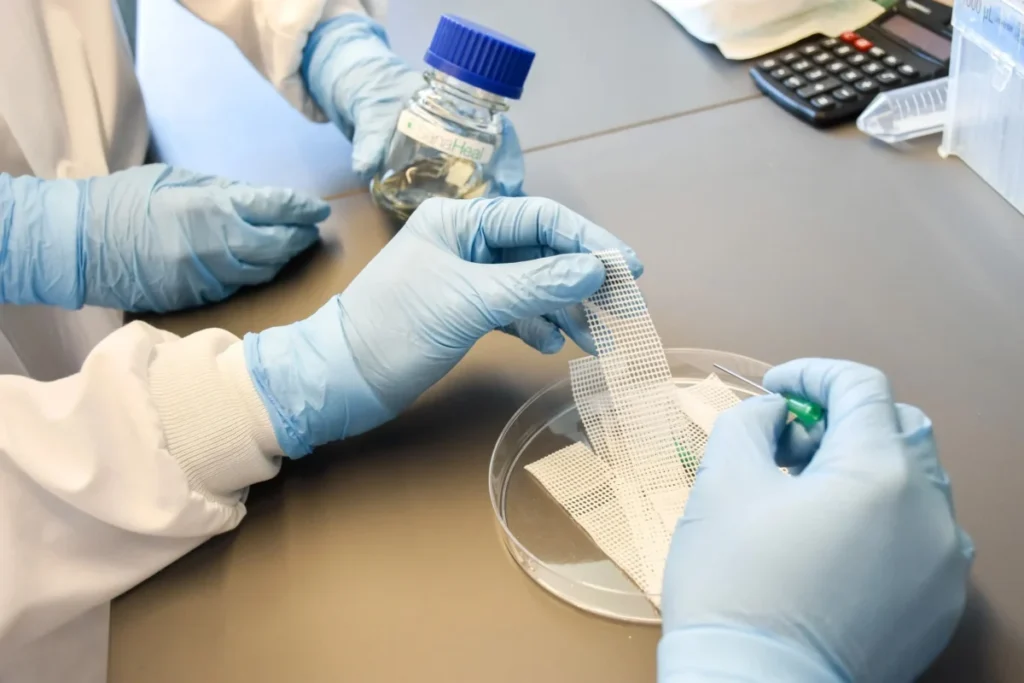
SanaHeal’s bioadhesive technology represents a paradigm shift from mechanical joining to biological adhesion. At its core, the innovation is a biocompatible hydrogel, a material composed of polymers and water, designed to interact seamlessly with biological environments. Unlike conventional glues that struggle with wet, irregular surfaces, SanaHeal’s product excels precisely where traditional adhesives fail. Its ability to rapidly stick to wet and uneven tissues and form robust, air- and fluid-tight seals within seconds is a testament to its sophisticated design.
The inspiration for this breakthrough directly stems from observing how organisms in nature achieve powerful adhesion. Barnacles, for instance, produce a strong, waterproof adhesive that allows them to cling tenaciously to rocks and ship hulls in dynamic marine environments. Spider webs, while seemingly delicate, exhibit remarkable adhesive strength and elasticity, capable of capturing prey without losing integrity. By dissecting the principles behind these natural phenomena, SanaHeal’s researchers, particularly founder Hyunwoo Yuk, were able to engineer a synthetic material that mimics these properties. Early versions of the technology acted much like a double-sided tape, incorporating polyacrylic acid—a super-absorbent material commonly found in diapers—to quickly absorb excess water from wet tissues. This rapid desiccation at the interface facilitates strong and immediate adhesion, a critical feature in a surgical setting where time is of the essence. The result is an adhesive that offers numerous advantages: it is less invasive, causes minimal tissue damage, significantly reduces the potential for inflammation and scar tissue formation, and is intrinsically biocompatible, minimizing adverse immune responses. Moreover, its tape-like application promises faster surgical procedures and enhanced compatibility with advanced surgical robots, which can maneuver and apply the adhesive with unprecedented precision in confined spaces.
The Genesis at MIT: A Journey from Lab to Clinic
The journey of SanaHeal’s transformative technology began in the hallowed halls of MIT, specifically within the laboratory of Xuanhe Zhao, the Uncas (1923) and Helen Whitaker Professor of Mechanical Engineering. It was here that Hyunwoo Yuk, then a master’s and later a PhD student, immersed himself in the study of soft materials, particularly hydrogels. Initially, Yuk’s research focused on the fundamental mechanical properties of these fascinating materials, exploring their elasticity, strength, and durability. However, a significant personal event—a serious accident involving a family member—catalyzed a pivotal shift in his academic trajectory. This experience underscored the critical importance of translating scientific discoveries into tangible solutions that could directly impact patient care.
Motivated by this personal imperative, Yuk pivoted his research towards the biomedical applications of hydrogels, specifically exploring their potential as advanced adhesives. Collaborating with medical professionals and institutions in the vibrant Boston medical ecosystem, he engaged in extensive discussions with surgeons. These conversations revealed a pervasive and unmet need: the frequent challenge surgeons faced in reliably sealing or attaching biological tissues without causing additional trauma or complications. He learned firsthand about the difficulties of microsurgery, where surgeons often employ needles thinner than a human hair to repair tiny tissues, procedures fraught with the risk of complications. Yuk realized that his hydrogel research offered a superior solution to the limitations of traditional sutures and staples. The biocompatibility of hydrogels, combined with their ability to adhere strongly to wet surfaces, presented a clear path to minimizing immune responses, reducing scar tissue buildup, and preventing the devastating leaks that plagued existing methods.
Yuk initially harbored plans to remain in academia after completing his PhD. However, as he delved deeper into the complex process required to bring such a groundbreaking technology to patients, he recognized that a different path was necessary. "It’s very difficult for innovations to make it into the clinic and help patients if you’re in an academic research lab," Yuk articulated. The sheer scale of regulatory hurdles, clinical trials, and commercialization strategies proved too daunting for a purely academic setting. Recognizing that potential industry partners were reluctant to assume the substantial risks associated with early-stage technologies, Yuk and his collaborators decided to take on the challenge of commercialization themselves.
They leveraged the invaluable resources available at MIT, including the Deshpande Center for Technological Innovation, which provides crucial seed funding for promising ventures, the Venture Mentoring Service, offering guidance from experienced entrepreneurs, and MIT’s Technology Licensing Office, which facilitated the intellectual property transfer. With initial funding secured from the Deshpande Center, SanaHeal was officially incorporated in 2021. The initial focus was on applying their technology to stop bleeding in trauma wounds, a critical and immediate need. However, through further market analysis and engagement with the medical community, they quickly shifted their primary focus to the even broader and more numerous applications within surgical procedures, recognizing it as a "major unmet need" with immense potential for impact.
Regulatory Milestones and Clinical Trajectory
SanaHeal’s journey from laboratory concept to clinical reality has been marked by significant progress on the regulatory front. The company has already achieved a crucial milestone: regulatory approval for its bioadhesive technology to stop trauma bleeding. This initial approval underscores the safety and efficacy of the material in a demanding acute care setting, paving the way for its broader application. Building on this success, SanaHeal is poised to embark on human trials next year, focusing on two critical areas: controlling bleeding during complex surgical procedures and facilitating the repair of various injured tissues. These trials will be instrumental in demonstrating the technology’s effectiveness and safety in a wider range of surgical contexts, including internal applications where the stakes are highest.
The startup adopts a strategic "platform company" model, acknowledging the vast potential of its technology and the practical limitations of developing every application internally. Hyunwoo Yuk explains, "We don’t have the resources to develop 10 products at once, so we partner with bigger companies to commercialize solutions." This collaborative approach allows SanaHeal to provide its core technology to established medical device partners who possess the extensive resources, regulatory expertise, and market access necessary to develop and commercialize a diverse portfolio of products. These partnerships are exploring a wide array of applications, including use in open surgeries, minimally invasive laparoscopic procedures, and highly specialized endoscopic interventions. The technology is also being integrated with existing medical devices for innovative sutureless implantation techniques, such as in hernia and nerve repairs, where traditional methods can be particularly challenging and prone to complications. This collaborative ecosystem is crucial for accelerating the adoption and widespread impact of SanaHeal’s innovation across the global healthcare landscape.
Broader Implications for Healthcare and Surgical Practice
The potential implications of SanaHeal’s bioadhesive technology extend far beyond individual surgical procedures, promising to reshape healthcare paradigms in several fundamental ways. The most immediate and profound impact will be on patient safety. By creating reliable, fluid-tight seals, the technology is expected to significantly reduce the incidence of post-operative complications such as anastomotic leaks, infections, and excessive bleeding. This, in turn, translates to fewer re-operations, shorter hospital stays, less pain, and a faster, smoother recovery for patients. Improved patient outcomes directly contribute to enhanced quality of life and reduced long-term morbidity.
From a surgical efficiency perspective, the "tape-like" application of SanaHeal’s adhesive offers substantial benefits. Faster tissue approximation means shorter operating times, which can lead to increased surgical throughput, allowing more patients to receive necessary care. Shorter procedures also reduce patient exposure to anesthesia and the overall stress on the body, further improving recovery trajectories. This efficiency gain is particularly valuable in a global healthcare system increasingly grappling with surgical backlogs and resource constraints.
Economically, SanaHeal’s innovation has the potential to significantly address the "ever-increasing costs of surgeries" that place a substantial strain on health care systems worldwide. By reducing complications, re-admissions, and the need for subsequent interventions, the technology can lead to considerable cost savings. For example, preventing a single anastomotic leak, which can cost tens of thousands of dollars to manage, represents a substantial financial benefit. The global surgical sealants and adhesives market is projected to reach over $10 billion by the end of the decade, driven by rising surgical volumes, an aging population, and the demand for advanced, minimally invasive solutions. SanaHeal is strategically positioned to capture a significant share of this expanding market by offering a superior and versatile platform technology.
Furthermore, the technology’s compatibility with advanced robotic surgery platforms is a crucial advantage. Robotic systems excel at precision and maneuverability in confined spaces, but traditional suturing with robotic instruments can still be time-consuming. A rapid, adhesive solution can unlock new levels of efficiency and precision for robotic-assisted procedures, making complex surgeries even less invasive and more accessible. This synergy could accelerate the adoption of robotic surgery for a wider range of indications.
Looking further ahead, SanaHeal’s bioadhesive could play a transformative role in regenerative medicine and advanced tissue engineering. Its ability to bond to biological tissues without causing trauma makes it an ideal candidate for attaching delicate tissue grafts, scaffolds, or even organs during transplantation, potentially improving integration and reducing rejection risks. The non-invasive nature and biocompatibility of the hydrogel are critical factors in these cutting-edge applications, promising to unlock new possibilities for repairing and replacing damaged tissues.
Expert Perspectives and Vision
Hyunwoo Yuk’s vision for SanaHeal is deeply rooted in his personal experience and scientific passion. His "Post-it note" analogy perfectly encapsulates the desired ease of use and efficacy, contrasting sharply with the arduous and precise nature of traditional suturing. "The current way of doing this is by suturing through tissues, which is painful and difficult to do perfectly during surgery. Our solution is more like a Post-it note. It’s much less invasive and easier to use with surgical robots. Also, faster and more efficient surgical procedures have potential to help lower ever-increasing costs of surgeries that are significantly straining the health care system," Yuk emphasizes. This highlights not only the technical superiority but also the profound humanitarian and economic benefits.
The medical community, particularly surgeons, has shown considerable excitement about the potential of this technology. While specific quotes from external surgeons are not provided, the sentiment can be inferred: a technology that simplifies intricate tasks, reduces complications, and shortens operating times would be universally welcomed. A hypothetical leading surgeon might remark, "This bioadhesive represents a true leap forward. It addresses fundamental challenges we face daily, offering a tool that could significantly improve patient outcomes and free us to focus on other critical aspects of complex procedures." Similarly, an MIT representative would likely laud SanaHeal as a prime example of the institution’s commitment to translating groundbreaking research into real-world impact. "SanaHeal embodies the spirit of innovation at MIT, demonstrating how fundamental scientific inquiry can evolve into practical solutions that address pressing global health challenges," such a representative might state.
For Hyunwoo Yuk, who has dedicated nearly a decade to this technology, the commercialization journey, while longer than anticipated, is driven by a profound sense of purpose. "My life goal as a researcher is to see the full lifecycle of a new technology, from the scientific discovery, to research, to understanding how it works, to engineering it, to working with subject matter experts, and finally developing a product that gets approved to help humans," Yuk passionately explains. This aspiration to witness the complete translation of scientific discovery into tangible patient benefit is a rare but incredibly rewarding endeavor. The success of SanaHeal would not only validate years of dedicated research but also serve as a powerful inspiration for future generations of scientists and entrepreneurs to pursue impactful innovations that transcend the laboratory bench and directly improve human lives.