In a landmark advancement for the field of green chemistry, a research team led by Professor Jaeyune Ryu at Seoul National University (SNU) has identified and harnessed a "hidden" variable that determines the success of complex chemical reactions. By engineering the microscopic acidity levels—known as local pH—immediately surrounding electrodes, the researchers transformed a chemical process with a meager 16% success rate into a highly efficient system with 97% selectivity. This discovery, published in the prestigious Journal of the American Chemical Society (JACS), offers a new blueprint for manufacturing essential ingredients used in medicines, biodegradable plastics, and electronic materials using nothing more than oxygen and electricity.
The study addresses a long-standing challenge in organic electrosynthesis: the unpredictable nature of reactions occurring at the interface of solids and liquids. While traditional chemical manufacturing relies heavily on thermal energy and hazardous reagents, electrosynthesis uses electrical current to drive transformations. However, despite its potential for sustainability, the technique has often been hampered by low yields and unwanted byproducts. The SNU team’s work suggests that the industry’s previous focus on catalysts and voltages may have overlooked the most critical factor—the localized environment where the molecules actually meet the electrode.
The Paradigm Shift: From Bulk Solution to Localized Environments
For decades, chemists have operated under the assumption that the chemical conditions measured in a large vat of liquid (the bulk solution) accurately reflect what happens at the microscopic level during a reaction. Professor Ryu’s team challenged this notion by investigating the "local pH," the specific acidity or alkalinity in the nanometers-thin layer directly adjacent to an electrode.
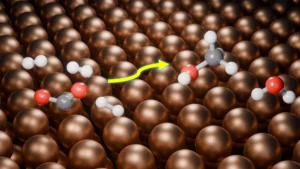
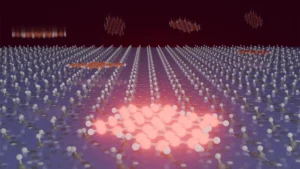
During an electrochemical reaction, the movement of electrons is almost always accompanied by the movement of protons (hydrogen ions). If these protons are consumed or produced faster than they can diffuse away into the rest of the liquid, the local environment becomes radically different from the rest of the solution. The SNU researchers discovered that even in a solution that appears neutral (pH 7), the area near the cathode (where reduction occurs) can spike to a highly alkaline pH 11, while the area near the anode (where oxidation occurs) can plummet to a highly acidic pH 2.5.
These extreme fluctuations can destabilize sensitive molecules, deactivate catalysts, or trigger side reactions that ruin the final product. By recognizing that this "hidden" acidity was the primary culprit behind failed reactions, the team shifted their focus from changing the chemical ingredients to "designing the environment" in which the chemistry takes place.
Methodology and Chronology of the Discovery
The research journey began with an exhaustive meta-analysis of the existing scientific literature. The SNU team, including co-first authors Seonghyeon Min and Junghoon Lee, examined more than 600 scientific papers on organic electrosynthesis published over the last 14 years. Their goal was to determine how widespread the issue of proton transfer—and thus local pH flux—truly was.
The findings were startling: approximately 89% of the surveyed studies involved reactions where both electrons and protons were transferred at the electrodes. This suggested that nearly nine out of ten experiments in the field were likely being influenced by overlooked local pH changes. This realization provided the impetus for the team to develop a specialized reactor capable of neutralizing these local extremes.
Following the literature review, the team moved into the experimental phase, focusing on the Baeyer-Villiger oxidation. This is a classic chemical reaction used to convert ketones into lactones or esters. Traditionally, this process requires peroxyacids, which are volatile, potentially explosive, and generate significant chemical waste. The SNU team sought to perform this reaction using only oxygen gas and electricity.
Initial tests in standard reactors yielded poor results, with only 16% of the starting material turning into the desired lactone. Using computer simulations and high-precision electrochemical measurements, the team realized that the reactive oxygen species needed for the reaction were being destroyed by the extreme pH levels at the electrode surfaces.
Reactor Redesign and Performance Data
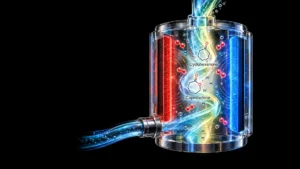
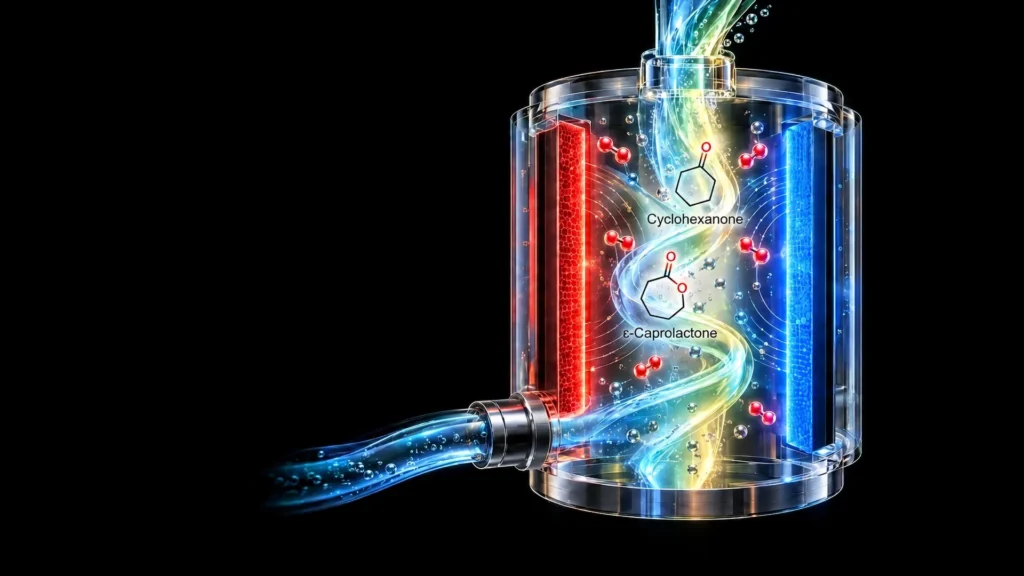
To solve the problem, the researchers engineered a "flow-through" electrochemical reactor. The design featured two key innovations:
- Reduced Electrode Gap: The distance between the anode and cathode was narrowed from 20 mm to just 4 mm.
- Continuous Electrolyte Flow: The liquid carrying the chemicals was forced to flow rapidly between the closely spaced electrodes.
The logic behind this design was elegant: since the anode creates acid and the cathode creates alkali, bringing them closer together allows the two environments to partially neutralize each other. The rapid flow of the liquid further ensures that ions are mixed and refreshed, preventing the buildup of extreme pH "pockets."
The impact of these physical changes was transformative. When the liquid was stagnant, the production of the desired chemical was nearly zero. However, as the flow rate increased, the production rate surged by a factor of 14. Furthermore, by reducing the electrode distance to 4 mm, the team saw a 2.2-fold increase in the rate of chemical production compared to wider gaps. The most significant metric, however, was selectivity: the proportion of the desired product rose from 16% to an astounding 97%.
To verify the source of the chemical transformation, the team employed isotope-tracing experiments. By using a specific isotope of oxygen, they proved that the oxygen atoms incorporated into the final product came directly from the oxygen gas supplied to the system, rather than from water molecules in the solution. This confirmed that their "oxygen-activation" method was working exactly as intended.
Applications in Medicine, Plastics, and Electronics
The versatility of the SNU team’s approach was demonstrated through the synthesis of 24 different high-value compounds. The researchers focused on two primary chemical families: lactones and epoxides.
Lactones and Biodegradable Plastics:
The team successfully synthesized 18 different types of lactones. Most notably, they produced ε-caprolactone with an 82% yield. This compound is the precursor to polycaprolactone (PCL), a specialized biodegradable plastic used extensively in the medical field for drug-delivery devices and absorbable surgical sutures. As the global demand for sustainable materials grows, the ability to produce PCL precursors without toxic waste is a significant milestone.
Epoxides and High-Tech Manufacturing:
The researchers also applied their local pH control strategy to create six different epoxides. Epoxides are essential for the production of epoxy resins, which serve as protective coatings for everything from food cans to aerospace components. They are also vital in the electronics industry for insulating circuit boards and in the pharmaceutical industry as "intermediates" that allow for the construction of complex drug molecules.
Analysis of Implications for Green Manufacturing
The implications of this research extend far beyond the laboratory. The chemical industry is currently one of the largest contributors to global carbon emissions and hazardous waste. The SNU breakthrough aligns with the principles of "Green Chemistry" in several critical ways:
- Elimination of Hazardous Oxidants: By using oxygen and electricity, the process removes the need for peroxyacids and other dangerous oxidizing agents that are difficult to transport and store.
- Energy Efficiency: The reactions take place at room temperature and standard atmospheric pressure. Traditional chemical plants often require massive amounts of energy to maintain high-pressure and high-temperature environments.
- Scalability via Electrification: Because the process is driven by electricity, it can be powered by renewable energy sources like solar or wind. This opens the door to "decentralized" chemical manufacturing, where small-scale reactors could produce specialty chemicals on-site and on-demand.
Industry experts suggest that the pharmaceutical sector may be the first to adopt these methods. Pharmaceutical synthesis requires extreme precision; a 97% selectivity rate is highly attractive because it reduces the need for expensive and time-consuming purification steps to remove unwanted byproducts.
Future Outlook and Official Responses
Professor Jaeyune Ryu emphasizes that this study represents a shift in how scientists should think about chemical engineering. "This study transforms ‘local pH’ near the electrode from a hidden variable into a controllable design principle," Ryu stated. "To improve the efficiency of organic electrosynthesis, we need to design not only the reaction substrates and catalysts but also the environment in which the molecules actually react."
The research was a collaborative effort within Seoul National University’s Department of Chemical and Biological Engineering, supported by the National Research Foundation of Korea and the Institute for Basic Science (IBS). Co-authors Seonghyeon Min and Junghoon Lee have indicated that their next steps will involve scaling the reactor design for industrial-sized applications and exploring whether this "local pH control" can be used to capture and convert carbon dioxide into useful fuels.
While the technology is currently at the laboratory stage, the jump from 16% to 97% selectivity provides a compelling economic argument for commercialization. If the "hidden" chemistry of the electrode interface can be mastered at scale, the next generation of factories may look less like sprawling refineries and more like compact, electrified cleanrooms. This SNU-led discovery marks a decisive step toward a future where the chemicals we rely on daily are produced in harmony with the environment.