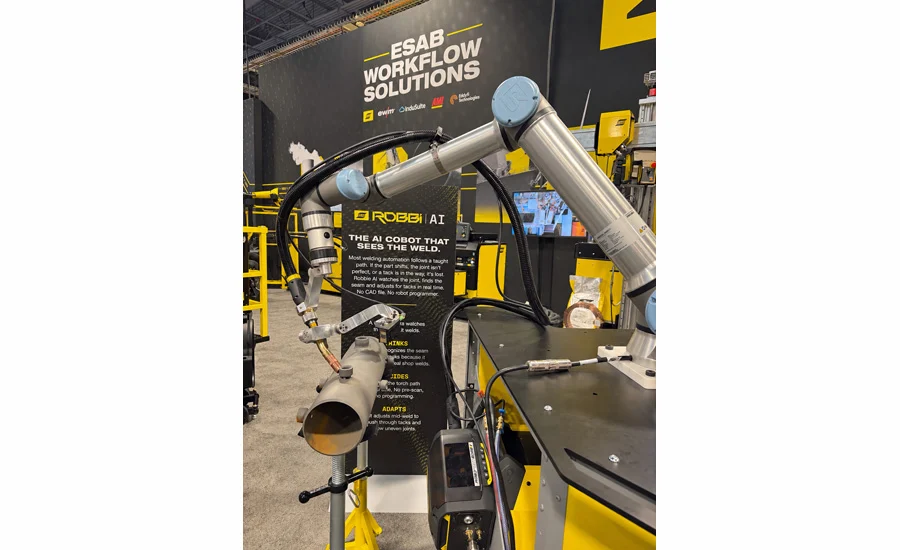
NORTH BETHESDA, MD—ESAB, a global leader in welding and cutting technology, has unveiled ROBBI AI, an innovative cobot system engineered to fundamentally transform the landscape of industrial welding. This groundbreaking system leverages "physical artificial intelligence" (AI) to perceive, comprehend, and dynamically respond to real-world conditions encountered during both MIG and TIG welding operations. Breaking away from conventional robotic welding paradigms that rely heavily on meticulously predefined robot paths and rigid weld sequences, ROBBI AI employs advanced camera and laser sensing technologies. This allows the system to assess the welding environment in real time, make autonomous decisions, and continuously adjust welding motion and process parameters as conditions evolve. The primary objective of this pioneering system is to eliminate the labor-intensive and often repetitive task of manual weld path teaching by human operators, a significant hurdle, especially in scenarios involving multiple parts fixtured on a single workstation.
The Dawn of Physical AI in Welding
The introduction of ROBBI AI marks a pivotal moment in the ongoing evolution of industrial automation, particularly within the welding sector. For decades, robotic welding systems have been instrumental in boosting productivity and ensuring consistency in manufacturing. However, their efficacy has traditionally been constrained by their reliance on precise programming and highly consistent part fit-up. Even with advanced seam tracking capabilities, any substantial variation in joint gaps, material irregularities, or environmental factors often necessitates manual intervention, time-consuming reprogramming, or significant process adjustments. These limitations have historically restricted the widespread adoption of automation in industries characterized by high-mix, low-volume production or applications demanding exceptionally high levels of precision and adaptability, such as pipe fabrication or specialized TIG welding.
Physical AI, as embodied by ROBBI AI, represents a significant leap forward. It refers to artificial intelligence systems designed with the capacity to perceive, understand, make complex decisions about, and interact with the physical world through robotic or mechanical means. Unlike purely software-based AI, physical AI directly influences physical processes, making intelligent adjustments at the point of action. Dan Colvin, Vice President for Advanced Technology Solutions at ESAB, succinctly articulates this shift: "Physical AI brings intelligence directly into the welding process. Instead of programming every movement and anticipating every possible variation, ROBBI AI assesses the joint, determines how to proceed, and makes adjustments while welding." This capability is particularly critical in welding, where even minor deviations can compromise weld integrity and necessitate costly rework.
Addressing Industry Challenges: The Imperative for Smarter Automation
The global manufacturing sector is currently grappling with a confluence of challenges, including a persistent skilled labor shortage, increasing demands for product customization, and the need for greater operational efficiency. The welding industry, in particular, faces a looming crisis. According to projections from the American Welding Society (AWS), the United States alone is expected to face a shortage of over 375,000 skilled welders by 2024. Similar trends are observed worldwide. This deficit not only drives up labor costs but also restricts production capacity and innovation. Moreover, specific welding processes like TIG welding require years of dedicated practice and specialized expertise, making them difficult to automate using traditional methods. The precision required for critical applications, such as welding in data centers, infrastructure projects, and aerospace, further underscores the need for highly adaptive and intelligent solutions.
ROBBI AI is specifically engineered to confront these pressing challenges head-on. The system is targeted at some of manufacturing’s most demanding welding jobs: those requiring high-quality work on low-volume, high-mix production runs, and applications where joint fit-up frequently varies. These include intricate pipe fabrication, the precision-intensive TIG welding processes, and other tasks that have historically relied heavily on the nuanced skills of experienced human welders and have proven notoriously difficult to automate effectively. By automating these complex, variable tasks, ROBBI AI not only addresses labor shortages but also frees up highly skilled welders to focus on more intricate, non-routine assignments or supervisory roles, thereby maximizing human capital.
A New Paradigm in Workflow: From Teaching to Supervising
One of the most revolutionary aspects of ROBBI AI is its ability to autonomously generate its own weld path. This eliminates the conventional need for operators to manually "teach" the robot every intricate movement. In a traditional robotic welding setup, an operator might spend hours or even days programming complex weld paths, especially for parts with multiple joints or variable geometries. With ROBBI AI, the operator’s role shifts dramatically. Instead, the operator positions the system at or near the intended joint, inputs essential parameters derived from welding procedure specifications (WPS)—such as consumable type, material composition, and desired weld type—and then initiates the welding process.
Once initiated, the AI system takes over. Utilizing its sophisticated sensing capabilities, it autonomously evaluates the project, precisely identifies the expected joint configuration, and determines the optimal path and parameters required to proceed, all while operating strictly within the predefined application parameters. This dramatically reduces setup time and enhances overall operational flexibility. As welding progresses, ROBBI AI continuously adapts its motion and welding parameters to dynamically changing conditions. For instance, if a joint gap unexpectedly widens or narrows—a common occurrence due to material tolerances, thermal distortion, or imprecise fixturing—the system can intelligently adjust its travel speed, oscillation pattern, or welding parameters (such as voltage, amperage, or wire feed speed) as appropriate, all within the established procedure guidelines. "Rather than relying solely on a predetermined weld sequence, it can make welding decisions in real time," Colvin emphasizes, highlighting the system’s unprecedented level of autonomy and responsiveness.
The Power of Continuous Learning and Local Intelligence
A cornerstone of ROBBI AI’s advanced capabilities is its embedded machine learning framework. The system is designed to continuously learn from its welding experiences, leveraging data from every completed weld to enhance its ability to recognize and respond to dynamic conditions. Prior to its deployment in a customer’s facility, the system undergoes an intensive simulation-based learning period, building a foundational knowledge base. Once operational, it continues to collect vast amounts of weld data, paired with associated video recordings. This rich dataset serves a dual purpose: it continuously refines the AI’s predictive and adaptive algorithms, and it provides an invaluable forensic record that operators can use to investigate any detected defects and identify opportunities for further process improvement.
Critically, if ROBBI AI detects a condition that could potentially compromise the integrity of a weld, it is programmed to immediately halt the welding process. This proactive measure prevents the production of defective parts, thereby minimizing material waste and rework. Operators can then review the recorded information—including sensor data and video footage—to understand the precise circumstances that led to the interruption. This feedback loop is vital; operators can provide input that helps the AI recognize similar conditions more effectively in the future, further augmenting its learning capabilities.
A key architectural decision underpinning ROBBI AI’s design is its commitment to local AI processing. All AI computations occur directly on a dedicated computer housed within the customer’s facility, rather than relying on continuous, high-bandwidth communication with a cloud-based system. This approach offers several significant advantages: it ensures that the system’s proprietary learning data remains securely onsite, protects sensitive manufacturing information, and, most importantly, enables ultra-low-latency, real-time decision-making at the precise point of welding. This localized processing is crucial for applications where instantaneous reactions to changing physical conditions are paramount. To further ensure compliance and quality, ESAB utilizes its existing InduSuite software to meticulously manage and validate all AI-driven welding decisions, ensuring they strictly adhere to predefined welding procedure specifications (WPS) and qualification requirements. Colvin affirms, "ESAB’s approach is designed to reduce the risk of AI-driven adjustments that could result in welding outside those specifications or with an unapproved procedure," underscoring the company’s commitment to both innovation and regulatory compliance.
Comprehensive Integration and Versatile Power Sources
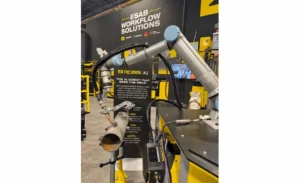
The ESAB Cobot featuring ROBBI AI is built around robust and widely adopted collaborative robot platforms, specifically the Universal Robots UR10e or UR20e six-axis robot arms. These cobots are known for their ease of use, safety features for human-robot collaboration, and reliability. For enhanced reach and expanded part envelope capabilities, the system is also available with an optional seventh-axis configuration. To facilitate mobility and organized component management within a dynamic shop floor environment, the cobot can be mounted on a wheeled cart, allowing it to be easily repositioned for different jobs.
ROBBI AI’s adaptability is further amplified by its seamless integration with a selection of ESAB’s high-performance welding power sources: the EWM Titan XQ, EWM Tetrix XQ, or ESAB Aristo Edge 500R. Each of these power sources brings a distinct set of advanced capabilities to the ROBBI AI ecosystem:
- EWM Titan XQ: This power source offers a comprehensive suite of conventional, pulsed, and advanced welding processes. A standout feature is EWM React, an innovative technology that actively controls wire movement and droplet transfer. This allows for significantly faster welding speeds—up to 100 percent quicker than conventional methods—while simultaneously achieving higher quality results and reducing heat input by as much as 35 percent compared to traditional short-arc welding. This translates to less distortion and improved material properties.
- EWM Tetrix XQ (DC and AC/DC): These TIG welding machines provide versatile conventional and pulse options, catering to a wide range of TIG applications. A particularly noteworthy accessory is EWM’s tigSpeed Drive 45, which feeds the welding consumable continuously to the welding point as cold wire, akin to MIG welding. This significantly increases deposition rates. Furthermore, with an integrated power source, tigSpeed can preheat the welding consumable and feed it as hot wire, boosting the deposition rate by up to 60 percent compared to traditional manual TIG welding, offering substantial productivity gains without compromising quality.
- ESAB Aristo Edge 500R: This power source is equipped with advanced weld modes designed for specific applications. The Warrior Edge 500 CX variant offers advanced pulse, craft, and speed processes, optimizing performance for various material types and joint configurations. The Warrior Edge 500 DX further expands capabilities by adding specialized thin, root, and root pipe weld modes, which are crucial for high-integrity applications like pipeline construction and pressure vessel fabrication.
This comprehensive integration ensures that ROBBI AI is not merely a path-generating system but a holistic, intelligent welding solution capable of executing a broad spectrum of high-quality welding processes across diverse industrial applications.
Broader Impact and the Future of Human-Robot Collaboration
The advent of ROBBI AI heralds a transformative shift in manufacturing workflows. By combining sophisticated sensing, adaptive welding decisions, and continuous machine learning, ESAB is offering manufacturers a potent tool to address critical industry challenges. It provides a viable pathway to mitigate chronic labor shortages, effectively accommodate inherent part variation, and significantly expand the reach of automation into applications that have historically been deemed too complex or too reliant on individual welder expertise.
This technology also redefines the relationship between human operators and robotic systems. Instead of being replaced, skilled welders are elevated to supervisory and analytical roles. They can oversee multiple ROBBI AI cobots, manage complex setups, provide expert feedback to the learning system, and focus on non-routine challenges that still require human ingenuity. This human-robot collaboration, often referred to as "cobot" operation, promises to unlock new levels of productivity and quality across the manufacturing spectrum. The system’s ability to support conventional cobot operation, allowing users to switch off full-AI mode and operate the robot using more traditional methods when appropriate, further underscores its flexibility and user-centric design.
As Dan Colvin aptly summarizes, "With ROBBI AI, we are extending the role of AI beyond digital analysis and into the physical welding process—where intelligent decisions can directly influence how a weld is made." This represents a profound shift from programmed automation to truly intelligent automation, where machines learn, adapt, and make decisions that directly impact the physical world. ESAB’s ROBBI AI is not just another welding cobot; it is a harbinger of a more intelligent, adaptive, and resilient future for industrial manufacturing, empowering businesses to overcome current limitations and thrive in an increasingly dynamic global economy. For more detailed information, interested parties are encouraged to visit ESAB’s official website at https://esab.com/us/nam_en.