The Elusive Neutrino: Unlocking Cosmic Secrets
George Fuller, a distinguished professor at the University of California San Diego (UC San Diego), has provided critical insights into neutrinos, the enigmatic particles at the heart of the anticipated 2026 Nobel Prize in Physics. Fuller’s work builds upon his early collaboration with Francis Halzen, PhD, a Belgian-American physicist whose foundational contributions to the IceCube Neutrino Observatory earned him this year’s hypothetical physics Nobel. Fuller’s recent disclosures illuminate how these subatomic "ghost particles" traverse the vast expanses of the universe and why their detection remains one of the most formidable challenges in modern physics.
Neutrinos are elementary particles that interact so weakly with matter that billions of them pass through every square centimeter of our bodies each second, leaving no trace. Their extreme elusiveness makes them incredibly difficult to study, yet their unique properties offer an unparalleled window into extreme astrophysical phenomena and the fundamental laws governing the universe. Fuller emphasized the critical importance of deciphering these particles, stating, "Halzen’s work, and the work of those he inspired with his vision, was foundational in giving humanity a new window on the universe and on the mysterious and notoriously slippery neutrino."
A Brief History of the "Ghost Particle"
The concept of the neutrino first emerged in 1930 when theoretical physicist Wolfgang Pauli hypothesized its existence to explain apparent energy and momentum conservation violations in beta decay. Pauli famously described his proposed particle as "a desperate remedy to save the law of conservation of energy." He suggested it was electrically neutral and possessed very little mass, allowing it to escape detection.
It wasn’t until 1956 that Clyde Cowan and Frederick Reines experimentally confirmed the neutrino’s existence in the "Project Poltergeist" experiment at the Savannah River Plant, detecting antineutrinos produced in a nuclear reactor. This groundbreaking achievement earned Reines a share of the Nobel Prize in Physics in 1995. Subsequent research revealed that neutrinos come in three "flavors" – electron, muon, and tau – and famously oscillate between these states, implying they possess a tiny, non-zero mass, a discovery that fundamentally challenged the Standard Model of particle physics and earned Takaaki Kajita and Arthur B. McDonald the Nobel Prize in 2015.
Despite these advancements, the astrophysical origins of high-energy neutrinos, particularly those originating from beyond our solar system, remained a profound mystery, a challenge Halzen and the IceCube collaboration sought to address.
IceCube: A Gigantic Detector in Antarctic Ice
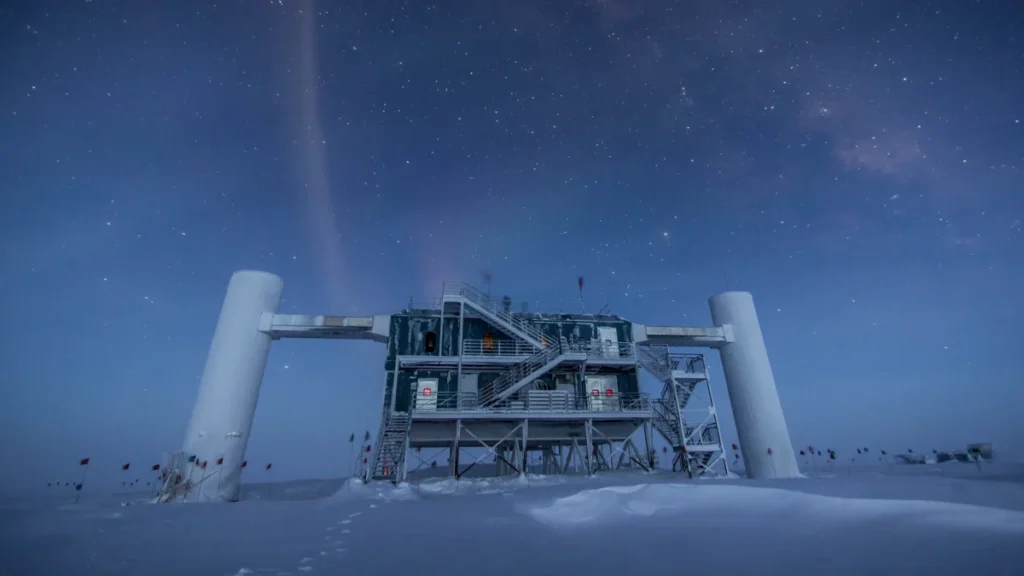
The IceCube Neutrino Observatory stands as the world’s largest neutrino detector, an engineering marvel positioned deep beneath the Antarctic ice sheet near the US Amundsen-Scott South Pole Station. Its inception traces back to Halzen’s visionary idea in the 1990s: to construct a colossal detector utilizing the pristine, transparent ice as a detection medium. At such depths, the extremely low temperature and pressure create an environment largely free of interfering air bubbles and impurities, crucial for precise measurements.
The observatory operates by embedding thousands of digital optical modules (DOMs) – spherical glass pressure vessels containing photomultiplier tubes – into holes drilled through approximately 0.24 cubic miles (one cubic kilometer) of ice. These DOMs are arranged in a hexagonal grid, forming a three-dimensional array designed to capture the faint signatures of high-energy neutrinos.
Detecting these elusive particles requires extraordinary equipment due to their exceptionally weak interaction with matter. When a high-energy neutrino interacts with an atomic nucleus within the ice, it can produce charged particles (muons, electrons, or taus). These secondary particles travel faster than the speed of light in ice, generating a characteristic flash of blue light known as Cherenkov radiation. The DOMs register these faint flashes, and by analyzing the timing and intensity of the light signals across the array, scientists can reconstruct the neutrino’s energy, flavor, and, crucially, its direction of origin. This allows IceCube to act as a powerful telescope, peering into the universe with neutrinos instead of light.
George Fuller’s Insights and the Detection Challenge
Fuller elaborated on the extreme rarity of high-energy cosmic neutrinos, noting that IceCube detects only a few dozen such events each year. These neutrinos carry energies billions of times greater than those produced by the Sun. He highlighted one particularly energetic event, stating, "One detected by a similar experiment has an energy 200 times higher than that." Yet, despite their immense energy, their origins often remain shrouded in mystery. "We don’t really know where that neutrino came from," Fuller admitted. "The fact that it got here at all may be saying something profound about the universe."
The challenge lies not only in their weak interaction but also in distinguishing cosmic neutrinos from the far more abundant atmospheric neutrinos, which are produced when cosmic rays collide with Earth’s atmosphere. IceCube’s location at the South Pole and its deep burial within the ice are strategic. By looking down through the Earth, the Earth itself acts as a shield, filtering out most background noise and allowing IceCube to primarily detect neutrinos that have traveled through the planet’s core, ensuring they are truly extraterrestrial in origin.
The 2026 Nobel Prize and Halzen’s Enduring Legacy
The hypothetical 2026 Nobel Prize in Physics, attributed to Francis Halzen, underscores the monumental impact of the IceCube Neutrino Observatory. Halzen’s vision transcended mere theoretical contemplation; it translated into the construction and successful operation of an unprecedented instrument that opened a new frontier in astronomy – neutrino astronomy. Prior to IceCube, the universe was primarily observed through electromagnetic radiation (light, radio waves, X-rays) and cosmic rays. Neutrinos offer a unique, unhindered view, as they are not deflected by magnetic fields and can escape dense, opaque environments like the cores of supernovae or active galactic nuclei.

Fuller’s statements reinforce Halzen’s pivotal role. "In that sense, Halzen really is at the frontier of experimental fundamental particle physics," Fuller concluded in a press release. The implications of this work extend far beyond mere detection; it promises new discoveries that could illuminate the Big Bang, the early universe, and the most violent cosmic events.
Neutrinos as Keys to the Universe’s Grandest Puzzles
As elementary particles, neutrinos are indivisible. There are three known types: electron, muon, and tau neutrinos. Their unique properties, particularly their ability to traverse vast distances through space at nearly the speed of light with minimal interaction, make them invaluable cosmic messengers. Fuller aptly described them as "truly ghost-like particles. It’s hard to stop them. It’s hard to catch them. How do we even know they exist or where they are?"
Their exceptional penetrating power means they can escape extreme conditions near collapsing stars and black holes, carrying information directly from these otherwise impenetrable regions. Fuller noted that depending on their energy, neutrinos "can even travel through light-years of lead without stopping." Despite their elusiveness, they are incredibly abundant; estimates suggest approximately one billion neutrinos exist for every atom in the cosmos, remnants of the Big Bang and products of stellar processes.
The study of neutrinos holds the potential to unravel several of the universe’s most profound mysteries:
-
Cosmology and the Early Universe: Neutrinos are relics of the Big Bang, forming a cosmic neutrino background analogous to the cosmic microwave background (CMB). Studying these ancient neutrinos could provide insights into the universe’s first second, the epoch of Big Bang nucleosynthesis, and the properties of dark matter, as some theories propose the existence of heavier "sterile neutrinos" that could contribute to dark matter. UC San Diego’s involvement in the Simons Observatory in Chile’s Atacama Desert, which studies the CMB, directly contributes to this quest for clues about ancient neutrinos.
-
Astrophysical Accelerators: High-energy neutrinos detected by IceCube are believed to originate from extreme cosmic accelerators such as active galactic nuclei (AGN), gamma-ray bursts (GRBs), and possibly supernovae. Identifying the sources of these neutrinos can pinpoint the engines of the most energetic phenomena in the universe, shedding light on how cosmic rays are accelerated to incredible energies.
-
Supernovae: When massive stars explode as supernovae, they release a tremendous burst of neutrinos moments before the light signal arrives. Detecting these neutrino bursts could provide an early warning system for supernovae and offer an unprecedented look into the core collapse process, nuclear synthesis, and the formation of neutron stars or black holes.
-
Fundamental Particle Physics: Neutrino oscillation revealed that neutrinos have mass, a property not accounted for in the original Standard Model. Further research into neutrino mass hierarchy, whether neutrinos are their own antiparticles (Majorana particles), and potential CP violation in the lepton sector could lead to new physics beyond the Standard Model, potentially explaining the universe’s matter-antimatter asymmetry.
The Broader Landscape of Neutrino Astronomy
While IceCube is preeminent for high-energy astrophysical neutrinos, the field of neutrino astronomy is diverse, with several other major observatories contributing to our understanding across different energy ranges:
- Super-Kamiokande (Japan): A massive water Cherenkov detector renowned for detecting solar and atmospheric neutrinos, crucial for confirming neutrino oscillations.
- SNO (Sudbury Neutrino Observatory, Canada): Used heavy water to detect all three flavors of solar neutrinos, definitively solving the "solar neutrino problem" by proving neutrino oscillation.
- Borexino (Italy): A liquid scintillator detector focused on low-energy solar neutrinos, providing precise measurements of the Sun’s core processes.
- DUNE (Deep Underground Neutrino Experiment, USA): A future flagship experiment designed to study neutrino oscillations with unprecedented precision and search for proton decay, aiming to shed light on matter-antimatter asymmetry.
- KM3NeT (Cubic Kilometre Neutrino Telescope, Mediterranean Sea): An upcoming deep-sea detector similar in principle to IceCube, aiming to detect astrophysical neutrinos from the Northern Hemisphere.
These complementary experiments, employing various detection techniques and located in different environments, collectively paint a comprehensive picture of neutrino properties and their roles in the universe, highlighting the global collaborative effort in this frontier of physics.
The Future of Ghost Particle Research
The journey to fully comprehend neutrinos is far from over. Future upgrades to IceCube, such as IceCube-Gen2, aim to expand its volume and sensitivity significantly, increasing the detection rate of high-energy cosmic neutrinos and improving angular resolution to pinpoint their sources more accurately. New projects, like the Pacific Ocean Neutrino Experiment (P-ONE), are exploring the feasibility of similar large-scale detectors in oceanic environments, potentially offering an all-sky view of neutrino sources.
The ongoing research at UC San Diego, particularly its involvement with the Simons Observatory, promises to provide further clues. By studying the cosmic microwave background, the oldest light in the universe, scientists hope to find subtle imprints left by ancient neutrinos, thereby gaining a deeper understanding of the universe’s earliest moments.
In conclusion, the work spearheaded by Francis Halzen and elucidated by George Fuller marks a pivotal moment in science. The anticipated 2026 Nobel Prize acknowledges not just a scientific achievement, but the opening of a new era of discovery. Neutrinos, once merely theoretical "ghost particles," have become indispensable tools for probing the most extreme and hidden corners of the cosmos, promising to unveil secrets that could redefine our understanding of existence itself. The quest to fully harness these elusive messengers continues, holding the potential for revolutionary insights into the fundamental fabric of reality.