In a groundbreaking demonstration that reshapes our understanding of the fundamental nature of the universe and its interaction with matter, researchers have for the first time shown that the seemingly empty void of space is, in fact, an active participant capable of enhancing macroscopic quantum phenomena. This pivotal discovery reveals that quantum fluctuations inherent in a vacuum can significantly strengthen superconductivity, thereby unlocking an entirely new avenue for manipulating and controlling unusual states of matter. The implications of this work extend from fundamental physics, challenging long-held assumptions about the passive role of the vacuum, to potential technological advancements in quantum computing, energy efficiency, and beyond.
The landmark study, meticulously detailed in the prestigious scientific journal Nature, was spearheaded by an international collaborative team. Leading the charge were Professor Changgan Zeng and Professor Guanghui Cheng from the University of Science and Technology of China, affiliated with the Chinese Academy of Sciences. Their efforts were augmented by the crucial theoretical insights provided by Professor Qingdong Jiang of Shanghai Jiao Tong University and the esteemed Nobel laureate Professor Frank Wilczek of the Massachusetts Institute of Technology, alongside contributions from a diverse group of other dedicated researchers. This convergence of experimental prowess and theoretical acumen was essential in not only observing but also interpreting this novel interaction between the quantum vacuum and superconducting materials.
A Deeper Look at the Quantum Vacuum: Beyond the Void
To grasp the profound significance of this discovery, it is crucial to first understand how quantum physics redefines the concept of a vacuum. In everyday parlance, a vacuum is synonymous with absolute emptiness – a space devoid of matter, energy, and even light. However, the intricate laws governing the subatomic world paint a dramatically different, far more dynamic picture. According to the tenets of quantum electrodynamics (QED) and the Heisenberg uncertainty principle, even what appears to be the lowest possible energy state, an absolute vacuum, is never truly inert or perfectly still.
Instead, this "empty" space is a vibrant, seething cauldron of activity, teeming with what are known as virtual particles. These ephemeral particles, such as virtual photons and electron-positron pairs, spontaneously pop into existence and almost instantaneously vanish back into the vacuum. Their fleeting presence, governed by the uncertainty principle, means they exist for such brief durations that they cannot be directly observed. Yet, their collective activity produces an omnipresent background of quantum fluctuations – a constant, energetic hum that permeates all of space.
These quantum fluctuations are not merely theoretical constructs or mathematical curiosities; their tangible effects have been rigorously observed and experimentally verified through several well-established phenomena over the past century. One such example is the Lamb shift, a minute shift in the energy levels of atoms that cannot be explained by classical electrodynamics but is perfectly accounted for by the interaction of electrons with virtual photons in the vacuum. Another is spontaneous emission, the process by which an excited atom emits a photon and decays to a lower energy state, which is also driven by its interaction with vacuum fluctuations. Perhaps the most illustrative example for macroscopic effects is the Casimir effect, where two uncharged, parallel conductive plates placed in a vacuum experience a small attractive force. This force arises because the plates restrict the spectrum of virtual photons that can exist between them, leading to an imbalance in radiation pressure compared to the external vacuum. These observations underscore that the quantum vacuum is not a passive backdrop but an active, energetic component of our universe.
The Genesis of an Idea: From Theory to Experiment
For several years prior to this breakthrough, the research teams led by Professors Zeng and Cheng had been at the forefront of investigating how these elusive vacuum fluctuations might influence condensed matter systems. Their earlier pioneering work laid crucial groundwork, demonstrating that they could, in fact, directly manipulate vacuum fluctuations. In a prior study, the researchers successfully showed that by applying a magnetic field, they could reversibly switch the Casimir force – the very force mediated by vacuum fluctuations – between attraction and repulsion. This earlier achievement was a monumental step, confirming the manipulability of the quantum vacuum and suggesting its potential for broader applications.
This initial success inevitably led to a more profound and challenging question: If vacuum fluctuations could be controlled at a fundamental level, could they also be harnessed to control macroscopic quantum states of matter, such as superconductivity? This ambitious inquiry formed the core motivation for their subsequent research, setting the stage for the current discovery.
Concurrently, Professor Jiang’s group approached this intricate problem from a complementary theoretical perspective. Their focus was on systematically studying how meticulously engineered quantum vacuum environments could potentially influence and shape the behavior of different states of matter. This theoretical exploration led them to introduce the innovative concept of "vacuumronics." Vacuumronics posits that specially designed vacuum environments could be utilized as a novel control mechanism for electronic and photonic behavior in materials. This visionary theoretical framework proved invaluable, providing the essential conceptual scaffolding and predictive power required to understand and interpret the unprecedented superconductivity enhancement subsequently observed in the new experimental investigations. It offered a lens through which the experimental results could be contextualized and explained, bridging the gap between abstract quantum theory and tangible material properties.
Engineering the Quantum Environment: The Terahertz Dark Cavity
A significant hurdle in harnessing vacuum fluctuations for practical applications has always been their inherent weakness. "Vacuum fluctuations in free space are generally too weak to produce observable effects in macroscopic condensed-matter systems," explained Professor Zeng, highlighting the central challenge. To overcome this fundamental limitation, the researchers devised an ingenious strategy: they introduced a terahertz split-ring resonator, which functions as a "dark cavity."
This dark cavity is not merely an empty enclosure; it is a precisely engineered electromagnetic environment designed to reshape and significantly amplify the subtle background of vacuum fluctuations. A split-ring resonator is a type of metamaterial structure, typically composed of non-magnetic conductive rings with gaps, that exhibits unique electromagnetic properties not found in natural materials. When designed to operate in the terahertz frequency range, it can effectively localize and enhance electromagnetic fields, including the virtual photons that constitute vacuum fluctuations, within its confined space. By creating such a resonant environment, the researchers effectively "tuned" the vacuum, making its fluctuations robust enough to interact measurably with a macroscopic material.
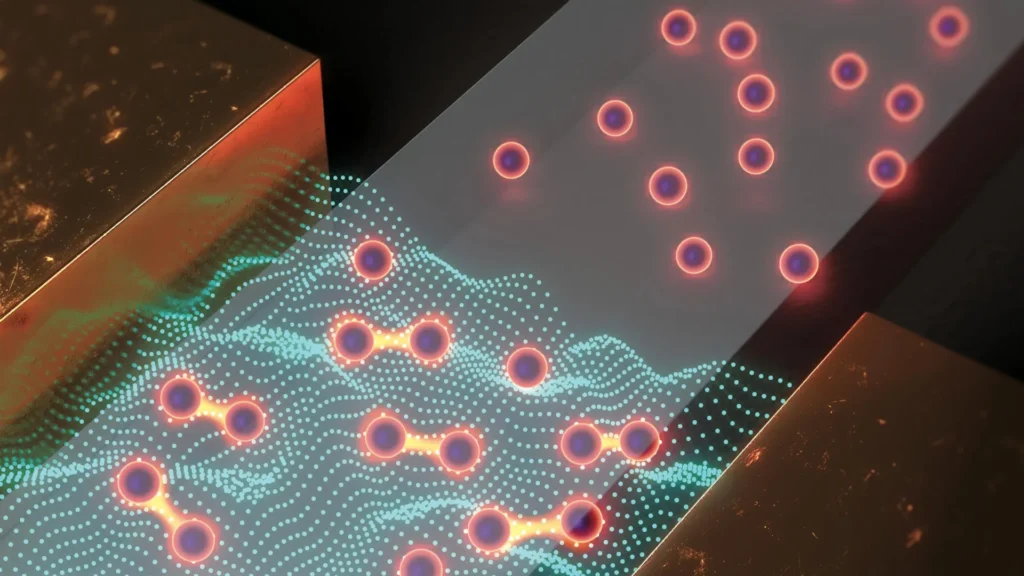
To experimentally test their audacious hypothesis, the research team selected niobium diselenide (NbSe2), a well-characterized two-dimensional superconductor, and strategically placed it inside the specially constructed terahertz dark cavity. NbSe2 is a transition metal dichalcogenide known for its robust superconducting properties and relatively high critical temperature for a conventional superconductor, making it an ideal candidate for observing subtle enhancements. This arrangement created a meticulously coupled system: the superconducting material, NbSe2, was brought into intimate interaction with the carefully engineered electromagnetic environment inside the dark cavity. The goal was to observe if this amplified, structured quantum vacuum could indeed influence the material’s superconducting state.
Quantifying the Enhancement: Superconductivity Gets Stronger
The crux of the experiment involved a comparative analysis: the team rigorously compared the superconducting behavior of NbSe2 when it was situated inside the dark cavity versus when it was outside. The results were not just statistically significant; they were profoundly impactful. The data unequivocally demonstrated that placing NbSe2 within the terahertz cavity led to a remarkable and significant increase in its superconducting critical temperature (Tc). The critical temperature is a defining characteristic of a superconductor, representing the specific temperature below which a material transitions into its superconducting state, characterized by zero electrical resistance and the expulsion of magnetic fields (the Meissner effect).
"We observed that the critical temperature can increase by up to 5.4% in a six-layer NbSe2 device," announced Professor Cheng, underscoring the magnitude of the enhancement. For a material whose superconductivity is typically achieved at cryogenic temperatures, a 5.4% increase in Tc is a substantial leap, pushing its operational limits higher and reducing the cooling requirements. But the enhancement was not limited solely to the critical temperature. Professor Cheng further elaborated, stating, "while the critical current and critical magnetic field are significantly enhanced near the superconducting transition." The critical current refers to the maximum current a superconductor can carry before resistance reappears, and the critical magnetic field is the maximum magnetic field it can withstand before losing its superconducting properties. Enhancements in these parameters are equally crucial for practical applications, indicating a more robust and stable superconducting state. Professor Cheng concluded with a statement that encapsulates the historical significance of their findings: "This represents the first experimental observation of vacuum-fluctuation-enhanced superconductivity."
Rigorous Validation and Unconventional Explanations
Given the unprecedented nature of their findings, the researchers undertook an exhaustive series of control experiments. This rigorous validation process was critical to definitively rule out any more conventional explanations for the observed enhancement that might not involve quantum vacuum fluctuations. They meticulously varied numerous properties of their experimental setup, including:
- Cavity geometry: Altering the physical dimensions and shape of the terahertz resonator.
- Characteristic frequency: Tuning the resonant frequency of the dark cavity.
- Material thicknesses: Testing NbSe2 samples with different numbers of atomic layers.
- Dielectric materials: Changing the insulating materials used within the setup.
- Metallic strips: Modifying other metallic components of the device.
Through this comprehensive array of tests, the team was able to systematically exclude alternative hypotheses. They ruled out explanations involving mechanical strain on the material, which could alter its electronic properties; material degradation, which would lead to inconsistent results; inhomogeneity, suggesting uneven material properties; and metallic screening effects, which could mask or mimic certain interactions. The consistency of the enhancement across varied conventional parameters, while remaining tied to the cavity’s specific properties, strongly pointed towards a non-conventional origin.
One of the most compelling pieces of evidence for the quantum vacuum interaction emerged from the precise relationship between the superconductivity enhancement and the characteristic frequency of the dark cavity. Instead of observing a smooth, gradual change in enhancement, the researchers detected a distinct, resonance-like peak at a particular frequency. This "resonant enhancement" is a hallmark of strong coupling between two interacting systems when their characteristic energies align. "This result, closely tied to the cavity’s photonic properties, provides strong experimental evidence of the coupling between the superconducting state and dark-cavity modes," affirmed Professor Zeng, emphasizing the direct link between the engineered vacuum environment and the material’s quantum state.
The Theoretical Framework: Ginzburg-Landau and Virtual Photons
To provide a robust theoretical explanation for the observed phenomena, Professor Jiang’s team collaborated closely with Professor Wilczek to develop a model rooted in the well-established Ginzburg-Landau framework. The Ginzburg-Landau theory, developed in 1950, is a phenomenological theory that describes superconductivity near its critical temperature, providing a powerful tool to understand the macroscopic properties of superconductors.
Their interpretation, building upon this framework, suggests a profound interaction: the superconducting state of NbSe2 actively exchanges virtual photons with the dark cavity. This continuous, dynamic interaction with the amplified vacuum fluctuations effectively lowers the overall energy of the superconducting state. By making the superconducting state energetically more favorable, the interaction inherently stabilizes it, making it more robust and effectively strengthening its properties, including its critical temperature, current, and magnetic field.
Professor Jiang elucidated the mechanism further: "When the characteristic energy of the cavity mode matched the low-energy superconducting fluctuations, the NbSe2 device exhibited resonant enhancement, producing the peak in superconductivity enhancement." This resonant coupling mechanism is analogous to how a radio receiver tunes into a specific frequency, maximizing the signal. In this case, the cavity was tuned to resonate with the intrinsic quantum fluctuations within the superconductor itself, facilitating an optimal energy exchange that bolstered the superconducting state.
Rethinking the Vacuum: A Paradigm Shift
This groundbreaking result fundamentally alters the traditional way physicists conceptualize the vacuum. For centuries, and even in many contemporary applications of physics, the vacuum has been largely considered a passive entity – an empty stage upon which the drama of particles and forces plays out. It was seen as a neutral background, devoid of active influence on matter. This discovery, however, emphatically challenges that notion.
Instead of serving merely as an inert backdrop, the quantum vacuum can now be seen as a potentially engineerable medium, capable of actively influencing and shaping the behavior of matter itself. Professor Wilczek, reflecting on the profound implications, articulated this paradigm shift eloquently: "In most practical physics, the vacuum serves merely as the passive stage on which phenomena play out. This work shows that the background itself can become an actor — engineered to strengthen superconductivity and reshape the behavior of quantum matter." This redefinition of the vacuum’s role opens up entirely new avenues for theoretical exploration and experimental manipulation across various fields of physics. It suggests that the "empty" space around us holds untapped potential for control and innovation.
Broader Implications and Future Horizons: A New Way to Control Quantum Matter
The significance of this research extends far beyond a mere increase in critical temperature. What makes this approach particularly revolutionary is the method of control: it strengthens superconductivity without directly driving the material with an external energy source like an applied current, intense light, or high pressure. Instead, the researchers ingeniously reshaped the surrounding vacuum environment, providing a noncontact, non-invasive method for influencing a quantum state of matter. This distinction is critical because conventional methods often introduce energy dissipation, heat, or structural changes that can be detrimental or limit the operational window of quantum devices.
This novel, non-contact control mechanism, utilizing engineered vacuum fluctuations, holds immense promise as a powerful new tool for influencing superconductors and potentially other exotic quantum materials. The ability to manipulate quantum states simply by modifying their electromagnetic environment opens up a wealth of possibilities. For instance, it could lead to the development of superconductors that operate at higher temperatures or under less extreme conditions, reducing the energy and infrastructure costs associated with cryogenic cooling.
The practical implications of such advancements are vast. Superconductors are critical for numerous cutting-edge technologies, including:
- Energy transmission: Zero-loss power grids could revolutionize energy efficiency.
- Medical imaging: More powerful and compact MRI machines.
- Magnetic levitation: Faster, more energy-efficient transportation systems.
- Quantum computing: Stable qubits, the fundamental building blocks of quantum computers, could be engineered and protected through vacuum interaction.
- Particle accelerators: Stronger magnetic fields for fundamental research.
While the current enhancement of 5.4% in NbSe2 is a proof of concept, it lays the groundwork for future optimizations. "With further optimization of cavity structures and material systems, vacuum-fluctuation coupling may enable more pronounced and widely applicable control of quantum states," predicted Professor Zeng, looking ahead to the future trajectory of this research. This could involve exploring different cavity designs, utilizing other superconducting materials with potentially stronger coupling efficiencies, or even extending the technique to other quantum phenomena beyond superconductivity, such as topological states of matter or quantum entanglement.
The journey towards room-temperature superconductivity, a holy grail in condensed matter physics, remains a formidable challenge. However, this new discovery offers an entirely fresh perspective and a powerful, previously unrecognized tool in that quest. By demonstrating that the quantum vacuum is not just an empty stage but an active participant that can be engineered to influence matter, these researchers have opened a captivating new chapter in physics. Their work not only deepens our fundamental understanding of the universe but also lights a promising path toward unlocking transformative technologies that could redefine our future. The "empty" space, it turns out, is brimming with possibilities.