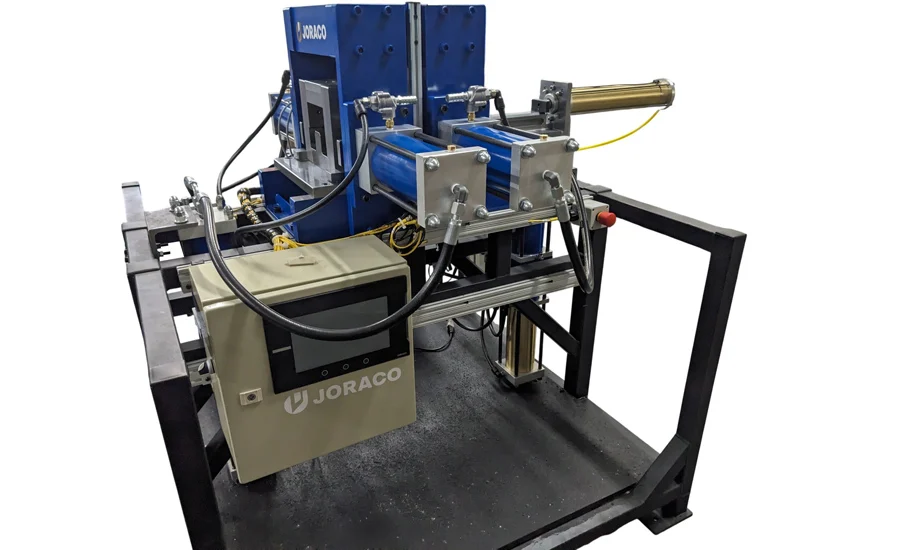
The genesis of this advanced workcell originated from a specific and demanding customer requirement. The client sought an automated system capable of seamlessly transferring parts both into and out of the press mechanism, thereby minimizing manual intervention and accelerating cycle times. Beyond basic automation, a key parameter was the integration of a custom, 24-inch wide worktable, meticulously designed with the agility to be relocated across various production line stations. This dual-purpose design was crucial, ensuring the system could operate effectively within fully automated gantries while also accommodating the needs of human operators during specific tasks, maintenance, or changeovers, thus embodying a true human-robot collaborative (cobot) philosophy in its operational flexibility.
Precision Engineering Meets Production Demands
The journey from initial concept to a fully operational system was characterized by intensive collaboration and sophisticated engineering. AIM-Joraco’s engineering team embarked on a detailed review of the manufacturing requirements, working hand-in-hand with the customer’s internal engineering experts. This synergistic approach was pivotal in refining the machine concept, ensuring every aspect of the design aligned perfectly with the client’s operational goals and existing infrastructure. Key considerations meticulously analyzed during this phase included optimal part orientation for consistent processing, precise loading and unloading locations to prevent bottlenecks, unfettered operator accessibility for routine checks and adjustments, seamless gantry access for robotic handling, and robust integration capabilities with both an inbound material feed system and an outbound conveyor. Such a holistic evaluation underscores the complexity inherent in designing truly custom automation, where every interface and interaction point must be considered for overall system performance and reliability.
The metal stamping industry, a cornerstone of global manufacturing, relies heavily on precision and speed. Stamped metal parts are ubiquitous, forming essential components in industries ranging from automotive and aerospace to consumer electronics and medical devices. The global metal stamping market, valued at approximately $200 billion in recent years, is projected to grow steadily, driven by increasing demand for lightweight, durable, and cost-effective components. This growth, however, brings with it heightened pressure on manufacturers to reduce production costs, improve quality, and accelerate time-to-market. Custom automation solutions, such as the one developed by AIM-Joraco, are increasingly critical for companies seeking to gain a competitive edge in this dynamic landscape. By automating repetitive and precise tasks like hole punching, manufacturers can achieve higher throughput, minimize human error, and reallocate skilled labor to more complex, value-added activities.
A Collaborative Design and Development Process
The chronological development of the workcell began with the initial problem statement from the customer, highlighting the need for increased efficiency and flexibility in their metal part punching operation. This led to AIM-Joraco’s involvement, bringing their specialized expertise in press systems and custom automation. The subsequent phase involved extensive brainstorming and concept generation, where preliminary designs were sketched and discussed. The collaborative engineering review, as mentioned, was critical here, serving as a feedback loop where both teams iterated on design elements, material specifications, and operational parameters.
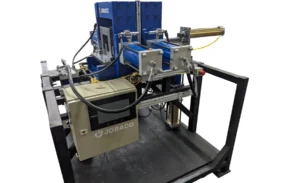
Following the conceptualization, the engineering phase commenced with the design of a robust mobile stand, meticulously engineered to provide dedicated mounting points for two high-performance, multistage hydropneumatic cylinders. These cylinders are central to the punching operation, providing the force required for precise material deformation. The structural integrity of the machine was paramount, necessitating rigorous stress simulations and iterative design refinements. AIM-Joraco’s engineers leveraged advanced CAD/CAE software to predict material stresses and optimize the machine’s structural supports, ensuring not only safe and precise punching operations but also enabling partial disassembly of the tooling area. This latter feature is a testament to thoughtful design, significantly simplifying maintenance routines and facilitating rapid tooling changeovers, which are crucial for manufacturers handling diverse product lines or adapting to evolving production needs.
The custom piercing dies themselves were a focal point of the design, specifically crafted to produce four distinct slots simultaneously across both sides of the stamped part. The horizontal configuration of the dies was chosen to optimize material flow and punch alignment, contributing to the overall efficiency and accuracy of the operation. This level of customization ensures that the machine is perfectly attuned to the specific geometry and material properties of the customer’s parts, a stark contrast to generic, off-the-shelf solutions that often require compromises in performance or flexibility.
Engineering Innovation: Hydropneumatic Power and Remote Piston Technology
A key innovation distinguishing this AIM-Joraco workcell is its ingenious application of remote piston technology. This advanced design enables the entire piercing operation to be performed using just two full-length hydropneumatic cylinders, a significant achievement given the complexity of punching four slots simultaneously. Traditional approaches might necessitate more cylinders or a more complex mechanical linkage, increasing machine footprint, maintenance complexity, and energy consumption. Remote piston technology effectively decouples the force generation point from the tooling, allowing for greater flexibility in machine layout and punch placement.
The integration of heavy-duty structural supports directly into the tool area further exemplifies AIM-Joraco’s commitment to precision and durability. These supports play a critical role in maintaining perfect alignment between the punches and dies, even when the punch operates at a considerable distance—more than 7 inches—from the cylinder piston. This robust structural integration is vital in preventing deflection and ensuring consistent, high-quality holes, which is particularly challenging in applications requiring punches to operate far from the power source. The stability offered by this design minimizes tool wear, reduces scrap rates, and extends the operational life of the machine, all contributing to a lower total cost of ownership for the client.
Hydropneumatic presses, a specialty of AIM-Joraco, offer a compelling alternative to traditional hydraulic or pneumatic presses in many industrial applications. They combine the speed of pneumatics during approach and return strokes with the high force capabilities of hydraulics during the working stroke. This hybrid technology provides energy efficiency, reduced noise levels, and precise force control, making them ideal for delicate yet powerful operations like punching, riveting, and pressing. The use of multistage cylinders further refines this, allowing for varying force profiles throughout the stroke, tailored precisely to the material being worked. The global market for industrial presses, including hydropneumatic systems, is projected to reach over $30 billion by the end of the decade, reflecting the sustained demand for efficient and powerful forming solutions across manufacturing sectors.
Broader Industry Context: The Drive Towards Smart Manufacturing
This custom workcell is not merely an isolated engineering feat; it is a microcosm of the broader trends sweeping through the manufacturing industry. The advent of Industry 4.0 has propelled manufacturers towards greater automation, data exchange, and smart factory concepts. In this landscape, bespoke solutions like the AIM-Joraco workcell are increasingly essential. While off-the-shelf machines offer standardization, they often fall short in addressing highly specific production challenges or integrating seamlessly with existing complex production lines.
The demand for custom machinery has been steadily rising, with projections indicating significant growth in the market for industrial automation solutions. Companies are seeking not just machines, but integrated systems that can communicate with other equipment, collect data, and adapt to changing production requirements. This particular workcell, with its accommodation for both automated gantries and human operators, exemplifies the move towards flexible manufacturing systems that can leverage the strengths of both robotics and human intelligence. It represents an investment in agility, allowing the customer to optimize their production line for current needs while retaining the flexibility to reconfigure for future product variations or increased demand.
The Role of Custom Automation in Modern Production
The rationale behind investing in custom automation is multifaceted. Firstly, it addresses unique bottlenecks or quality issues that standard equipment cannot resolve. For the unnamed customer, the simultaneous punching of four holes with high precision across both sides of a stamped part likely presented a challenge that required a tailored approach. Secondly, custom solutions can lead to significant cost savings in the long run by optimizing material usage, reducing cycle times, and minimizing scrap. A study by the National Institute of Standards and Technology (NIST) indicated that manufacturers could reduce production costs by up to 30% through advanced automation and smart manufacturing practices.
Thirdly, custom automation can enhance worker safety by removing human operators from hazardous or repetitive tasks. While the workcell accommodates human operators, its primary design intent for automated transfer signifies a move towards safer operational environments. Finally, it provides a competitive advantage by enabling manufacturers to produce higher quality products more consistently and efficiently, differentiate their offerings, and respond more quickly to market demands.
Implications and Future Outlook
The successful deployment of AIM-Joraco’s custom workcell carries significant implications for both the customer and the broader manufacturing industry.
Enhancing Efficiency and Safety in Stamping Operations: For the customer, the benefits are immediate and tangible. The automated transfer system, coupled with the simultaneous four-hole punching capability, dramatically reduces cycle times and increases throughput. Precision is significantly enhanced, leading to higher quality parts and fewer defects. The mobile worktable provides unparalleled flexibility, allowing the production line to be reconfigured with minimal downtime, adapting to different product runs or space constraints. By automating the most repetitive and potentially ergonomic-stressful tasks, the system also contributes to a safer working environment for human operators, who can now focus on supervision, maintenance, and more complex problem-solving. This translates directly into improved operational efficiency, reduced labor costs associated with manual handling, and a stronger return on investment.
AIM-Joraco’s Strategic Position in Advanced Manufacturing: For AIM-Joraco, this project reinforces its position as a leader in bespoke industrial automation and press systems. It showcases their deep engineering expertise, their capability to innovate with technologies like remote piston mechanisms, and their commitment to collaborative problem-solving. Successfully delivering such a complex, highly customized solution builds trust and credibility, potentially attracting other clients with similar intricate manufacturing challenges. This project could serve as a blueprint, demonstrating AIM-Joraco’s ability to tackle sophisticated integration projects, thereby expanding their market reach beyond standard press sales to full-scale automation solutions. It highlights the company’s strategic importance in helping manufacturers navigate the complexities of Industry 4.0.
Expert Perspectives and Market Trends
"The development of highly specialized, integrated workcells like this one is exactly what modern manufacturing needs," states Dr. Eleanor Vance, a leading analyst in industrial automation. "The ability to combine the power of hydropneumatic presses with intelligent automation, all within a flexible, mobile footprint, represents a significant leap. It addresses the core challenge manufacturers face today: how to achieve mass customization and high efficiency simultaneously. We are seeing a clear trend towards systems that can adapt, integrate, and optimize, rather than static, single-purpose machines."
The market for metal fabrication equipment, which includes press systems, is projected to grow at a compound annual growth rate (CAGR) of over 4% in the coming years, driven by increasing industrialization, particularly in emerging economies, and the continuous need for advanced manufacturing capabilities. Within this growth, custom automation solutions are carving out a larger share, as manufacturers seek to differentiate themselves through proprietary processes and optimized production flows.
The Evolving Landscape of Metal Stamping
The metal stamping industry is continually evolving, driven by demands for higher precision, lighter materials, and more complex part geometries. Innovations in tooling materials, sensor technologies, and predictive maintenance are transforming how stamped parts are produced. The integration of artificial intelligence and machine learning is also beginning to play a role, enabling machines to learn from operational data, predict potential failures, and optimize their performance autonomously. The AIM-Joraco workcell, with its focus on precise alignment and efficient force application, fits perfectly into this evolving landscape, demonstrating how fundamental mechanical engineering principles can be enhanced through smart design and advanced integration.
Conclusion: A Blueprint for Bespoke Manufacturing Excellence
The custom workcell designed and built by AIM-Joraco for simultaneously punching four holes in stamped metal parts stands as a testament to the power of tailored engineering solutions in the era of advanced manufacturing. By meticulously addressing the customer’s specific requirements for automation, flexibility, and precision, AIM-Joraco has not only delivered a highly efficient operational asset but has also showcased its innovative spirit, particularly through the application of remote piston technology and robust structural integration. This project serves as a compelling example of how collaborative engineering, combined with deep technical expertise, can unlock significant productivity gains, enhance product quality, and contribute to safer, more agile manufacturing environments. As industries continue to embrace the principles of Industry 4.0, the demand for such bespoke, intelligent automation solutions will only grow, positioning companies like AIM-Joraco at the forefront of this transformative wave.