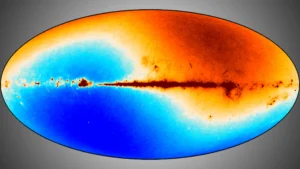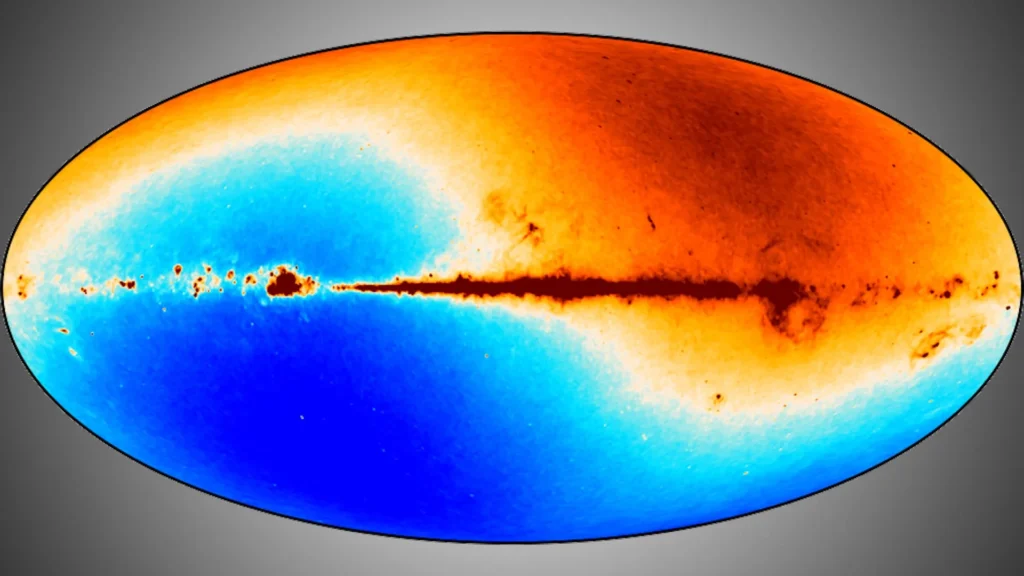
The shape of the universe, a concept rarely contemplated in daily life, has become the subject of a groundbreaking new study by a team of researchers, including this author’s colleagues, suggesting it could be fundamentally asymmetric or "lopsided." This revelation implies that the cosmos might not appear the same in every direction, a finding that directly challenges the bedrock assumptions of the prevailing "standard cosmological model." The implications of such an asymmetry are profound, potentially necessitating a radical rethinking of our understanding of the universe’s dynamics, structure, and evolution.
Challenging the Cosmological Orthodoxy: The Standard Model’s Foundation
The standard cosmological model, often referred to as the Lambda-CDM model (Lambda-Cold Dark Matter), stands as humanity’s most successful framework for describing the dynamics and large-scale structure of the entire cosmos. It posits a universe composed of ordinary matter, cold dark matter, and dark energy (represented by Lambda, Einstein’s cosmological constant). Crucially, this model rests on a fundamental assumption: that the universe is isotropic and homogeneous. Isotropic means it looks the same in all directions from any vantage point, while homogeneous implies it is uniform in its distribution of matter and energy when averaged over sufficiently large scales. These assumptions, collectively known as the "cosmological principle," vastly simplify the complex equations of Einstein’s theory of general relativity, allowing for a mathematically tractable description of the expanding universe, notably the Friedmann-Lemaître-Robertson-Walker (FLRW) metric. For decades, the FLRW description, underpinning the Lambda-CDM model, has provided a remarkably accurate fit to a vast array of observational data, from the expansion of space to the formation of galaxies. Its success has led cosmologists to largely accept its foundational principles as robust descriptions of reality.
The Universe’s Relic Glow: Understanding the Cosmic Microwave Background
A cornerstone of modern cosmology and a primary piece of evidence supporting the Big Bang theory is the Cosmic Microwave Background (CMB). Discovered accidentally in 1964 by Arno Penzias and Robert Wilson, the CMB is the faint afterglow, or relic radiation, left over from the Big Bang. It represents the oldest light in the universe, emitted approximately 380,000 years after the Big Bang when the universe had cooled sufficiently for protons and electrons to combine into neutral hydrogen atoms, making the universe transparent to photons. Observations by satellites like COBE, WMAP, and Planck have revealed the CMB to be remarkably uniform across the sky, with temperature variations of only about one part in a hundred thousand. This near-perfect isotropy has been a powerful testament to the universe’s early homogeneity and isotropy, reinforcing the FLRW description.
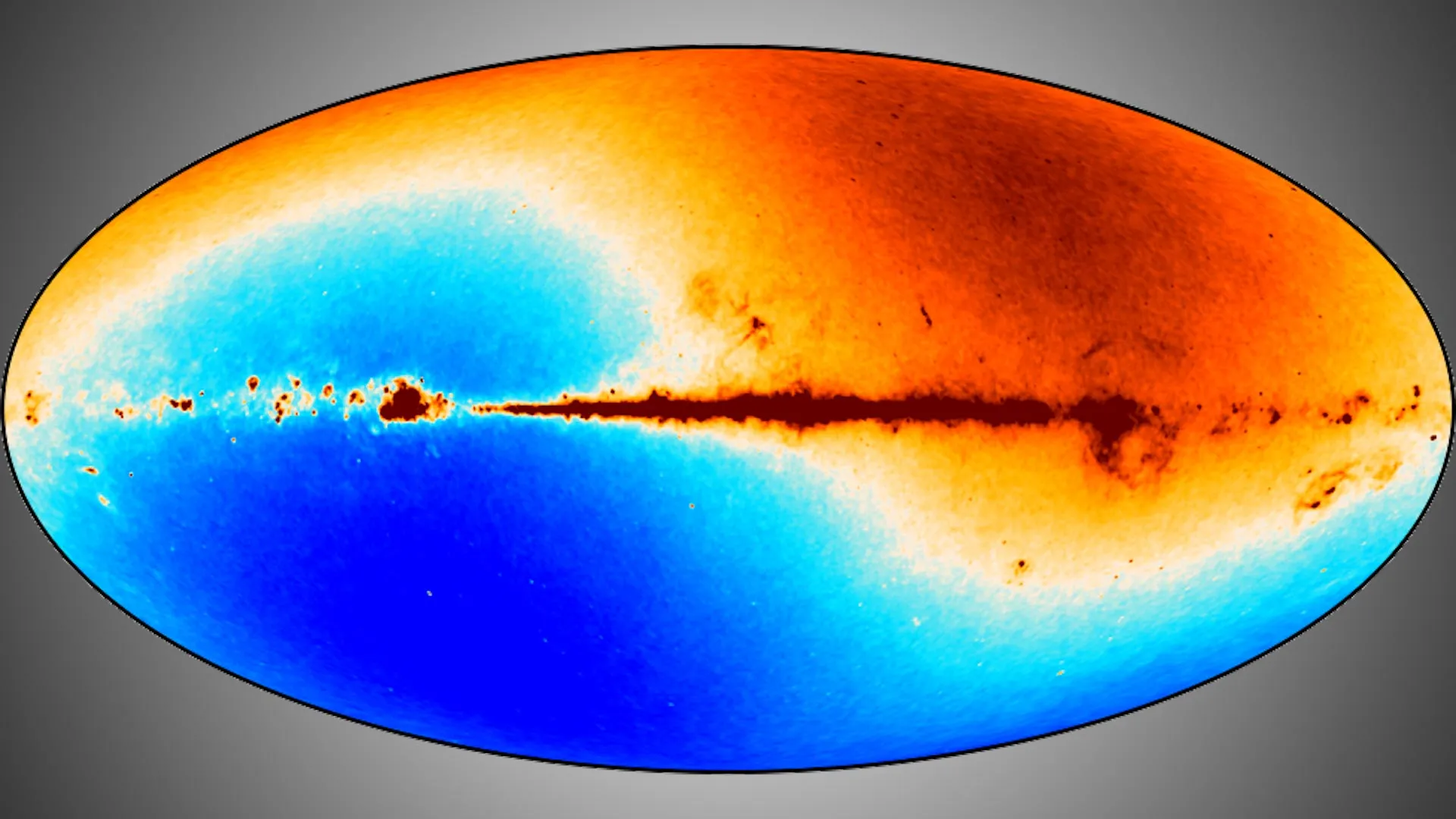
However, embedded within this uniformity are subtle variations. The most significant of these is the CMB dipole anisotropy. This is the largest temperature difference observed in the CMB, where one side of the sky appears slightly hotter and the opposite side slightly cooler, by about one part in a thousand. This dipole is widely understood not as an intrinsic property of the universe’s shape, but rather as a consequence of our solar system’s peculiar motion through space relative to the CMB rest frame. As our solar system rushes through the cosmos, we observe the CMB photons approaching us from the direction of our motion as blueshifted (slightly hotter) and those receding from us as redshifted (slightly cooler). This kinematic interpretation of the CMB dipole is fully consistent with the Lambda-CDM model and the FLRW metric, posing no challenge to the standard cosmological picture.
Unveiling the Cosmic Dipole Anomaly: A Deeper Challenge
The recently published paper, focusing on the cosmic dipole anomaly, asserts that this specific anomaly poses a severe challenge to the most widely accepted description of the universe, the Lambda-CDM model. Unlike the CMB dipole, which is attributed to our local motion, the cosmic dipole anomaly refers to a discordance in the observed distribution of matter at vast cosmological distances.
The question of whether a similar variation, or "dipole anisotropy," exists in the sky distribution of distant astronomical sources, such as radio galaxies and quasars, was first raised in 1984 by George Ellis and John Baldwin. Their crucial insight was that if the FLRW assumption of a symmetrical universe is correct, then any observed dipole in the distribution of matter from very distant sources should be directly determined by, and consistent with, the observed CMB dipole. This consistency would arise because both phenomena would be influenced by our motion relative to a truly isotropic and homogeneous universe. The sources must be sufficiently distant to ensure that any observed clustering is cosmological in origin rather than a spurious "clustering dipole" caused by nearby, gravitationally bound structures.
The Ellis-Baldwin Test: A Critical Examination
The methodology proposed by Ellis and Baldwin, now known as the Ellis-Baldwin test, provides a precise means to probe the universe’s large-scale structure. It posits that if the universe is indeed isotropic and homogeneous on large scales, then the dipole observed in the CMB (due to our motion) should correspond exactly to a dipole observed in the number counts or brightness of distant galaxies. That is, if we are moving towards one region of space, we should observe a higher apparent density or brightness of distant objects in that direction due to relativistic aberration and Doppler effects, perfectly matching the CMB dipole. Consistency between the variations in the CMB and in the distribution of distant matter would strongly support the standard Lambda-CDM model. Conversely, discord would directly challenge it, and indeed the fundamental FLRW description itself.
For decades, the observational data required to perform this extremely precise test was unavailable. However, with the advent of advanced telescopes and satellites gathering vast catalogues of distant radio galaxies and quasars, the necessary data has only recently become available. The outcome, as highlighted by the new study, is that the universe fails the Ellis-Baldwin test. The variation observed in the distribution of distant matter does not match that in the CMB. This discrepancy is not easily dismissed as an observational error; the same result has been obtained with diverse instruments, including terrestrial radio telescopes and satellites observing at mid-infrared wavelengths, employing different methodologies and sensitive to different parts of the electromagnetic spectrum. The cosmic dipole anomaly has thus solidified its position as a major challenge to the standard cosmological model.
Beyond the Dipole: The Hubble Tension and Other Discrepancies
The cosmic dipole anomaly is not an isolated problem; it joins a growing list of "tensions" or disagreements in cosmological data that pose challenges to the idea of a perfectly uniform universe. Perhaps the most widely debated of these is the Hubble tension. Named after Edwin Hubble, who in 1929 famously discovered that the universe is expanding, this tension emerged in the 2000s from different datasets. Measurements of the universe’s expansion rate (the Hubble constant, H₀) derived from observations of the early universe (primarily from the CMB) do not match measurements from the nearby, more recent universe (using standard candles like Type Ia supernovae observed by telescopes like the Hubble Space Telescope, and more recently, data from the Gaia satellite). The early universe measurements typically yield a lower value for H₀ (around 67-68 km/s/Mpc), while local measurements suggest a higher value (around 73-74 km/s/Mpc). This persistent 8-9% discrepancy has led to intense debate and numerous proposed solutions, none of which have fully resolved the issue without introducing new problems.
While the Hubble tension has garnered significant attention, the cosmic dipole anomaly, despite receiving less public and scientific focus, is arguably even more fundamental. The Hubble tension might imply a need for new physics within the Lambda-CDM framework (e.g., modified dark energy models or new early universe particles). The cosmic dipole anomaly, however, strikes at the very heart of the cosmological principle – the assumption of isotropy and homogeneity – which underpins the FLRW metric itself. If the universe is not isotropic, then the foundational equations used to describe its expansion and evolution are inherently flawed, requiring a return to first principles.
Why the Anomaly Matters: Implications for Fundamental Physics
The implications of the cosmic dipole anomaly are truly profound. The FLRW description, based on a maximally symmetric space-time, vastly simplifies the solution of Einstein’s equations of general relativity. Abandoning FLRW would mean confronting a much more complex, anisotropic universe. This would necessitate rethinking not just the Lambda-CDM model, but potentially our understanding of space-time itself on cosmological scales. Such a paradigm shift could impact our theories of gravity, the nature of dark energy and dark matter, and even the very early universe.
For instance, if the universe is indeed lopsided, it might imply a preferred direction in space, challenging the long-held assumption that the laws of physics are the same in all directions. It could suggest that the universe began with an intrinsic anisotropy that has persisted, or that some large-scale structure or dynamic process is influencing the distribution of matter in a way not accounted for by the standard model. Such a scenario could open doors to exotic physics, such as vector fields influencing cosmology, or even a universe that is rotating on vast scales. The "largely ignored" status of the cosmic dipole anomaly within the astronomical community might stem from the sheer difficulty and radical implications of patching up this problem. It’s not a matter of tweaking a parameter; it requires fundamentally reimagining the cosmic canvas.
The Scientific Community’s Response and Future Outlook
While the cosmic dipole anomaly may have been sidelined in public discourse compared to the Hubble tension, its significance is not lost on a subset of cosmologists. The scientific community, though perhaps hesitant to discard a highly successful model without overwhelming evidence, is increasingly aware of these accumulating tensions. The path forward will undoubtedly involve more precise observations and innovative theoretical work.
Fortunately, an unprecedented avalanche of new data is expected from upcoming missions and observatories. Satellites like Euclid, launched in 2023, are designed to map the large-scale structure of the universe with unprecedented precision, providing 3D maps of billions of galaxies over a third of the sky. SPHEREx (Spectro-Photometer for the History of the Universe, Epoch of Reionization, and Ices Explorer), slated for launch in 2024, will conduct an all-sky survey to gather data on galaxies and star-forming regions. On the ground, the Vera C. Rubin Observatory, with its Legacy Survey of Space and Time (LSST), will perform a decade-long survey, cataloging billions of celestial objects and generating an enormous amount of data relevant to cosmic expansion and large-scale structure. The Square Kilometre Array (SKA), currently under construction, promises to be the world’s largest radio telescope, offering unparalleled sensitivity to distant radio galaxies and quasars, crucial for the Ellis-Baldwin test.
These future datasets will provide vastly improved statistical power and reduce systematic uncertainties, either solidifying the evidence for an anisotropic universe or, perhaps, revealing new physics that resolves the apparent anomalies within the Lambda-CDM framework. It is conceivable that these new observations, combined with recent advances in artificial intelligence (AI), particularly machine learning, could offer bold new insights into constructing a new cosmological model. Machine learning algorithms are uniquely suited to sifting through immense datasets, identifying subtle patterns, and potentially uncovering hidden correlations that human analysis might miss. They could help theorists explore a wider range of alternative cosmological models, potentially pointing towards a new, more accurate description of our universe.
A New Era of Discovery
The potential impact of confirming a fundamentally asymmetric universe would be truly immense for fundamental physics and for our understanding of the cosmos. It would signify a new era of discovery, challenging physicists to revisit the very foundations of gravity and cosmology. It would mean that the universe is a more complex, perhaps less "perfect" place than we had imagined, holding secrets about its origin and evolution that are far more intricate than our current models allow. The cosmic dipole anomaly, once an esoteric inconsistency, is now emerging as a potential harbinger of a profound revolution in our cosmic worldview.