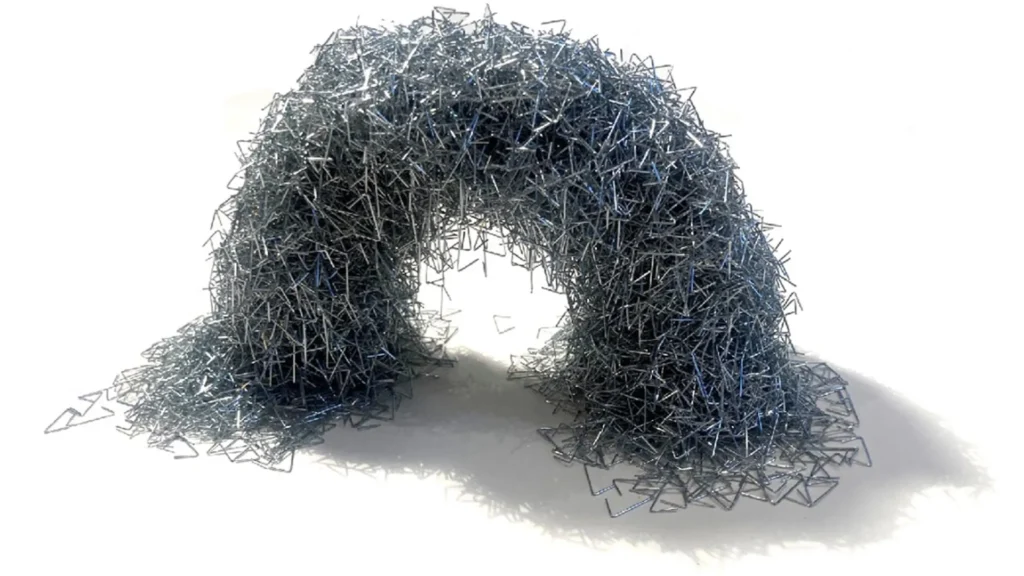
A tightly compressed bundle of office staples can behave in a surprising way. Even though it is made of many separate pieces, the tangled mass can be difficult to pull apart and can act almost like a single solid object. Yet that same bundle can quickly come undone. With the right vibration or movement, the staples can separate and return to a loose collection of individual pieces. This seemingly mundane observation has ignited a new frontier in material science, as researchers at the Paul M. Rady Department of Mechanical Engineering at CU Boulder believe this unusual combination of strength and reversibility could help inspire a new generation of engineered materials. By designing particles that interlock in a similar way to staples, they hope to create materials that are not only exceptionally strong and adaptable but also inherently recyclable, paving the way for a more sustainable future in construction, robotics, and beyond.
The Quest for Adaptable Materials: A Scientific Imperative
For decades, material scientists have grappled with a fundamental trade-off: achieving high strength often comes at the expense of toughness, and vice versa. Traditional materials, once formed, are largely static in their properties, limiting their adaptability to changing conditions or their end-of-life recycling potential. The pursuit of "smart materials" or "active materials" that can dynamically alter their properties in response to external stimuli has been a holy grail, driven by the increasing demand for advanced functionalities across diverse industries, from aerospace to biomedical engineering.
The challenge of creating materials that are both robust and reversible is particularly acute in an era increasingly focused on sustainability and the circular economy. Conventional construction, for instance, generates vast amounts of waste, with buildings often demolished rather than deconstructed, leading to significant environmental impact. Similarly, the rapid pace of technological innovation necessitates materials that can be easily repurposed or recycled, minimizing resource depletion and pollution. It is against this backdrop that the CU Boulder team’s recent findings, published in the Journal of Applied Physics, emerge as a significant breakthrough, offering a novel paradigm for material design rooted in the principle of mechanical entanglement.
Unraveling Nature’s Secrets: The Power of Entanglement
The research centers on a phenomenon known as entanglement, which occurs when particles become intertwined and form complex mechanical connections with one another. This principle is not new; nature has perfected entanglement over millennia, offering countless examples of its efficacy. Bird nests, for instance, defy gravity and withstand harsh weather not through strong chemical bonds but through a meticulously interwoven network of twigs and fibers. Bones, too, derive their remarkable strength and resilience from the intricate interaction of hard mineral components and softer, fibrous proteins, a sophisticated composite structure. Even the humble burdock burr, which inspired the invention of Velcro, demonstrates the power of mechanical interlocking.
Professor Francois Barthelat, leader of the Laboratory for Advanced Materials & Bioinspiration at CU Boulder, has been at the forefront of biomimetic material design for many years. "We’ve been playing around with the idea of building blocks and geometry for many years, but we started looking at interlocking, entangled particles only recently," Barthelat stated, highlighting the evolutionary shift in their research focus. This pivot towards entangled systems was driven by the recognition that purely geometric interactions, rather than chemical bonds, could offer unprecedented control over material properties, including the ability to transition between solid-like and fluid-like states.
From Sand Grains to Staple Shapes: A Journey in Particle Design
The CU Boulder team embarked on a systematic investigation to understand how similar natural principles could be harnessed to create manufactured materials with tunable properties. Their work quickly pointed to one crucial factor: the shape of the particles themselves. Youhan Sohn, a PhD student involved in the research, elucidated this concept: "Let’s take sand as an example. Sand is smooth and convex-shaped, meaning it cannot interlock from grain to grain. However, we found that if we change the shape of a grain of sand, we can drastically affect its behavior and mechanical properties, including the particle’s ability to link with other particles." This insight underscored the potential for designing particles that could actively participate in forming a robust, entangled network.
To investigate further, the researchers leveraged advanced computational techniques, specifically Monte Carlo simulations. This powerful statistical method allowed them to model and predict how different particle shapes would interact under various conditions, enabling them to explore a vast design space virtually. The primary objective was to identify a geometry that would maximize entanglement efficiency and strength, laying the groundwork for real-world material fabrication.
The "Two-Legged" Revelation: Why Staple-Shaped Particles Stand Out
Following the identification of promising designs through meticulous simulation, the team moved to the experimental phase, conducting rigorous pickup tests to observe how the particles behaved in tangible, real-world conditions. These tests involved creating aggregates of various particle shapes and then attempting to lift them, measuring the forces required to separate the entangled mass.
The results were compelling and unequivocally pointed to a "two-legged" particle, strikingly resembling a common office staple, as producing the highest degree of entanglement. This specific geometry offered several unexpected and highly beneficial characteristics. One of the most notable was its ability to combine tensile strength and toughness—two properties that are notoriously difficult to achieve simultaneously in conventional materials. Tensile strength refers to a material’s resistance to breaking under tension, while toughness describes its ability to absorb energy and deform plastically without fracturing. Typically, materials strong in one are weak in the other; for example, ceramics are incredibly strong but brittle, while many plastics are tough but lack ultimate strength.
"Our entangled granular material using the staple-like particle demonstrates both high strength and toughness at the same time," affirmed PhD student Saeed Pezeshki, highlighting a significant leap in material performance. This synergistic combination of properties opens up entirely new avenues for material design, enabling the creation of robust structures that can withstand both steady loads and sudden impacts.
Beyond this impressive mechanical performance, the staple-like particles displayed another truly unusual characteristic: their rapid and reversible assembly and disassembly. By precisely applying different vibration patterns, the researchers were able to control the degree of entanglement. Gentle, low-frequency vibrations encouraged the particles to interlock tightly, thereby strengthening the material. Conversely, stronger, higher-frequency vibrations caused the intricate network to unravel, allowing the material to quickly transition back to a loose collection of individual pieces.
"It’s a strange material because it’s obviously not a liquid. However, it’s also not quite solid. This opens new and intriguing engineering possibilities," Barthelat observed, emphasizing the unique phase-changing capabilities. He added, "Handling a bundle of these entangled particles feels very remote and exotic," hinting at the profound shift in tactile experience and functional potential these materials represent. This dynamic tunability, transitioning between solid-like rigidity and granular fluidity, is a hallmark of truly adaptable materials.
Beyond the Lab: Visionary Applications in Construction and Robotics
The implications of this breakthrough extend far beyond academic curiosity, promising to revolutionize several key industries. The researchers believe the technology could fundamentally support more sustainable approaches to construction, addressing some of the most pressing environmental challenges posed by the built environment.
In the not-so-distant future, bridges, buildings, and other large infrastructure might be constructed using entangled materials that can later be precisely taken apart rather than demolished. Such deconstructable structures could dramatically reduce construction waste, a major contributor to landfills globally. More importantly, the individual staple-like particles could potentially be reused directly or fully recycled at the end of their service life, fostering a truly circular economy in construction. This vision aligns perfectly with global initiatives pushing for reduced carbon footprints and enhanced resource efficiency in urban development. Imagine entire cities built with components designed for infinite reuse, drastically cutting down on raw material extraction and processing.
The concept may also have transformative applications in the burgeoning field of robotics. The ability of these materials to rapidly change their mechanical properties—from rigid to compliant and back again—makes them ideal candidates for a new generation of reconfigurable robots. "I was talking with other students who believe this technology can be used in swarm robotics – where small robots can entangle, do a task and then disentangle when they are done," Pezeshki explained.
Barthelat drew a vivid, if futuristic, parallel: "Yes, kind of like that liquid metal T-1000 in Terminator 2 who can change shape to slide under a door and then transform back to a human’s size on the other side." While acknowledging the significant hurdles of cost and scaling, he affirmed, "It’s expensive and scaling up is a challenge, but it’s something that’s on everybody’s mind." Such reconfigurable robotic systems could offer unprecedented flexibility in navigating complex environments, performing delicate manipulations, or even self-assembling into larger, more complex machines for specific tasks, then disassembling once complete. This could revolutionize areas like disaster response, space exploration, and advanced manufacturing.
Challenges and the Path Forward: Towards "Burr-Like" Particles
Despite the groundbreaking nature of these findings, the path from laboratory discovery to widespread industrial application is often fraught with challenges. Scaling up the production of precisely engineered particles, controlling their dynamic behavior in large-scale systems, and managing the economic viability of these novel materials are all significant hurdles that will require sustained research and development efforts. However, the potential benefits, both economic and environmental, provide a powerful incentive for overcoming these obstacles.
The CU Boulder team is already forging ahead, moving into the next exciting stage of their research. Their latest experiments focus on refining the particle design even further, exploring geometries that include additional protruding "legs." The researchers compare this advanced shape to the spiky burrs that cling stubbornly to shoes and clothing outdoors—a prime example of nature’s mastery of mechanical interlocking. They hypothesize that these added features could create even stronger entanglement effects, leading to materials with enhanced strength, toughness, and finer control over their reversible properties. This iterative design process, informed by both simulation and empirical testing, is crucial for unlocking the full potential of this technology.
The work at CU Boulder represents a compelling demonstration of how fundamental insights into particle mechanics can lead to revolutionary material systems. By mimicking nature’s ingenious solutions for entanglement and leveraging advanced engineering principles, researchers are poised to deliver a new class of materials that are not only stronger and more adaptable but also intrinsically designed for a sustainable future. The "exotic" feel of these materials, as described by Professor Barthelat, is a testament to their departure from conventional material paradigms and their promise to redefine what is possible in engineering and design.