Researchers at the École Polytechnique Fédérale de Lausanne (EPFL) have pioneered a groundbreaking 3D printing technique that overcomes the inherent limitations of traditional vat photopolymerization, paving the way for the cost-effective fabrication of exceptionally strong and intricate metal and ceramic objects. This novel approach, detailed in a recent publication in the prestigious journal Advanced Materials, fundamentally shifts the paradigm of additive manufacturing by decoupling material selection from the initial printing stage.
A New Era for Additive Manufacturing: Beyond Light-Sensitive Polymers
Vat photopolymerization, a prevalent form of 3D printing, relies on a light-sensitive liquid resin that is selectively solidified by a laser or ultraviolet light source to build objects layer by layer. While this method has facilitated the creation of complex geometries, its utility has been largely confined to polymers due to the light-reactive nature of the materials. Efforts to transform these printed polymers into more robust materials like metals and ceramics have historically encountered significant hurdles.
"Previous attempts to convert printed polymers into dense metal or ceramic components often resulted in materials that were highly porous," explained Daryl Yee, who leads the Laboratory for the Chemistry of Materials and Manufacturing at EPFL’s School of Engineering. "This porosity severely compromises their structural integrity, leading to a significant reduction in strength. Furthermore, these processes typically induced excessive shrinkage, causing the printed parts to warp and lose their dimensional accuracy." These drawbacks have historically relegated such advanced materials to niche applications or necessitated expensive and complex post-processing steps.
The limitations have been a persistent challenge in the field. For instance, the demand for lightweight yet robust components in aerospace and automotive industries, or the need for precise metallic structures in microelectronics and medical implants, has long outstripped the capabilities of existing polymer-to-metal conversion techniques. The inherent trade-off between geometric complexity and material strength has been a constant source of innovation frustration.
The EPFL Innovation: A Hydrogel Framework for Material Alchemy
The EPFL team’s innovative solution circumvents these challenges by reversing the conventional process. Instead of embedding metal compounds directly into a light-sensitive resin, their method begins with the 3D printing of a structural framework using a simple, water-based gel known as a hydrogel. This hydrogel acts as a scaffold, providing the initial shape and volume for the final object.
"Our approach allows us to first establish the desired form with remarkable precision using an accessible and inexpensive hydrogel," stated Yee. "This initial printed template is then subjected to a series of carefully controlled chemical transformations to imbue it with metallic or ceramic properties."
Following the printing of the hydrogel framework, the researchers immerse it in a solution containing metal salts. Through a process of chemical conversion, these metal salts are transformed into tiny, metal-containing nanoparticles that evenly disperse throughout the porous hydrogel structure. This crucial step ensures a uniform distribution of the desired material throughout the nascent object.
The "Growth Cycle" Technique: Building Density and Strength
The key to achieving high material density and exceptional strength lies in the iterative nature of this process. The hydrogel "blank" is repeatedly soaked in the metal salt solution and undergoes the chemical conversion multiple times. Each "growth cycle" deposits more metal-containing nanoparticles, gradually increasing the metallic content of the composite structure.
"By repeating this infusion and conversion process five to ten times, we can achieve composites with a remarkably high metal content," Yee elaborated. "This multi-stage infiltration is critical for building up the material density and ensuring that the final object is not only shaped correctly but also possesses the desired mechanical properties."
After the completion of these growth cycles, the remaining hydrogel matrix is removed through a controlled heating process. This thermal treatment burns away the organic hydrogel, leaving behind a solid, dense metal or ceramic object. Crucially, the final object precisely replicates the intricate shape of the original hydrogel print.
An added advantage of this methodology is its versatility. Because the metal salts are introduced after the initial 3D printing of the hydrogel template, the same template can be utilized to produce a wide array of different materials. This means that a single hydrogel structure can be converted into iron, silver, copper, or various ceramic compositions, offering unparalleled flexibility in material selection for a given design.
A Paradigm Shift: Material Choice Post-Printing
This decoupling of material selection from the printing process represents a significant departure from established additive manufacturing workflows. Traditionally, the material choice dictates the printing technology and process parameters. In the EPFL team’s method, the design is printed first, and then the material is tailored to that design.
"Our work not only enables the fabrication of high-quality metals and ceramics with an accessible, low-cost 3D printing process; it also highlights a new paradigm in additive manufacturing where material selection occurs after 3D printing, rather than before," Yee summarized. This innovative approach has the potential to democratize the production of advanced materials, making them more accessible to researchers, engineers, and manufacturers across various sectors.
Demonstrating Precision and Strength: Gyroid Lattices in Focus
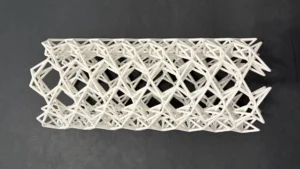
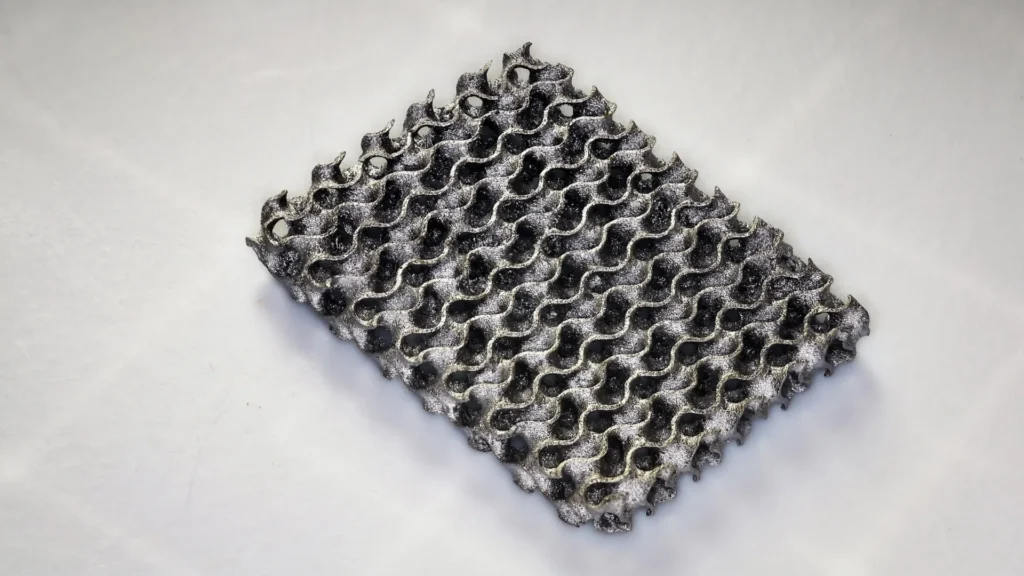
To validate their technique, the EPFL researchers fabricated complex mathematical lattice structures known as gyroids. These intricate, self-supporting architectures were produced in iron, silver, and copper. The choice of gyroids was deliberate, as their high surface area and complex internal geometry make them ideal candidates for applications requiring both strength and lightweight properties.
The strength of these fabricated gyroid lattices was rigorously tested using a universal testing machine. This device applies increasing pressure to the samples until they deform or fracture, providing quantitative data on their mechanical performance.
"Our materials could withstand 20 times more pressure compared to those produced with previous methods, while exhibiting only 20% shrinkage versus 60-90%," reported Yiming Ji, a PhD student and the first author of the study. This dramatic improvement in strength and reduction in shrinkage underscores the efficacy of the hydrogel-based approach. The significant reduction in warping is particularly noteworthy, as it directly translates to improved dimensional accuracy and reduced post-processing requirements for complex parts.
Implications for Advanced Technologies: From Catalysts to Biomedical Devices
The ability to create strong, lightweight, and complex 3D architectures has profound implications for a wide range of advanced technologies. The researchers highlight several key areas where their technique could be transformative:
- Sensors: The high surface area and tunable porosity of the fabricated materials are ideal for developing highly sensitive and efficient sensors for environmental monitoring, industrial process control, and medical diagnostics.
- Biomedical Devices: The precision achievable with this method, combined with the potential to create biocompatible metals and ceramics, opens doors for advanced implants, prosthetics, and tissue engineering scaffolds. For example, porous metallic implants can encourage bone ingrowth, leading to better integration with the body.
- Energy Conversion and Storage: Devices involved in energy conversion and storage often rely on materials with specific surface properties and complex internal structures to maximize efficiency. Metal catalysts, for instance, are crucial for enabling reactions that convert chemical energy into electricity in fuel cells. High-surface-area metals produced by this method could also find applications in advanced battery technologies and thermoelectric devices.
- Cooling Technologies: The intricate, high-surface-area designs achievable could lead to significantly improved cooling solutions for high-performance electronics and industrial machinery, dissipating heat more effectively.
The potential for creating metal catalysts with optimized pore structures and surface areas is particularly exciting. These catalysts are fundamental to numerous chemical processes, and improvements in their design and fabrication can lead to more efficient and environmentally friendly industrial operations.
Future Directions: Scaling Up and Accelerating Production
While the EPFL team’s breakthrough is significant, they are already looking towards the future to further refine and industrialize their process. Key areas of focus include increasing material density even further and accelerating the production timeline.
"We are already working on bringing the total processing time down by using a robot to automate these steps," Yee stated. The current multi-step infusion process, while essential for achieving high material content, can be more time-consuming than some conventional 3D printing methods. Automating these repetitive steps with robotic precision is expected to significantly reduce the overall manufacturing time, making the technology more competitive for industrial applications.
Another ongoing objective is to further enhance the density of the printed materials. Achieving near-theoretical densities would further push the boundaries of strength and performance, opening up even more demanding applications.
A Milestone in Additive Manufacturing
The research conducted at EPFL represents a significant leap forward in the field of additive manufacturing. By developing a versatile and robust method for creating intricate metal and ceramic components from a simple hydrogel template, the team has overcome critical limitations of existing technologies. The ability to precisely control material composition and structure post-printing, coupled with the enhanced mechanical properties and reduced shrinkage, positions this technique as a promising solution for the next generation of advanced materials and high-performance devices. The journey from a light-reactive polymer to a dense, high-strength metal or ceramic has been dramatically simplified and made more accessible, heralding a new era of innovation in 3D printing.