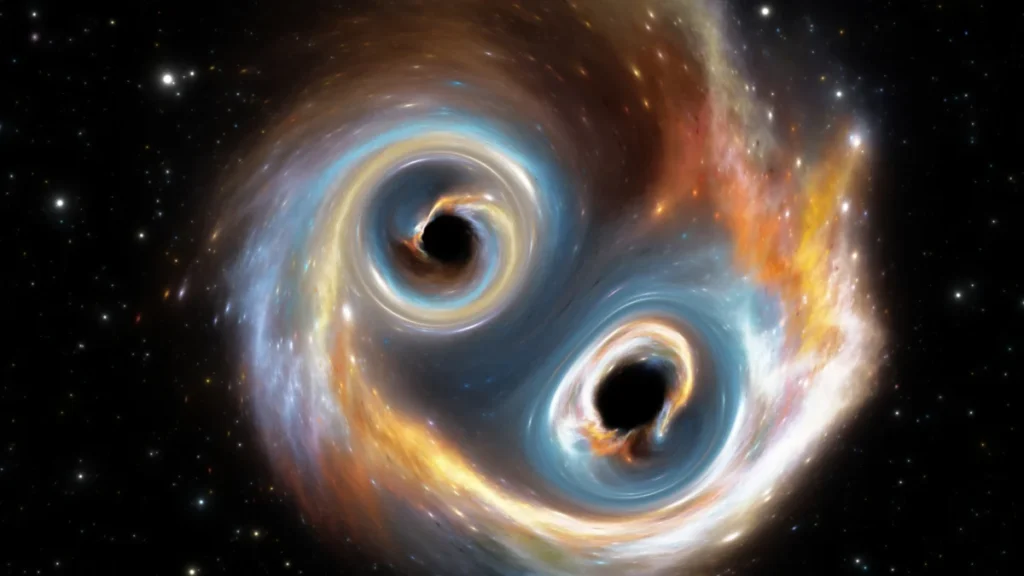
Black holes, enigmatic cosmic entities renowned for their insatiable gravitational pull and their propensity for cataclysmic mergers, have long been understood to coalesce into larger, more massive versions of themselves. This fundamental aspect of their behavior is well-documented through observations of gravitational waves, which are ripples in spacetime generated by these colossal collisions. However, a groundbreaking new theoretical study posits a radical alternative: could a black hole, under extreme conditions, tear itself apart and fragment into two smaller entities? This intriguing proposition challenges deeply ingrained assumptions about black hole thermodynamics and the very limits of Einstein’s theory of general relativity.
A recent investigation delves into this counterintuitive possibility, suggesting that a black hole spinning at an almost maximal rate—approaching the theoretical limit allowed by physics—might possess the necessary characteristics for such a fission event. While the laws governing black holes inherently make such a breakup extraordinarily difficult, the study identifies a narrow set of conditions under which it could theoretically occur. These findings are crucial for scientists seeking to probe the boundaries of Albert Einstein’s century-old theory of general relativity, potentially revealing novel behaviors of black holes that extend beyond our current understanding of the cosmos. The implications could reshape our models of astrophysical phenomena and even hint at physics beyond the Standard Model.
Challenging the Cosmological Status Quo: Mergers Versus Fission
For decades, the prevailing narrative in astrophysics has been one of black hole accretion and merger. From stellar-mass black holes, born from the collapse of massive stars, to supermassive black holes residing at the hearts of galaxies, their growth is primarily attributed to consuming surrounding matter and merging with other black holes. Landmark observations by the LIGO (Laser Interferometer Gravitational-Wave Observatory) and Virgo collaborations, beginning in 2015 with the detection of GW150914, have provided irrefutable evidence of black hole mergers, confirming a major prediction of general relativity and opening the era of gravitational-wave astronomy. These events typically involve two black holes spiraling inward, eventually colliding and fusing to form a single, more massive black hole, emitting a tremendous burst of gravitational waves in the process. The total mass of the resulting black hole is slightly less than the sum of the initial two, with the difference converted into energy in the form of gravitational waves.
Against this backdrop of confirmed mergers, the idea of a black hole splitting represents a significant departure. The study’s authors highlight the profound implications of their work: "Our analysis clarifies the theoretical landscape where black holes may fragment, which is particularly relevant for primordial black holes and catastrophic events such as black hole mergers." This statement underscores that understanding the potential for fragmentation is not merely an academic exercise but could offer new insights into the lifecycle of black holes, especially those formed in the early universe.
The Entropic Barrier: Why Black Holes Resist Splitting
One of the most formidable obstacles to a black hole splitting is rooted in the fundamental laws of thermodynamics, specifically the concept of entropy. In the context of black holes, entropy is a measure of the number of microscopic configurations a system can have while appearing the same from the outside. Jacob Bekenstein and Stephen Hawking famously demonstrated that black holes possess entropy, proportional to the area of their event horizons. For a non-rotating black hole (described by the Schwarzschild metric), its entropy is directly linked to the square of its mass.
Consider the scenario of a single non-rotating black hole attempting to split into two smaller ones. If the combined mass of the two resulting black holes were equal to the mass of the original, their total entropy would necessarily be less than that of the original, larger black hole. This reduction in total entropy would violate the second law of thermodynamics, which states that the total entropy of an isolated system can only increase or remain constant over time; it can never decrease. Therefore, from a purely thermodynamic standpoint, the splitting of a non-rotating black hole is profoundly unfavorable and effectively forbidden by the laws of physics as we understand them.
Francesco Sannino, a co-author of the study and a professor of physics at the University of Naples Federico II, articulated the core challenge: "In our study, we investigate which physical laws normally prevent a black hole from splitting into two. We also investigate if certain circumstances may allow a split to happen." This highlights the rigorous approach taken by the researchers to identify not just the barriers but also any potential "loopholes" in these fundamental laws.
Extreme Rotation: A Narrow Theoretical Loophole
The researchers discovered that rapidly rotating black holes, described by the Kerr metric, could offer a potential pathway to circumvent the entropic barrier. Unlike non-rotating black holes, the relationship between a rotating black hole’s mass, angular momentum, and entropy is more complex. The presence of angular momentum can significantly alter the properties of the event horizon and, consequently, its associated entropy.
For a rapidly spinning black hole, the addition of angular momentum contributes to its overall "energy budget" in a way that can make fragmentation thermodynamically more favorable than it would be for a non-rotating black hole. In essence, the energy stored in the black hole’s rotation might be leveraged to overcome the entropy deficit associated with splitting. The faster a black hole spins, the more angular momentum it possesses, and the more potential energy it has stored in its rotation. This property is routinely investigated through methods such as measuring black hole spin, which can be inferred from the dynamics of accretion disks or gravitational wave signals. An "extremal" black hole is one that spins at the maximum rate physically possible without shedding its event horizon, possessing the maximum allowed angular momentum for its mass. It is in this extreme regime that the theoretical conditions for splitting become most plausible.
However, merely satisfying the entropy requirement is insufficient. The theoretical framework dictates that for a split to genuinely occur, the two resulting black holes must also possess enough kinetic energy and momentum to successfully move apart and overcome their mutual gravitational attraction. If they lack this outward impetus, they would simply fall back together and re-merge, rendering the initial split transient and unobservable. When the researchers incorporated this critical requirement into their calculations, the window for a stable, observable split narrowed considerably, potentially remaining open only for black holes spinning infinitesimally close to their absolute maximum possible rate. This makes such an event exceedingly rare and contingent on highly specific initial conditions.
The geometric transformation involved in such a splitting event is also fascinating. If a black hole were to divide, its event horizon—the point of no return beyond which light cannot escape—would bifurcate, separating into two distinct horizons. When traced through the fabric of spacetime over time, this evolving geometry would graphically resemble a "pair of trousers," with a single, unified section branching out into two separate "legs." This evocative imagery gives rise to the study’s unusual but descriptive term: "pair-of-pants topologies." This conceptualization offers a visual representation of how spacetime itself would warp and reconfigure during such an exotic event.
Beyond Einstein: Exploring Exotic Physics and Higher Dimensions
The researchers further pushed the boundaries of current understanding by exploring more speculative scenarios, including the potential influence of additional spatial dimensions and theories that extend beyond Einstein’s classical general relativity. While our universe is observed to have three spatial dimensions plus time, many theoretical frameworks, such as string theory, propose the existence of extra, curled-up spatial dimensions that are not readily apparent to us.
In theoretical models of higher-dimensional gravity, certain black-hole-like objects, such as "black strings" (hypothetical black holes extended infinitely in one or more extra dimensions), can exhibit instabilities that lead to fragmentation. Under these exotic conditions, the splitting of a black hole might become thermodynamically favorable, particularly if one of the resulting fragments is significantly smaller than the other. This asymmetry in mass could help balance the entropy budget in ways not possible in four-dimensional spacetime.
It is crucial to emphasize, however, that a favorable entropy balance, even in these exotic scenarios, does not definitively prove that fragmentation will actually occur. The calculations primarily identify the necessary conditions and theoretical possibilities, not a confirmed mechanism for ordinary black holes to spontaneously divide. The universe’s fundamental laws are complex, and the mere possibility of an event does not guarantee its realization.
Sannino underscored this point, stating, "We cannot yet give a single probability for a black hole to split. It depends on how gravity behaves beyond Einstein’s theory, and we are working to quantify this." This highlights the ongoing nature of theoretical physics research and the dependence of such exotic phenomena on the as-yet-unconfirmed aspects of quantum gravity and unified field theories.
The Role of Primordial Black Holes and Future Detection
One particularly intriguing aspect of the study concerns primordial black holes (PBHs). These hypothetical black holes are believed to have formed not from the collapse of massive stars, but from density fluctuations in the extremely hot, dense plasma of the early universe, shortly after the Big Bang. Unlike stellar or supermassive black holes, PBHs could theoretically span a vast range of masses, from microscopic (Planck mass) to much larger, even earth-mass. Their existence, if confirmed, could provide answers to pressing cosmological questions, including the nature of dark matter.
The study suggests that small primordial black holes might be more susceptible to splitting than their much larger astrophysical counterparts. Sannino elaborated on this, noting, "We expect small primordial black holes to be more prone to splitting than much larger astrophysical black holes. We may detect a split indirectly: gamma-ray telescopes such as Fermi-LAT can search for signals from tiny black-hole fragments that might form during mergers." This statement offers a tangible pathway for potential future observational confirmation. If very small black holes were to fragment, they could potentially evaporate rapidly via Hawking radiation, emitting bursts of gamma rays or other particles that could be detected by instruments like the Fermi Gamma-ray Space Telescope. These unique signatures could serve as indirect evidence of a splitting event, providing an unprecedented window into the most extreme physics of the universe.
Broader Implications for Fundamental Physics and Astrophysics
This theoretical research carries profound implications across several domains of physics and astronomy:
- Testing General Relativity: The study directly probes the limits of Einstein’s general relativity. If black holes can indeed split under certain conditions, it would mean that the theory, while incredibly successful, might require modifications or extensions at extreme energy scales or in the presence of very high angular momentum. This could point towards new physics beyond the classical framework.
- Understanding Black Hole Evolution: While mergers are the dominant mode of black hole growth, fragmentation could represent an exotic, albeit rare, mode of black hole evolution, particularly for primordial black holes. This would add a new dimension to our understanding of the black hole population in the universe.
- Insights into Quantum Gravity: The discussion of entropy and the behavior of spacetime at the event horizon intrinsically links this research to the elusive theory of quantum gravity, which aims to unify general relativity with quantum mechanics. Phenomena like black hole splitting could provide theoretical clues for developing a complete theory of quantum gravity.
- Search for Exotic Astrophysical Phenomena: The potential observational signatures, particularly from primordial black holes, could guide future searches for novel astrophysical events. Detecting such signals would not only confirm the splitting hypothesis but also provide strong evidence for the existence of primordial black holes themselves, a major goal in modern cosmology.
- Higher Dimensions and Fundamental Theories: The exploration of extra spatial dimensions and alternative gravity theories highlights the interdisciplinary nature of modern physics. It underscores how theoretical explorations in one area can inform and be informed by research in fundamental theories like string theory or loop quantum gravity.
For now, the research establishes a compelling theoretical possibility under highly restrictive conditions, not definitive evidence that any black hole has ever been divided into two. The next crucial step for the scientific community is to quantify the likelihood of fragmentation under various theoretical models of gravity, moving from qualitative possibility to statistical probability. If the splitting of tiny primordial black holes is indeed a viable phenomenon, their unique observational signatures could offer an indirect, yet powerful, means to investigate this exotic process and further refine our understanding of gravity and the fundamental nature of spacetime.
The study, a significant contribution to theoretical astrophysics, is published in the esteemed journal Physical Review D. As researchers continue to push the boundaries of theoretical physics and observational astronomy, the universe consistently reveals itself to be far more complex and wondrous than previously imagined, continuously challenging our most cherished assumptions and inviting us to explore new frontiers of knowledge.