The intricate dance of atoms, long theorized but rarely observed in real-time, has now been captured with unprecedented clarity, offering a groundbreaking insight into the fundamental mechanisms of radiation damage. In a recent study, an international team of researchers, spearheaded by scientists from the Molecular Physics Department, directly witnessed atoms moving in a "roaming" pattern before undergoing a specific type of radiation-driven decay. This remarkable observation provides a crucial missing piece in understanding how high-energy radiation wreaks havoc on biological systems and materials, potentially paving the way for more targeted therapies and protective measures.
Unpacking the Perils of Radiation: A Microscopic Battle
High-energy radiation, an omnipresent force from cosmic rays to medical X-rays, poses a significant threat to living organisms and technological systems alike. Its destructive power stems from its ability to disturb the delicate balance of atoms and molecules within cells. When these energetic particles strike, they can excite electrons, leading to ionization – the ejection of an electron from an atom or molecule. This initial event triggers a cascade of chemical reactions, creating highly reactive species like free radicals, which can break chemical bonds, damage DNA, denature proteins, and ultimately disrupt the complex machinery of life.
The consequences range from immediate cellular death to long-term genetic mutations that can lead to cancer. In medical contexts, while radiation therapy is a cornerstone in cancer treatment, its efficacy is often hampered by collateral damage to healthy tissues. Similarly, astronauts on long-duration space missions face continuous exposure to cosmic radiation, raising concerns about their long-term health. Understanding the precise atomic and molecular events that unfold in the wake of radiation exposure is therefore not merely an academic pursuit but a critical imperative for human health and technological advancement.
Electron-Transfer-Mediated Decay (ETMD): A Hidden Pathway to Damage
Among the myriad decay processes initiated by radiation, one specific mechanism, known as electron-transfer-mediated decay (ETMD), has garnered increasing scientific interest. Unlike simpler direct ionization events, ETMD involves a more complex, non-local energy transfer. The process begins when radiation excites an electron in one atom, creating a ‘hole’ or vacancy. To stabilize itself, this excited atom then draws an electron from a neighboring atom. The energy released during this electron transfer is not dissipated as light or heat in the first atom but instead is transferred to a third nearby atom, causing it to eject a low-energy electron.
This low-energy electron is particularly insidious. While high-energy radiation can cause damage directly, low-energy electrons have been shown to be exceptionally efficient at inducing chemical changes and breaking bonds in biological molecules, including DNA. They possess just enough energy to interact resonantly with molecular orbitals, leading to specific, highly damaging reactions. Consequently, unraveling the intricacies of ETMD is paramount for developing accurate models of radiation damage, especially in complex environments like water – the primary component of biological tissues.
Pioneering the Observation: The Experimental Setup and Methodology
To shed light on this elusive process, the international research team embarked on an ambitious experimental campaign, employing cutting-edge techniques to observe atomic motion at timescales previously unimaginable. Their choice of a model system was critical: a simple trimer consisting of one neon atom weakly bound to two krypton atoms (NeKr2). This minimalist arrangement provided a tractable system to study ETMD without the overwhelming complexity of larger biomolecules.
The experiment commenced by precisely targeting the neon atom with soft X-rays. These X-rays possess sufficient energy to knock out an electron from the neon atom, initiating the ETMD process. What followed was a remarkable feat of atomic surveillance. Using an advanced COLTRIMS (Reaction Microscope) at the highly sophisticated synchrotron facilities BESSY II in Berlin and PETRA III in Hamburg, the researchers meticulously tracked the evolution of the system for an astonishing duration – up to a picosecond (one trillionth of a second). While seemingly fleeting, a picosecond is an exceptionally long period on an atomic timescale, allowing ample opportunity to observe the subtle atomic reconfigurations before the final decay occurred.
The COLTRIMS microscope, a marvel of precision engineering, functions by detecting all charged fragments (ions and electrons) resulting from the decay event in coincidence. By measuring their momentum and trajectories, scientists can reconstruct the exact positions and movements of the atoms at the very moment of decay. This provides a "snapshot" of the atomic arrangement just before the electron transfer and emission.
Crucially, these groundbreaking experimental observations were not conducted in isolation. They were paired with extensive ab initio simulations. These sophisticated computational models tracked thousands of possible atomic pathways, calculating the probability of decay along each trajectory. The synergy between direct experimental observation and detailed theoretical modeling provided a robust framework for interpreting the complex atomic dynamics, ensuring the findings were not only accurate but also deeply understood.
The "Atomic Dance": Unforeseen Nuclear Motion
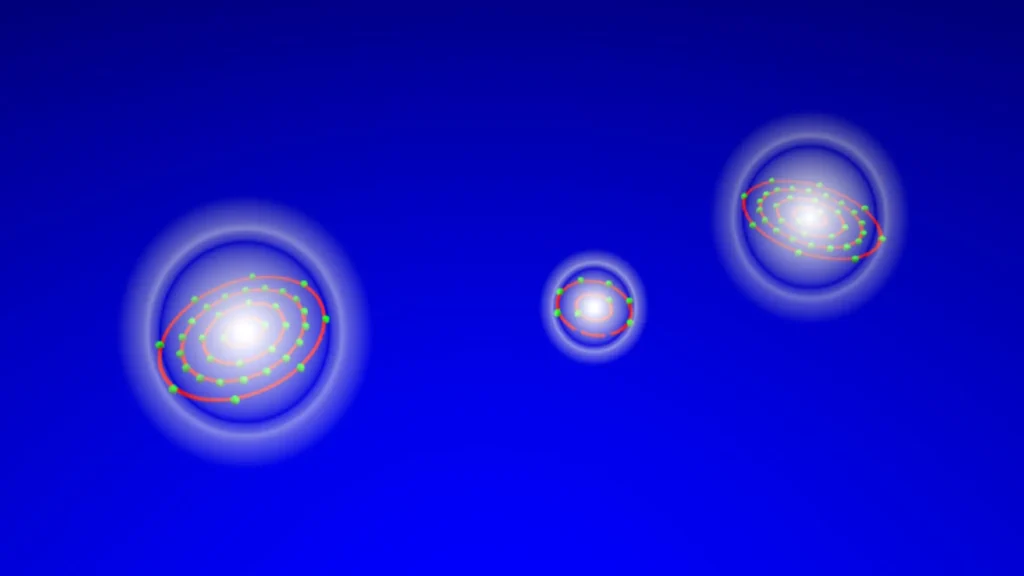
The results of this meticulously planned study delivered a profound surprise, challenging long-held assumptions about how atoms behave during decay processes. Conventional wisdom often presumes that atoms remain relatively fixed in their positions, with the decay being primarily an electronic phenomenon. However, the NeKr2 trimer revealed a starkly different reality: the atoms were far from static. Instead, they engaged in a dynamic, "roaming-like" pattern, constantly shifting their positions and reshaping the local structure of the system. This continuous motion, the researchers discovered, profoundly influenced both the timing and the ultimate outcome of the ETMD process.
"We can literally watch how the atoms move before the decay happens," remarked Florian Trinter, one of the lead authors of the study, emphasizing the directness of their observation. His statement underscores a pivotal shift in understanding: "The decay is not just an electronic process – it is steered by nuclear motion in a very direct and intuitive way." This revelation implies that the physical rearrangement of the atomic nuclei is not merely a consequence of the electron transfer but an active participant, guiding and even dictating the probability and efficiency of the decay.
Beyond Electronic Processes: The Role of Nuclear Dynamics
The study systematically documented the chronology of these atomic reconfigurations. Early in the picosecond observation window, the decay tended to occur when the atoms were close to their initial, relatively stable configuration. However, as time progressed, the system began to explore a wider "configuration space." The researchers observed that one krypton atom would migrate closer to the neon atom, while the other krypton atom would drift further away. This transient geometric arrangement, they found, created particularly favorable conditions for the electron transfer and energy flow characteristic of ETMD.
At even later stages within the picosecond timeframe, the atoms adopted more stretched and distorted shapes, exhibiting a pronounced swinging, roaming motion. These continuous changes in geometry directly impacted the decay rate, causing it to vary significantly depending on the instantaneous atomic arrangement. This fluctuating decay rate provides compelling evidence that nuclear motion is not a minor perturbation but a fundamental control mechanism for non-local electronic decay processes like ETMD.
Till Jahnke, a senior author of the study, articulated the significance of these findings, stating, "The atoms explore large regions of configuration space before the decay finally takes place. This shows that nuclear motion is not a minor correction – it fundamentally controls the efficiency of non-local electronic decay." This statement represents a paradigm shift, asserting that the physical movement of atomic nuclei is as crucial, if not more so, than the electronic interactions themselves in determining the fate of a system under radiation.
Why ETMD is a Critical Area of Study: Broadening the Horizon
The implications of this study extend far beyond the confines of basic atomic physics. The ability to precisely track atomic motion and understand its influence on ETMD has profound ramifications for a multitude of scientific and technological domains.
Medical Science and Radiotherapy: In cancer treatment, radiotherapy aims to maximize damage to tumor cells while minimizing harm to surrounding healthy tissues. A deeper understanding of ETMD and the role of low-energy electrons could lead to the development of more precise radiation delivery techniques or radiosensitizing drugs that exploit or mitigate these atomic-level processes. By knowing how and when these damaging low-energy electrons are produced, medical physicists could refine treatment plans, potentially reducing side effects and improving patient outcomes. This knowledge could also inform the design of novel radio-protective agents.
Space Exploration and Radiation Shielding: As humanity ventures further into space, protecting astronauts and sensitive electronics from high-energy cosmic radiation becomes increasingly vital. Current shielding technologies are often bulky and heavy. Insights into atomic-level damage mechanisms like ETMD could inspire the development of advanced, lightweight materials designed to specifically interrupt or neutralize the harmful cascades initiated by radiation. Understanding how materials degrade under constant bombardment, particularly through low-energy electron emissions, is crucial for ensuring the long-term integrity of spacecraft and habitats.
Fundamental Chemistry and Physics: This research pushes the boundaries of our understanding of molecular dynamics and energy transfer. It provides an unprecedented benchmark for the simplest three-atom system capable of ETMD, offering a robust foundation for extending these insights to much larger and more complex systems. This includes understanding radiation effects in liquids (like water), solvated ions, and intricate biological macromolecules such as DNA and proteins. The study’s methodologies also represent a powerful new approach for imaging ultrafast dynamics in weakly bound matter, opening doors to studying transient states and reaction intermediates that were previously inaccessible.
Future Research and Technological Advancements: The success of combining COLTRIMS microscopy with advanced synchrotron facilities and ab initio simulations highlights the power of interdisciplinary approaches. This synergy is likely to drive further innovation in experimental techniques and theoretical modeling. Future research could focus on applying these methods to more complex model systems, gradually building up to realistic simulations of biological environments. The development of theoretical models capable of accurately predicting these nuclear motions and their effects will be essential for translating these fundamental discoveries into practical applications.
A Foundation for Future Discoveries
In conclusion, this groundbreaking study represents a significant leap forward in our understanding of radiation damage at its most fundamental level. By providing a "movie" of atoms roaming and reorganizing before a critical decay event, the researchers have unveiled a hidden driver of damage, demonstrating that nuclear motion is not a passive bystander but an active, controlling force. "This work shows how non-local electronic decay can be used as a powerful probe of molecular motion," the authors assert, underscoring the dual impact of their findings. It not only illuminates a key mechanism of radiation damage but also establishes a novel technique for imaging ultrafast dynamics in weakly bound matter with unparalleled detail. This foundational research sets the stage for a new era of discoveries, promising to revolutionize our ability to mitigate the harmful effects of radiation across diverse scientific and technological frontiers.