New scientific research involving an international collaboration of researchers from University College London (UCL), the Chinese Academy of Sciences, and several other prestigious institutions has revealed that Saturn’s magnetic field is fundamentally different from that of Earth. Unlike the relatively symmetrical and balanced "bubble" that protects our planet from solar radiation, Saturn’s magnetosphere is noticeably uneven and distorted. This asymmetry, characterized by a significant shift in the planet’s magnetic "cusp," is driven by the gas giant’s rapid rotational speed and the massive amounts of plasma generated by its volcanic moon, Enceladus.
The study, published in the journal Nature Communications, utilizes over half a decade of data from NASA’s historic Cassini mission to map the complex interactions between Saturn’s internal magnetic forces and the external pressure of the solar wind. The findings suggest that for massive, fast-spinning planets, internal dynamics—rather than external solar forces—are the primary architects of their magnetic environments.
The Nature of the Magnetic Cusp and the Discovery of Asymmetry
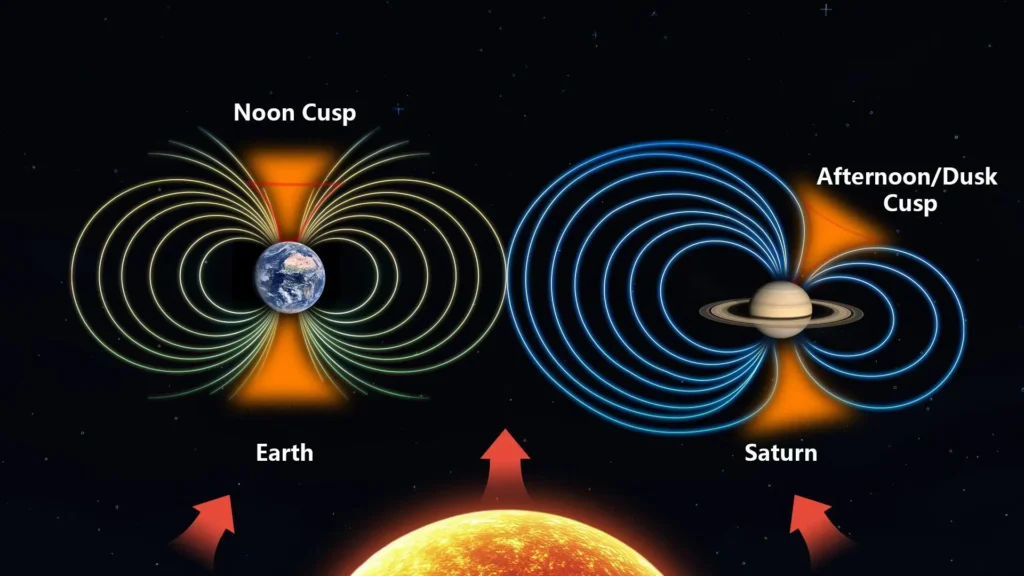
A magnetosphere is a region of space surrounding a planet where its magnetic field dominates the behavior of charged particles. For Earth, this field acts as a vital shield, deflecting the solar wind—a stream of high-energy particles emitted by the Sun. However, this shield is not impenetrable. Every magnetosphere has "cusps," which are funnel-like regions near the magnetic poles where the field lines bend inward toward the planet’s interior. These cusps allow solar wind particles to leak into the upper atmosphere, often resulting in phenomena such as the aurora borealis and aurora australis.
On Earth, the magnetic cusp is generally aligned with the Sun, appearing at a position equivalent to 12:00 on a clock face when viewed from the direction of the Sun. However, the new analysis of Saturn shows a starkly different configuration. By examining 67 distinct "cusp events" recorded by the Cassini spacecraft between 2004 and 2010, researchers discovered that Saturn’s cusp is consistently displaced.
Rather than sitting at the 12:00 position, Saturn’s cusp is shifted to the right, typically appearing between 1:00 and 3:00. This displacement indicates a massive, global distortion of the magnetic bubble. The research team concludes that this "sideways pull" is the result of a unique tug-of-war between the planet’s rotation and the material it carries through space.
The Role of Rapid Rotation and the Enceladus Plasma Engine
Two primary factors have been identified as the culprits behind this magnetic warping: Saturn’s incredible rotational velocity and the presence of a dense "soup" of ionized gas, or plasma, within its orbit.
Saturn is a behemoth that spins with surprising speed. Despite having a diameter nine times larger than Earth’s, it completes a full rotation on its axis in just 10.7 hours. This rapid spin generates immense centrifugal forces that influence everything in the planet’s vicinity. However, rotation alone is not enough to cause the observed shift; the magnetic field needs "weight" to be pulled.
This weight is provided by Enceladus, one of Saturn’s most active and intriguing moons. Enceladus is famous for its "tiger stripe" fractures near its southern pole, which eject massive plumes of water vapor and icy particles from a subsurface liquid ocean into space. Once in space, this water vapor becomes ionized—stripped of electrons by radiation—turning into a heavy plasma.
Because this plasma is trapped within Saturn’s magnetic field, the planet’s rapid rotation flings the heavy material outward and drags it around the planet. This creates a "mass-loading" effect. The sheer weight of the plasma, combined with the momentum of the 10.7-hour rotation, stretches the magnetic field lines and pulls the cusp away from its expected solar alignment.
A Legacy of Data: The Cassini-Huygens Mission
The findings are a testament to the enduring scientific value of the Cassini-Huygens mission, a joint endeavor by NASA, the European Space Agency (ESA), and the Italian Space Agency (ASI). Launched in 1997, Cassini arrived at Saturn in 2004 and spent 13 years orbiting the planet before its "Grand Finale" plunge into the Saturnian atmosphere in 2017.
To reach their conclusions, the research team focused on a six-year window of data (2004–2010). Identifying a cusp crossing is a complex task that requires correlating data from multiple scientific instruments. The team relied heavily on the Cassini Magnetometer (MAG) and the Cassini Plasma Spectrometer (CAPS).
The CAPS instrument, which featured an electron sensor developed by a team at UCL’s Mullard Space Science Laboratory, was essential for detecting the specific energy signatures of electrons as the spacecraft passed through the cusp. By identifying 67 such events, the researchers were able to build a statistically significant map of the cusp’s location over time, proving that the shift was a permanent feature of the magnetosphere rather than a fleeting anomaly.
Comparative Planetary Science: Earth vs. Gas Giants
This study provides critical evidence for a long-standing theory in planetary physics: that the magnetospheres of gas giants operate under fundamentally different rules than those of terrestrial planets like Earth.
On Earth, the solar wind is the dominant force. The shape of our magnetosphere is dictated by how hard the Sun "pushes" against our magnetic field. In contrast, at Saturn—and likely at Jupiter—the internal forces of rotation and mass-loading from moons are the dominant drivers.
Professor Zhonghua Yao of the University of Hong Kong, a corresponding author of the study, noted that these differences are essential for developing a "unified" understanding of how planets interact with their stellar environments. By comparing Earth’s solar-driven system with Saturn’s rotation-driven system, scientists can create better models for predicting the behavior of exoplanets—planets orbiting other stars—many of which are "Hot Jupiters" or gas giants with even more extreme rotational and plasma environments.
The simulations conducted by the team also revealed that the interaction between Saturn’s magnetosphere and the solar wind at its outer boundaries shares similarities with Jupiter. This suggests that the "gas giant model" of magnetospheres is a distinct category in astrophysics, characterized by internal momentum over external solar pressure.
Implications for Future Exploration and the Search for Life
The timing of this research is particularly relevant as space agencies turn their sights back toward the outer solar system. Enceladus has become a primary target in the search for extraterrestrial life due to its subsurface ocean, which contains the chemical building blocks necessary for biology.
The European Space Agency (ESA) is currently in the early stages of planning a mission to return to the Saturnian system in the 2040s, with a specific focus on Enceladus. Understanding the magnetic environment is not just a matter of theoretical physics; it is a practical necessity for mission planning.
"A better understanding of Saturn’s environment is especially urgent now as plans for our return to Saturn and its moon Enceladus start to be developed," said co-author Professor Andrew Coates of UCL. "These results feed into the excitement that we are going back there. This time we will look for evidence of habitability and for potential signs of life."
Knowing the exact location and behavior of the magnetic cusp is vital for spacecraft safety and data collection. High-energy particles funneled through the cusp can interfere with sensitive electronics. Furthermore, because the cusp is the "doorway" for the solar wind, mapping it allows scientists to understand how energy is transferred from the Sun into the Saturnian system, which in turn affects the chemistry of the moon’s plumes and the planet’s upper atmosphere.
Scientific Collaboration and Funding
The study was a global effort, reflecting the international nature of modern space science. Lead author Dr. Yan Xu of the Southern University of Science and Technology in China worked alongside colleagues from the Chinese Academy of Sciences and the University of Hong Kong, as well as the UK-based team at UCL.
The research received support from several major funding bodies, including the UK’s Science & Technology Facilities Council (STFC) and the National Natural Science Foundation of China. This cross-border cooperation allowed the team to combine high-resolution observational data with advanced numerical simulations, providing a more complete picture of the Saturnian magnetosphere than was previously possible.
Conclusion: A New Map of the Saturnian System
The discovery that Saturn’s magnetic field is lopsided changes our fundamental understanding of the planet’s relationship with its moons and the Sun. It reinforces the idea that Enceladus is not merely a passive satellite but a dynamic engine that physically reshapes the space environment of its parent planet.
As scientists continue to pore over the mountains of data left behind by the Cassini mission, and as they look forward to new missions in the coming decades, the image of Saturn as a balanced, symmetrical giant has been replaced by something much more complex. It is a planet in a constant state of internal tension, where the speed of its spin and the icy breath of its moons create a magnetic shield unlike any other in our solar system. This research provides the roadmap for the next generation of explorers who will venture into the 1:00 to 3:00 "shift" of Saturn’s magnetic cusp in search of the secrets of the outer solar system.