Backyard Brains, a pioneer in accessible neuroscience tools, has unveiled SpikerBot, an innovative robot designed to democratize understanding of both robotics engineering and fundamental neuroscience by allowing users to program "brains on wheels" using virtual neurons rather than traditional code. This groundbreaking educational platform, which emerged from a vision to bridge significant gaps in science education, promises to make complex concepts of intelligence and behavior accessible to a wider audience, from young students to seasoned enthusiasts. The initiative, spearheaded by Co-Founder & CEO Greg Gage and Designer Alex Hatch, represents a paradigm shift in how we approach teaching robotics, moving away from abstract computational logic towards intuitive, biologically-inspired design.
A New Frontier in Learning: Programming with Neurons
At its core, SpikerBot reimagines the very act of programming. Traditional robotics often introduces learners to the intricate world of computer logic, requiring mastery of "if-then" statements, loops, and variables—a steep learning curve that can often overshadow the excitement of bringing a robot to life. SpikerBot, by contrast, eschews this conventional approach entirely. Its accompanying application facilitates the creation of behavioral "sketches" built from virtual neurons, synapses, and neural circuits. As the creators emphatically state, "there’s no code, no LLMs, just neurons, synapses, and behavior emerging from a circuit a kid designed." This philosophical underpinning is deeply rooted in the work of Valentino Braitenberg, particularly his seminal 1984 book Vehicles: Experiments in Synthetic Psychology, which demonstrated how surprisingly complex, "lifelike" behaviors could emerge from simple, direct connections between sensors and motors. SpikerBot embodies this principle, allowing users to observe intricate behaviors arising from elementary neural configurations.
The significance of this neural-network-based programming lies in its directness and intuitiveness. Instead of grappling with abstract commands, users manipulate fundamental building blocks of biological intelligence. They drag and drop virtual neurons and axons on a screen, forming connections that mimic the brain’s own architecture. This visual, tactile interface resonates more with how humans intuitively understand cause and effect, transforming programming from a language-based task into a spatial, circuit-building exercise. The creators liken the experience to "moving cables on a patch synthesizer," an analogy that highlights the immediate, holistic view of the entire system. This visual representation ensures that users can grasp the "whole picture in one pulled-back overview," fostering a more integrated understanding of their robot’s emergent behaviors.

The immediate visual feedback, where neural activity is displayed live as the robot senses and moves, further enhances this direct engagement. Changes—such as modifying a neuron from excitatory to inhibitory—are instantaneous, reflecting on the robot’s behavior without the delays of compilation or uploading. This rapid iteration cycle fosters a culture of experimentation and discovery, aligning the pace of learning with the pace of thought itself. This "happens at the pace of thought and experimentation" approach is crucial for maintaining engagement, particularly for younger learners who thrive on immediate results and tangible consequences of their actions.
This novel programming language presents an intriguing inversion of complexity. Behaviors traditionally considered challenging for beginner robotics, such as a robot following a person or autonomously tracking an object, become remarkably straightforward with SpikerBot. A creature capable of chasing objects, for instance, can be fashioned with as few as two neurons, demonstrating the profound emergent properties of simple neural circuits. Conversely, tasks that are trivial in conventional computer logic, like counting in binary, transform into intricate webs of neuronal connections within SpikerBot’s paradigm. This contrast highlights SpikerBot’s unique focus on natural, adaptive behaviors over purely logical computation, offering a fresh perspective on intelligence and machine interaction that mirrors biological systems more closely than typical algorithmic approaches. This intuitive focus on natural behaviors is expected to keep users engaged longer, allowing them to "slowly build in dog-like responses at a natural pace" rather than being bogged down by prerequisite programming fundamentals.
Bridging the Neuroscience Education Divide
Beyond its innovative approach to robotics, SpikerBot is poised to address a critical void in contemporary neuroscience education. Greg Gage and Alex Hatch identified a pervasive "neuroscience illiteracy" stemming from a fragmented curriculum. Students typically learn the basics of a single neuron in elementary school, but the continuity is often lost until college-level courses, where the focus shifts abruptly to the complex interplay of millions of neurons. This significant educational gap, akin to understanding a single transistor but then jumping directly to advanced Python programming without intermediate electronics knowledge, leaves many without a foundational understanding of how brains actually work. Statistics from organizations like the Society for Neuroscience indicate that while interest in brain science is growing, accessible educational tools for K-12 remain limited, perpetuating this knowledge gap.
SpikerBot serves as a crucial bridge over this chasm. By providing a hands-on platform to construct and observe neural circuits, it introduces students to the principles of neural networks at an accessible, intermediate level. Users are not just programming a robot; they are actively building and experimenting with simplified models of a brain. This experiential learning allows them to discover fundamental neurological patterns such as recurrent pairs (where neurons mutually excite each other, forming basic memory loops), lateral inhibition (where the activation of one neuron suppresses the activity of its neighbors, crucial for sensory discrimination and pattern recognition), and the basic mechanisms underlying working memory. These are not abstract concepts presented in a textbook but dynamic principles observed directly in their robot’s emergent behaviors. The ability to visualize "live spiking activity" within the app further reinforces this direct connection between neural architecture and observed behavior.

The development of SpikerBot’s educational framework was a meticulous and collaborative effort, informed by the insights of both child educators and professional neuroscientists. This interdisciplinary approach ensures that the learning journey is not only engaging but also scientifically accurate and pedagogically sound for various age groups. The app includes a rich library of sample "brain models," allowing users to deconstruct, modify, and learn from pre-built behaviors. This guided exploration encourages analytical thinking and fosters a deeper appreciation for the biological underpinnings of intelligence. The goal is to provide a "shared language and understanding of building-block brain patterns," which extends beyond academic curiosity. With an estimated 1 in 5 people experiencing some form of neurological condition, fostering a basic understanding of brain function can significantly contribute to greater empathy, reduce stigma, and improve public discourse surrounding neurological health, making neuroscience education a vital component of public literacy.
Hardware, Expandability, and Sustainable Design
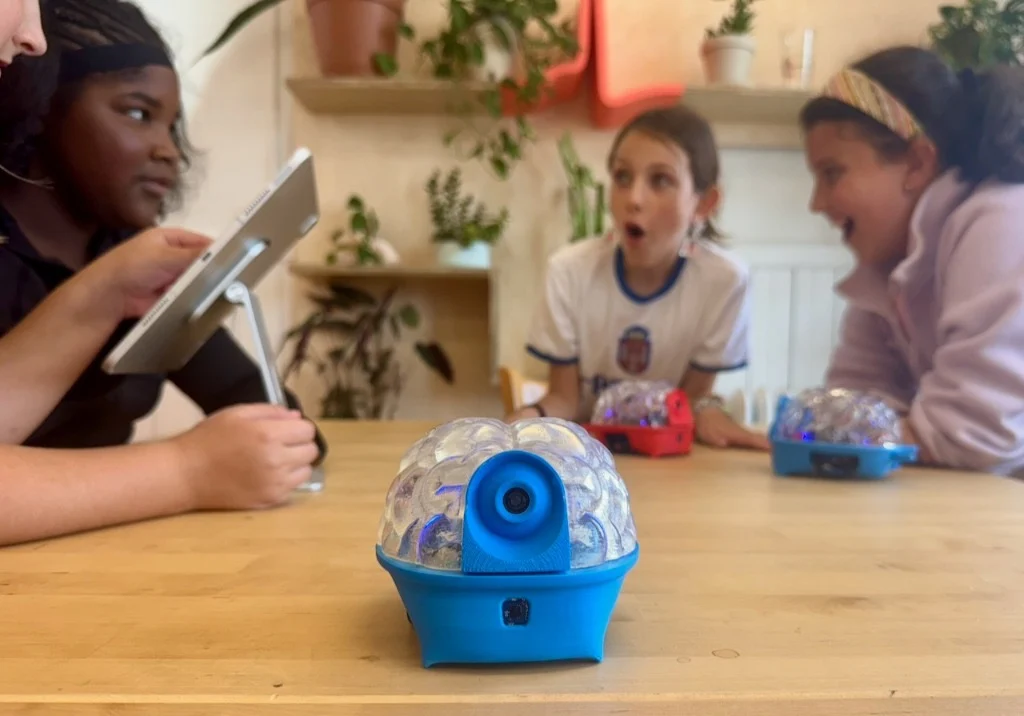
The intelligence of SpikerBot’s software is complemented by its thoughtfully designed hardware. The robot itself is a compact, brain-shaped chassis, a playful nod to Backyard Brains’ own logo, signifying its core purpose. It’s equipped with a comprehensive suite of sensors—a camera for visual input, a microphone for auditory perception, and a distance sensor for spatial awareness—allowing it to actively recognize and react to its real-world environment. This array of sensors provides rich data streams that can be interpreted by the user-designed neural circuits, leading to nuanced and responsive behaviors. Its output mechanisms, including lights and sounds, have been meticulously crafted for naturalistic responses. The lights don’t merely switch on and off; they pop on and subtly fade out, mimicking the gentle luminescence of bioluminescent cells, adding an organic feel to the robot’s expressions. The sound effects are designed to be charming and quirky, adding personality to the robot’s emergent behaviors, further enhancing the illusion of a "life-like" creature.
Customization is a key aspect of SpikerBot’s appeal, fostering creativity and personal connection. Connection points integrated into the chassis enable the attachment of 3D-printed accessories, allowing owners to personalize their bot and imbue it with a unique character. This feature encourages users to explore design and fabrication alongside programming, integrating multiple STEM disciplines. Imagine a SpikerBot configured as a "cat" reacting to a real feline or tracking a ball of yarn, or a "dragon" creature responding to its environment, all powered by a user-designed neural circuit. This open-ended design fosters creativity and allows for endless possibilities in form and function.
Furthermore, SpikerBot is not a standalone system but integrates into Backyard Brains’ broader ecosystem of neuroscience tools. It supports peripherals like their existing Spiker:bit board, which enables advanced experimentation. This compatibility means users can potentially connect their SpikerBot to their own muscle signals via biofeedback, effectively controlling their robot’s "brain" with their own biological impulses. This unprecedented level of interaction blurs the lines between human and machine, offering profound insights into neuro-prosthetics and the control of external devices through biological signals, a field of increasing relevance in medical and assistive technologies.

In an era often characterized by planned obsolescence and reliance on proprietary ecosystems, Backyard Brains has made a conscious commitment to long-term usability and sustainability. The SpikerBot app is free, eliminating subscription barriers, and critically, it operates without requiring cloud-based authentication. This ensures that the educational experience remains accessible and functional regardless of internet connectivity or future service changes, empowering users with full control over their learning environment. The robot is powered by easily swappable AA batteries, a deliberate choice over non-replaceable lithium cells that invariably degrade over time, leading to device obsolescence. Backyard Brains further supports this sustainable design by offering their own custom, high-performance NiMh AA batteries, promoting rechargeability and reducing electronic waste. These design choices reflect a commitment not just to innovative education but also to environmental responsibility and user autonomy, ensuring the product’s longevity and value.
The Genesis and Future Trajectory of SpikerBot
The journey of SpikerBot from concept to a tangible educational tool has been a meticulous process, reflecting Backyard Brains’ established expertise in making complex science accessible. Greg Gage and Alex Hatch have guided its development with a clear vision: to create a tool that is both profoundly educational and genuinely fun. Backyard Brains itself has a history of successful crowdfunding campaigns, having consistently delivered on ambitious projects that demystify neuroscience. Their previous products, such as the original SpikerBox, which allowed users to record electrical activity from insect neurons, have garnered widespread acclaim for their ability to bring university-level experiments into classrooms and homes. This proven track record instills significant confidence in their ability to deliver SpikerBot and continue its development, mitigating the inherent risks associated with crowdfunding.
The SpikerBot Kickstarter campaign, which was launched with an ambitious goal, is slated to conclude on June 14th. It offers an opportunity for early adopters to secure the robot at a reduced price of $219, significantly lower than the projected retail price of $299. This funding mechanism not only helps bring the product to market but also fosters a community of early enthusiasts who will contribute to its future evolution. The initial campaign has garnered considerable attention, demonstrating a clear demand for innovative STEM tools that merge robotics with fundamental biological principles, particularly in a market increasingly seeking hands-on, engaging educational experiences.
Looking ahead, the potential of SpikerBot extends far beyond its initial release. The developers have a roadmap of additional features and capabilities, including expanded sensor compatibility and more sophisticated neural modeling options. However, they also emphasize the open-ended nature of the platform, recognizing that true innovation often comes from the user community. Alex Hatch articulates this philosophy succinctly: "a lot we haven’t seen because you guys haven’t built anything yet." This statement underscores a core belief in user-driven innovation, inviting the community to explore the vast, undiscovered behavioral landscapes that can emerge from novel neural circuit designs. The platform is designed to be a living, evolving ecosystem, continuously enriched by the creativity and experimentation of its users, with future updates likely incorporating community feedback and popular neural circuit designs.

Broader Implications for STEM and Beyond
SpikerBot’s introduction carries significant implications across several domains. For STEM education, it represents a powerful tool to invigorate interest in robotics and neuroscience, particularly for younger demographics who might be intimidated by traditional coding. By lowering the barrier to entry and making the learning process inherently engaging and intuitive, it can foster a new generation of engineers, scientists, and critical thinkers. The emphasis on emergent behavior also aligns with contemporary pedagogical trends that prioritize inquiry-based learning and problem-solving over rote memorization, encouraging students to experiment and discover rather than simply follow instructions. The global educational robotics market is projected to grow significantly in the coming years, and SpikerBot positions itself as a unique offering within this expanding landscape.
Beyond the classroom, SpikerBot contributes to the broader public understanding of artificial intelligence and biological computation. In an era dominated by discussions around large language models (LLMs) and complex AI algorithms, SpikerBot offers a tangible, simplified model to explore the foundational principles of neural networks. It demonstrates that intelligence, even in its most rudimentary forms, can arise from interconnected simple units, providing a compelling contrast to purely symbolic or statistical AI approaches. This hands-on experience can demystify AI concepts, making them less abstract and more approachable, and introduce the concepts of neuromorphic computing.
Furthermore, the robot’s focus on natural behaviors and its connection to biological brain patterns has profound implications for understanding neurological conditions. By allowing users to simulate simple forms of working memory or sensory processing, it offers a tangible way to grasp how disruptions in these circuits might manifest. This experiential learning can foster greater empathy and understanding for individuals living with conditions ranging from ADHD to Parkinson’s disease, ultimately contributing to a more informed and compassionate society. The project also subtly champions open science and sustainable technology, promoting practices that prioritize user empowerment and environmental consciousness, setting a new standard for educational tech.
In essence, SpikerBot is more than just a robot; it is a pedagogical revolution on wheels. By merging the excitement of robotics with the profound insights of neuroscience, Backyard Brains is not only making learning fun but also cultivating a deeper, more intuitive understanding of what it means to think, to behave, and to be alive. It stands as a testament to the power of innovative design to unlock complex scientific principles, promising to inspire countless individuals to explore the fascinating frontier where biology meets engineering, shaping the future of how we interact with and comprehend intelligence.