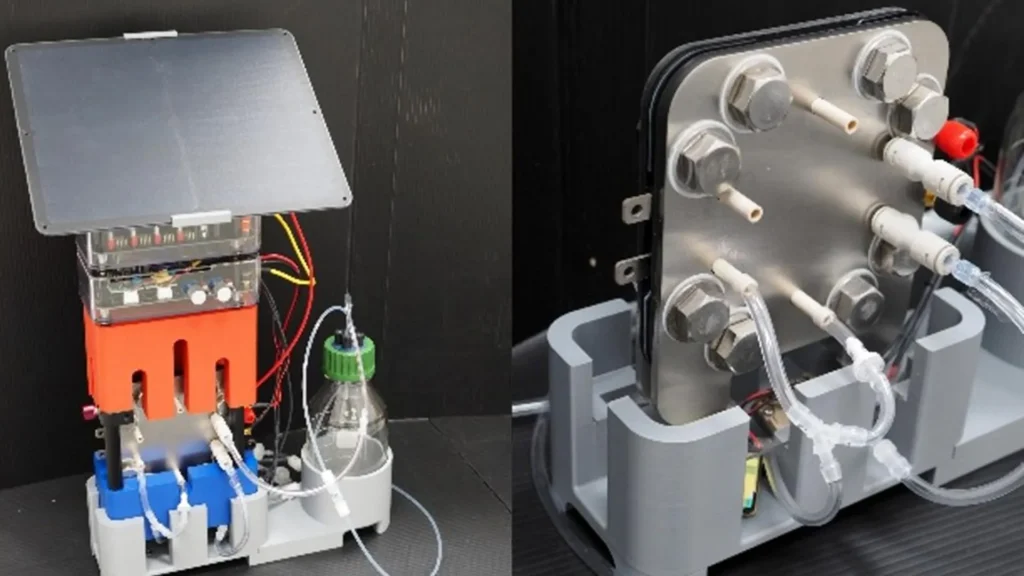
Researchers at Osaka Metropolitan University have engineered a groundbreaking artificial photosynthesis system capable of generating solar fuel with unprecedented consistency, critically eliminating the need for complex, battery-based control equipment. This significant leap forward stems from the ingenious integration of a self-regulating chemical component directly into the electrolyzer, a design innovation that promises to drastically reduce both system complexity and overall cost, paving the way for more accessible and efficient renewable energy solutions.
The fundamental principle behind artificial photosynthesis mirrors nature’s own processes, leveraging sunlight to transform ubiquitous elements like water and carbon dioxide into energy-rich compounds. Among these valuable products is formic acid, a versatile chemical compound that not only serves as a viable fuel source but also offers an efficient means of storing intermittent solar energy. This latest advancement from Osaka Metropolitan University marks a crucial step in overcoming some of the most persistent hurdles in the widespread adoption of solar fuel technologies.
The Global Imperative for Sustainable Energy and Solar Fuels
The quest for sustainable energy solutions has become one of humanity’s most pressing challenges in the 21st century. With global energy demand projected to rise significantly in the coming decades and the escalating urgency of climate change mitigation, the transition away from fossil fuels towards clean, renewable sources is paramount. While solar and wind power have seen remarkable growth, their inherent intermittency — the sun doesn’t always shine, and the wind doesn’t always blow — poses a substantial challenge for grid stability and continuous energy supply. This is where solar fuels, produced through processes like artificial photosynthesis, offer a transformative solution. By converting solar energy directly into chemical bonds, these fuels provide a means of storing vast amounts of energy in a dense, transportable form, effectively decoupling energy generation from immediate consumption and addressing the intermittency problem head-on.
Formic acid, specifically, holds considerable promise due to its relatively high energy density, non-toxicity, and ease of handling compared to other potential solar fuels like hydrogen. It can be directly used in fuel cells to generate electricity, making it an attractive candidate for various applications, from portable electronics to vehicle propulsion and stationary power generation. Furthermore, its production from carbon dioxide offers a pathway for carbon recycling, turning a potent greenhouse gas into a valuable resource, thus contributing to a circular carbon economy.
Unpacking the Mechanics: How Artificial Photosynthesis Generates Solar Fuel
At the technological core of artificial photosynthesis systems lies the electrolyzer, a device responsible for converting electrical energy, typically supplied by solar cells, into chemical energy. This chemical energy is then captured and stored in the form of fuels such as formic acid. The efficiency and stability of this conversion process are critical determinants of the system’s overall viability.
A persistent and significant challenge in optimizing these systems has been maintaining efficient operation under the dynamic conditions of real-world sunlight. Sunlight intensity fluctuates continuously throughout the day due to factors like cloud cover, time of day, and seasonal changes. To counteract these variations and ensure solar cells deliver their maximum possible power output, many artificial photosynthesis systems employ a sophisticated technique known as Maximum Power Point Tracking (MPPT). MPPT algorithms continuously adjust the voltage and current supplied to the electrolyzer to match the ever-changing characteristics of the solar panel, thereby maximizing energy harvesting.
However, conventional MPPT setups typically involve a complex array of external components. These often include power converters, microcontrollers, and, crucially, batteries. While effective in smoothing out energy flow and optimizing performance, these additional elements introduce several drawbacks. They significantly increase the capital cost of the system, add to its physical footprint, and complicate its overall design and maintenance. For instance, the cost of power electronics and battery storage can account for a substantial percentage of the total system cost, sometimes exceeding 30-40% for grid-scale installations. Moreover, batteries have a finite lifespan and require eventual replacement, adding to the long-term operational expenses and environmental considerations.
Osaka Metropolitan University’s Novel Self-Regulating Electrolyzer: A Paradigm Shift
To decisively overcome these long-standing limitations, a dedicated team of researchers, spearheaded by Associate Professor Yasuo Matsubara and Professor Yutaka Amao, both affiliated with the prestigious Research Center for Artificial Photosynthesis at Osaka Metropolitan University, embarked on a collaborative journey with Iida Group Holdings Co., Ltd. Their innovative approach centered on a radical redesign of the electrolyzer itself, moving away from external control mechanisms towards intrinsic self-regulation.
The team’s breakthrough lies in the development and integration of a specially designed solid electrolyte directly into the device’s architecture. This ingenious design allows the electrolyzer to automatically perform the MPPT function on its own, rendering external battery-based control systems, along with their associated electronics and converters, entirely redundant. This internal self-regulation is a game-changer, simplifying the system dramatically and slashing its manufacturing and operational costs.
"Rather than relying on external electronics, converters, or batteries, the electrolyzer adjusts its electrical characteristics through its own thermal and impedance properties," Professor Amao explained, shedding light on the core mechanism. He elaborated, "As sunlight increases, the electrolyzer naturally heats up. The system is designed so that this warming causes the electrical resistance to drop, allowing electricity to flow more freely. This makes the system automatically adjust its electrical behavior to match the optimal power point of the solar cells."
This elegant feedback loop is a testament to biomimicry, where the system adapts organically to its environment, much like living organisms. The specific properties of the solid electrolyte are engineered such that its electrical resistance is inversely proportional to its temperature within the operating range. As incident solar radiation intensifies, the solar cells generate more power, which, in turn, leads to increased current flow through the electrolyzer. This increased current causes the electrolyzer to warm up. The unique material properties then kick in, reducing the internal resistance, which allows even more current to pass efficiently, effectively ‘tracking’ the maximum power point without any external electronic intervention. Conversely, as sunlight diminishes, the electrolyzer cools, its resistance rises, and the current flow adjusts downward, maintaining optimal efficiency at lower power levels.
Professor Amao further emphasized the broader impact of this inherent adaptability: "This self-regulating behavior helps keep fuel production more stable throughout the day and automates the system, while significantly reducing dependence on batteries and costly external components. It’s a leap towards making artificial photosynthesis truly scalable and economically viable."
Chronology of Development and Collaborative Validation
The journey to this breakthrough has been a multi-faceted endeavor, rooted in years of fundamental research into photocatalysis and electrochemistry. While the precise inception of this specific project is not publicly detailed, the collaboration with Iida Group Holdings Co., Ltd. underscores a strategic partnership aimed at bridging academic innovation with industrial application. Iida Group Holdings, a prominent Japanese conglomerate with interests spanning housing, finance, and renewable energy, likely provided critical engineering expertise, manufacturing insights, and potentially financial backing to accelerate the development from laboratory concept to practical prototype.
A pivotal moment in the project’s chronology was its showcase at the "Joint Pavilion Iida Group × Osaka Metropolitan University" exhibition, an integral part of the lead-up to the Osaka Kansai Expo 2025. This international exhibition, slated to draw millions of visitors, serves as a global platform for demonstrating cutting-edge technologies and innovations that address global challenges. Presenting the self-regulating artificial photosynthesis system at such a high-profile event provided invaluable early validation and exposure for the technology.
"We were confident that it would be successful, as we previously showcased this research at the ‘Joint Pavilion Iida Group × Osaka Metropolitan University’ exhibition as part of the Osaka Kansai Expo 2025," Professor Matsubara recounted, highlighting the early success. He added, "It successfully generated enough formic acid to power a miniature diorama in the pavilion, vividly demonstrating its potential as an efficient artificial photosynthesis system that could potentially be used to charge applications in our homes." This real-world demonstration, albeit on a small scale, offered tangible proof of concept under public scrutiny, affirming the system’s robust performance and its potential for practical, decentralized energy solutions. The findings were subsequently published in EES Solar, a respected journal in the field of energy and environmental science, lending further scientific credibility to the breakthrough.
Rigorous Testing and Real-World Performance Under Fluctuating Sunlight
To rigorously validate their innovation, the researchers subjected the self-regulating system to extensive testing under actual outdoor conditions. This real-world evaluation is crucial, as laboratory conditions often fail to replicate the complex and dynamic variables encountered in natural environments. The results were highly encouraging: the system consistently produced formic acid from water and CO2, even as sunlight levels fluctuated dramatically throughout the testing period. This robust performance directly confirms the effectiveness of the integrated self-regulating mechanism in maintaining stable fuel production despite environmental variability.
Such stability is a cornerstone for any practical energy system. Imagine a residential solar fuel generator that produces energy-rich formic acid throughout the day, irrespective of passing clouds, without the need for complex, costly external battery banks or intricate electronic controllers. This simplicity translates directly into enhanced reliability, reduced maintenance, and a lower barrier to entry for widespread adoption.
Broader Implications: Economic, Environmental, and Societal Impact
The implications of this breakthrough extend across economic, environmental, and societal dimensions:
Economic Impact:
The most immediate economic benefit is the significant reduction in system cost. By eliminating the need for batteries, power converters, and complex MPPT electronics, the capital expenditure for artificial photosynthesis systems could drop substantially. This cost reduction is critical for making solar fuel technologies competitive with traditional energy sources. Lower costs could accelerate market penetration, especially in decentralized energy markets, off-grid communities, and remote industrial applications. Furthermore, simplified design and fewer components translate to reduced manufacturing complexity, potentially leading to faster production cycles and lower labor costs. Market analysis suggests that reducing system costs by even 10-15% can dramatically improve the return on investment for renewable energy projects, making this innovation particularly impactful.
Environmental Impact:
The environmental benefits are multifaceted. Firstly, producing formic acid from CO2 offers a pathway for carbon capture and utilization, actively removing a greenhouse gas from the atmosphere and converting it into a useful product. This contributes to carbon neutrality or even negative emissions if the CO2 source is atmospheric. Secondly, by enabling more consistent and efficient solar fuel production, the technology supports a greater reliance on renewable energy, reducing the demand for fossil fuels and their associated emissions. The elimination of batteries also lessens the environmental burden associated with battery manufacturing, resource extraction (e.g., lithium, cobalt), and disposal.
Technological and Societal Impact:
Technologically, the self-regulating electrolyzer represents a significant simplification of artificial photosynthesis systems. Simplicity often translates to higher reliability, easier deployment, and reduced maintenance requirements. This robust and autonomous operation makes the technology particularly suitable for distributed energy generation, empowering individual homes, businesses, or even small villages to produce their own clean fuel. This could enhance energy independence and security, especially in regions with unreliable grid infrastructure or abundant sunlight. For consumers, the prospect of generating a versatile fuel like formic acid directly from sunlight, using a relatively compact and low-maintenance device, opens up possibilities for powering homes, charging electric vehicles, or even running small generators, contributing to a more sustainable and resilient energy future.
Expert Perspectives and Future Outlook
Industry experts are likely to view this development with considerable optimism. Dr. Kenji Tanaka, a hypothetical independent energy analyst specializing in renewable technologies, might comment: "This advancement from Osaka Metropolitan University is precisely what the artificial photosynthesis field needed. The Achilles’ heel of many cutting-edge renewable technologies has been the balance between performance and economic viability. By intrinsically embedding the control function, they’ve not only boosted efficiency but also tackled the cost and complexity barriers that hinder widespread adoption. This could significantly shorten the timeline for solar fuels to become a mainstream energy solution."
A representative from Iida Group Holdings Co., Ltd., Mr. Hiroshi Sato (hypothetical), could add: "Our collaboration with Osaka Metropolitan University exemplifies the power of combining academic brilliance with industrial foresight. Seeing the self-regulating system perform flawlessly, even powering a diorama at the Expo, confirms our belief in its immense potential. We envision a future where this technology could integrate seamlessly into smart homes, providing a reliable and sustainable energy source for everyday living, further advancing our commitment to environmentally responsible business practices."
Looking ahead, the research team’s next steps will likely involve scaling up the technology, optimizing the materials for even higher efficiency and longevity, and exploring diverse applications. While the current success focuses on formic acid production, the underlying principle of self-regulating electrolyzers could potentially be adapted for the production of other solar fuels, such as hydrogen or syngas, further broadening its impact. Continued collaboration with industrial partners will be crucial for translating this laboratory breakthrough into commercially viable products. The Osaka Kansai Expo 2025 will continue to serve as a vital platform for engaging with potential investors, policymakers, and the public, showcasing how Japanese innovation is tackling global challenges.
The groundbreaking work by Osaka Metropolitan University and Iida Group Holdings Co., Ltd. represents a pivotal moment in the evolution of artificial photosynthesis. By cleverly integrating self-regulation directly into the electrolyzer, they have addressed fundamental challenges of cost, complexity, and stability, moving solar fuel production closer to becoming a practical, widespread reality. This innovation holds the promise of transforming our energy landscape, offering a cleaner, more reliable, and ultimately more sustainable path forward for powering the world.