The construction industry, a cornerstone of global development and a significant contributor to the Earth’s built environment, faces a critical challenge: the substantial carbon footprint associated with concrete production. As the most extensively utilized building material worldwide, concrete manufacturing is responsible for a considerable portion of global carbon emissions. In pursuit of a more sustainable future for construction, researchers are exploring innovative methods, with 3D printing of concrete emerging as a particularly promising avenue. This advanced technique, akin to a colossal robotic icing dispenser, meticulously lays down concrete layer by layer, eliminating the labor-intensive traditional method of formwork and precisely placing material only where it is structurally required.
However, a significant hurdle has emerged in realizing the full potential of this technology. The most structurally efficient designs, often conceived through sophisticated computer algorithms, frequently fall outside the capabilities of current large-scale concrete printers. Engineers employ a powerful computational technique known as topology optimization to identify designs that maximize strength while minimizing material usage. These mathematically optimized designs, characterized by their intricate, organic, and sometimes spider-web-like geometries, are inherently difficult for today’s industrial-scale 3D printers to replicate. The limitations stem from the physical constraints of these machines, including their thick extrusion nozzles, restricted turning radii, and the imperative to maintain a continuous printing motion without interruption.
MIT Researchers Develop Framework to Integrate Manufacturing Constraints into Design
A team of researchers at the Massachusetts Institute of Technology (MIT) has announced a significant breakthrough in bridging this critical gap. Their innovative framework, detailed in a recent publication in the journal Additive Manufacturing, directly incorporates the real-world fabrication limitations of 3D printers into the design optimization process. This integration ensures that the resulting designs are not only mathematically ideal but also practically constructible by existing machinery, minimizing or even eliminating the need for subsequent manual design modifications.
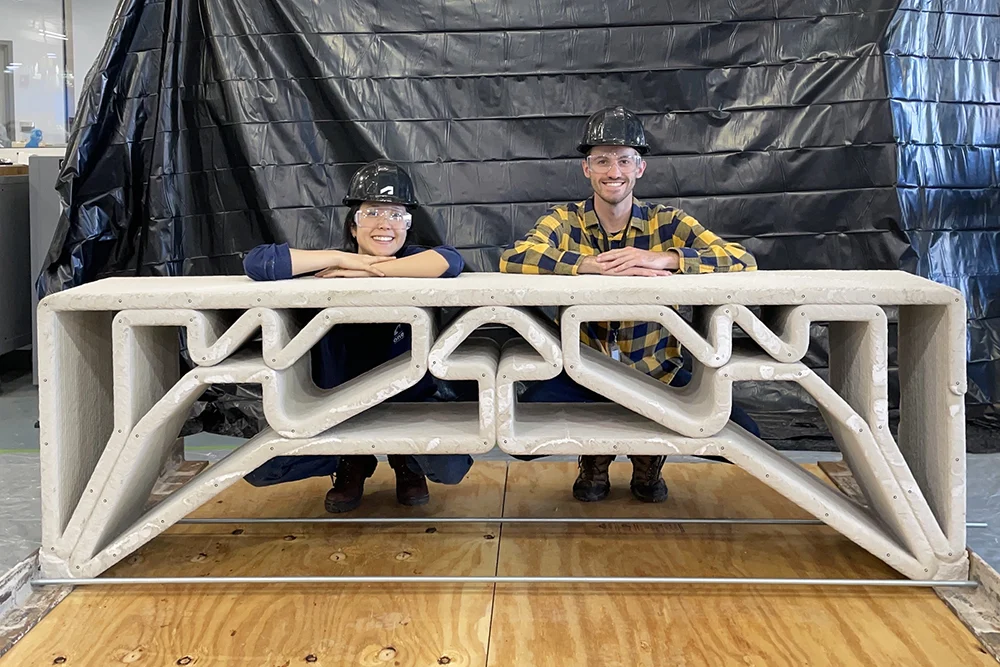
To demonstrate the efficacy of their approach, the MIT team undertook the ambitious project of designing, printing, and load-testing a 2.3-meter concrete bridge. The findings from this experiment yielded a crucial insight: it is the inherent limitations of current 3D printing hardware, rather than the properties of the concrete itself, that primarily dictate the maximum lightness achievable in such structures.
"We were encountering significant design flaws, almost like chasms, when attempting to translate these highly optimized designs into something that could actually be manufactured," explained Hajin Kim-Tackowiak, a postdoctoral researcher in MIT’s Department of Civil and Environmental Engineering (CEE) and a co-first author of the study. "These ‘cracks’ represented the fundamental disconnect between theoretical perfection and practical fabrication."
Designing for Manufacturability: A Collaborative Approach
The development of this integrated framework was significantly informed by a close collaboration with industry experts. The research team participated in the Autodesk Research Residency Program, gaining direct access to the large-scale printing machines and the operational expertise at Autodesk’s Technology Center in Boston. This hands-on experience provided invaluable insights into the practical challenges faced by operators of these complex systems.
"During our interactions, the operators would point to certain sharp angles in our designs and express concerns about the safety and feasibility of printing them," Kim-Tackowiak recounted. "This direct feedback was instrumental in identifying the core physical limitations."
Through these dialogues, three paramount constraints were identified: the minimum required thickness of each extruded concrete bead, the minimum turning radius achievable by the printer’s nozzle, and the necessity for a continuous, unbroken printing path. The researchers meticulously translated each of these identified constraints into precise mathematical rules that were then embedded within their optimization framework.
Accelerating the Design-to-Print Cycle
Traditional methods for producing 3D-printed structures typically involve a sequential process: first optimizing the geometric shape and then implementing the design for manufacturing. This often necessitates extensive post-processing, which can consume days of computational time and manual effort. In stark contrast, the MIT team’s framework is capable of generating fully printable designs in a remarkably short period – approximately two minutes when run on a standard laptop. Furthermore, the adaptability of the system was proven when the team needed to make minor adjustments to the bridge’s dimensions on the day of printing. A quick rerunning of the optimization process yielded an updated, printable design within a mere five to ten minutes.
"Achieving this level of speed is a recent development in computational optimization," stated Zane Schemmer, a PhD student in CEE and another co-first author of the paper. The underlying mathematical methodology, known as mixed-integer optimization, was historically considered too computationally intensive for practical application in such complex design problems. "Looking back even just five to ten years, the solvers we relied on, and even those from three years ago, would have been incapable of handling these types of problems," Schemmer elaborated. "This entire field was often sidestepped because it was perceived as an insurmountable computational challenge. However, with advancements in algorithms and processing power, it is now becoming a viable and powerful approach to framing and solving complex design issues."
The Concrete Bridge: A Testbed for Real-World Limitations
To rigorously validate their novel framework, the researchers returned to Autodesk’s facility to construct the 2.3-meter concrete bridge. The printing process itself was remarkably swift, taking approximately 30 minutes to complete using standard, off-the-shelf mortar.
Subsequent load testing of the approximately 900-pound bridge revealed its impressive structural integrity. The bridge successfully supported over 2,000 pounds distributed across its span with negligible deflection, a performance that closely aligned with the team’s computational simulations.
However, the testing also brought to light the study’s most surprising revelation. "We discovered that our design was excessively over-engineered," Kim-Tackowiak admitted. "The structural integrity, from zero up to 200,000 pounds of load, was dictated entirely by the ‘can I build it or not’ constraints imposed by the printer’s limitations. It was only after exceeding that significant load threshold that the actual physics of the concrete’s strength began to play a dominant role in the design." This finding underscored that, in the current landscape of 3D concrete printing, the capabilities of the printing technology itself serve as the primary bottleneck for achieving maximum structural efficiency, rather than the inherent material properties of concrete.
A Roadmap for Future Printer Development and Sustainability
The MIT framework’s ability to identify the mathematically optimal design under specific constraints provides a powerful tool for quantifying the material cost associated with each hardware limitation. "With mixed-integer optimization, we can identify the global optimum – the absolute best possible solution – rather than settling for a merely good approximation," explained senior author Josephine Carstensen, a professor in MIT’s Department of Civil and Environmental Engineering. "Because we are confident in finding the ultimate best solution, we can also precisely measure the impact of potential hardware improvements. If we had a machine with different capabilities, what would that mean for material consumption?"
The analysis pinpointed the width of the printed bead as the most significant factor influencing material usage. The experimental bridge utilized a 4-centimeter bead. The researchers’ calculations indicated that a machine capable of extruding a 1-centimeter bead could reduce material consumption by an astounding 76 percent, while still maintaining robust safety margins. This finding was particularly striking for Carstensen, who had initially hypothesized that the continuous path constraint would have a greater impact. "I initially believed the continuous path requirement would be the most significant limitation, exerting the largest influence," she stated. "However, our analysis clearly demonstrated that the bead width was the more critical factor."
This precise quantification offers a clear roadmap for manufacturers of 3D concrete printing equipment. It suggests that modest advancements in hardware, specifically in achieving finer extrusion capabilities, could unlock substantial gains in structural efficiency and, consequently, significantly reduce the carbon footprint associated with concrete construction.
The Power of Compression and the Next Frontier: Reinforcement
A key element enabling the efficiency of the printed bridge was its design to function purely under compression. "Concrete excels under compressive forces, performing exceptionally well when pushed upon, but it is significantly weaker when subjected to tensile forces, or pulling," Schemmer elaborated. "Our design ensures that every component of the concrete structure experiences only compression, with no parts being pulled apart."
The material savings are twofold: reduced material usage due to optimized geometry and the complete elimination of formwork, an advantage that becomes increasingly pronounced for unique, one-off structures. Carstensen sees immediate potential for this technology in disaster relief scenarios. "In emergency situations, new infrastructure can be rapidly deployed without the need for traditional mold construction," she noted.
The bridge’s reliance on compression was dramatically illustrated after its successful load testing. Despite its ability to withstand thousands of pounds, when a worker attempted to lift one corner to clear debris, the bridge fractured. This failure was not indicative of a design flaw in terms of intended structural loads but rather a stark demonstration of concrete’s inherent weakness in tension. The lift inadvertently subjected parts of the bridge to tensile forces it was not designed to withstand. "The design was optimal in its intended operational capacity, but it certainly wasn’t optimal in every conceivable scenario," Kim-Tackowiak observed.
This observation points directly to the team’s next area of research: reinforced concrete. "We recognize that a pure concrete structure, while optimal in certain ways, may not represent the most practical or versatile solution for all applications," Kim-Tackowiak explained. "Therefore, we are transitioning our focus towards reinforced concrete, which is the standard in construction today." The challenge, she added, lies in developing methods for effectively integrating steel reinforcement bars (rebar) into the 3D printing process, a task that is proving to be a significant engineering hurdle in itself.
The groundbreaking research was supported by funding from the National Science Foundation and technical assistance from the MIT Center for Advanced Production Technologies. The publication in Additive Manufacturing lists Kim-Tackowiak, Schemmer, and Carstensen as co-first authors, alongside co-authors Pittipat Wongsittikan, a PhD student in MIT’s Building Technology Architecture program, and Jackson Jewett, who contributed as a former MIT postdoc and is currently pursuing his PhD.