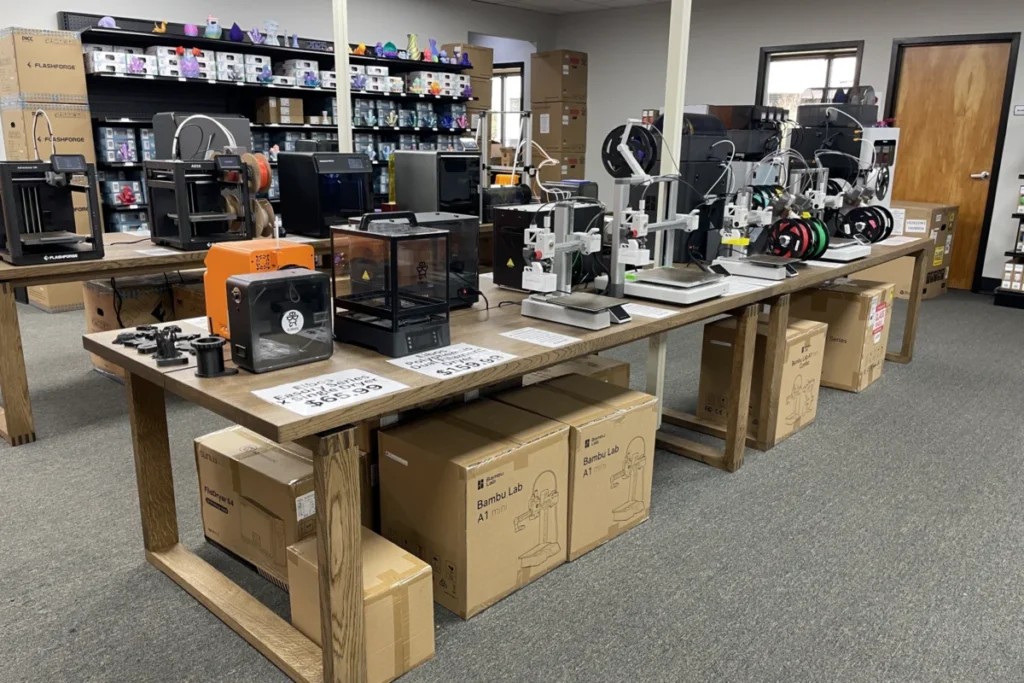
It’s a sunny Monday morning in St. Charles, Missouri, when I arrive at 3DSHQ (3D Supply Headquarters) for an unusual site visit. My travels for AM Media typically take me to nondescript industrial buildings off the side of the highway to learn about machines and applications few members of the public get to see. Often there is paperwork to sign, sometimes safety glasses to borrow and usually a visitor badge. But I’m here, 20 minutes outside of St. Louis, to visit a very different kind of facility: a brick-and-mortar store. Part retail store and part training facility, this is a building that is designed to sell equipment, yes, but also to grow a community. 3DSHQ is a totally public space, one that welcomes the 3D printing curious, the CAD novices, the engineers with side hustles, the seasoned hobbyists, the students, the educators.
As I approach the building, I even meet one of these folks, a recent convert to hobby 3D printing who tells me he’s having difficulty with the hot-end of his Creality 3D printer. He’s here because he’s hoping 3DSHQ can help – if not by fixing the machine, at least by suggesting what might be wrong with it and where to start with a repair. This is what 3DSHQ strives to be: an accessible resource to 3D printing users. Yet this is not all the organization is or everything this storefront represents. For 3DSHQ and its parent company, Jamplast, every person who walks through the door represents not only a potential customer, but quite possibly part of the next wave of industrial additive manufacturing engineers.
Genesis of a Dedicated Additive Manufacturing Hub
3DSHQ emerges as a strategic spin-off from Jamplast, a well-established plastics recycler and processor. Recognizing the burgeoning potential of additive manufacturing technology, company owners observed its growing prominence at key industry trade shows, such as NPE (The Plastics Show). This observation spurred the creation of 3DSHQ as the dedicated additive arm of the Jamplast enterprise. While Jamplast carved its niche in recycling and materials expertise, 3DSHQ positioned itself as a versatile player within the 3D printing ecosystem. The company’s multifaceted approach encompasses not only the sale of machines and equipment but also comprehensive service offerings, including warranty repairs for select brands like Bambu, and crucially, robust training programs.

The new St. Charles facility, which officially opened its doors to the public on September 6, 2025, represents an evolution from a previous, smaller retail location situated within a local mall. This strategic move to a larger, dedicated space underscores 3DSHQ’s commitment to fostering a local maker community and providing an accessible entry point for individuals interested in adopting 3D printing technology. The mall location, while successful in attracting foot traffic and introducing 3D printing to a broader local audience, lacked the capacity for the comprehensive educational and community-building initiatives that 3DSHQ now offers.
A Comprehensive Ecosystem for 3D Printing Enthusiasts
The St. Charles store is meticulously designed to cater to a diverse range of users. It features a retail space brimming with consumer-grade 3D printers and an extensive selection of materials. Beyond retail, a significant portion of the facility is dedicated to a large, well-equipped classroom. This space is outfitted with 30 laptops and a corresponding number of 3D printers, enabling hands-on learning experiences for groups of up to 30 individuals. This setup is ideal for workshops, educational programs, and collaborative projects.
As a retailer, 3DSHQ primarily focuses on desktop-sized fused filament fabrication (FFF) and photopolymerization 3D printers, along with essential materials and accessories. The company strategically partners with leading brands known for their consumer appeal, including Bambu, AnyCubic, and Creality, while continuously evaluating emerging manufacturers and innovative machines to expand its product portfolio.
The material offerings at 3DSHQ are equally impressive, boasting a wide array of colors and types from numerous suppliers. Notable partners include Ziro, Bambu, and Fusion Filaments, the latter being a local Missouri-based producer. The filament selection encompasses popular options like PLA, specialty PLAs, TPU, ASA, ABS, and PETG, with plans to introduce an even wider range of advanced materials. To allow customers to assess quality and aesthetics firsthand, sample parts meticulously printed by staff members are readily available for examination.

While 3DSHQ’s primary focus is on the hobbyist and enthusiast market, it also acknowledges the growing industrial demand. The company carries some industrial-focused products, notably large-format extrusion 3D printers from specialists like GZero Additive and IC3D Inc. This dual approach allows 3DSHQ to serve as a bridge, nurturing the next generation of industrial additive manufacturing users through accessible education and resources, regardless of their initial professional affiliation with the technology.
The Indispensable Role of a Physical Presence
In an era dominated by e-commerce, 3DSHQ’s commitment to a brick-and-mortar presence highlights the unique value proposition of physical retail in the additive manufacturing sector. While general technology retailers like Best Buy and Micro Center have begun stocking desktop 3D printers, their offerings are often limited, and their staff may lack the specialized knowledge required to effectively support customers. 3DSHQ distinguishes itself by providing an expansive inventory in a single location, allowing customers to physically interact with machines, materials, and sample prints before making a purchase. This tangible experience, coupled with the expertise of a knowledgeable staff, fosters a level of customer confidence and informed decision-making that online platforms often struggle to replicate.
Andrew Kramer, General Manager of 3DSHQ, emphasizes the passion that drives the company: "3D printing is the hobby and the passion of everyone on staff." This shared enthusiasm translates into a customer-centric approach where employees readily assist patrons with selecting their first 3D printers, choosing appropriate materials, troubleshooting technical issues, and optimizing print settings. These informal, yet crucial, interactions with customers have been instrumental in shaping 3DSHQ’s growth strategy, directly influencing the expansion to a larger facility and the integration of classroom-style education.
A Structured Approach to 3D Printing Education
The educational curriculum at 3DSHQ is designed to be comprehensive and accessible, catering to all skill levels. The company currently offers 15 distinct classes, ranging from foundational courses such as "Intro to 3D Printing" and "Troubleshooting and Maintaining Your 3D Printer," to advanced modules covering various aspects of slicing software and design tools like Tinkercad and Blender. This robust educational framework ensures that individuals can progress from novice to proficient users at their own pace.

Beyond formal instruction, 3DSHQ actively engages the community through a variety of events. The facility hosts birthday parties, outings for scouting troops, and themed holiday classes, providing unique opportunities for participants to explore their creativity through 3D printing. These events not only foster a sense of community but also introduce the technology to a wider demographic, potentially sparking future interest in STEM fields.
Expanding Educational Reach and Impact
3DSHQ’s commitment to education extends beyond the St. Louis metropolitan area. In a significant move to broaden its impact, the company has recently partnered with The Society of Plastics Engineers (SPE) to enhance the latter’s grant program for classroom educators. As a first initiative under this collaboration, Akron Public Schools in Ohio will receive FlashForge 3D printers, materials, and essential support, enabling educators to integrate 3D printing into their curricula.
To spearhead these ambitious educational endeavors, 3DSHQ has brought on Dr. Laura Holt-Hovis, an expert in pedagogical studies. Dr. Holt-Hovis is tasked with leading courses and developing curricula specifically tailored for 3D printing education. A key objective is the creation of a state-aligned curriculum for Missouri, with plans to adapt and expand these programs to meet the educational standards of other states, potentially leading to accredited coursework.
The emphasis on education is deeply rooted in 3DSHQ’s philosophy. In contrast to the often impersonal nature of online retail, 3DSHQ aims to provide a personal and community-driven introduction to 3D printing. "We don’t want to spread bad word of mouth about 3D printing," states Kramer. "The worst thing is for someone to start 3D printing and have a bad experience." A negative initial encounter can have far-reaching consequences, influencing perceptions within a person’s social circle, professional network, and ultimately, the broader industry adoption of additive manufacturing. By prioritizing user success through comprehensive support and education, 3DSHQ aims to cultivate a positive and encouraging environment for all who engage with the technology. "The education needs to be there to welcome all these people," Kramer adds.

Implications for Industrial Adoption and Future Growth
While the most visible aspect of 3DSHQ’s operations is geared towards new users and hobbyists, its work is also strategically positioned to benefit industrial users and clients. In addition to supplying industrial-grade equipment and materials to professional additive manufacturing users, 3DSHQ is actively developing its capabilities as a contract manufacturer. Its service offerings include Design for Additive Manufacturing (DFAM), which involves creating detailed plans to facilitate the transition from additive manufacturing to traditional production processes as demand scales. This also encompasses Printing as a Service (PaaS) and comprehensive product development support to help clients transform nascent ideas into additive-ready product versions.
A testament to its commitment to scaling production, 3DSHQ is currently establishing a significant print farm within a nearby warehouse space. The initial phase aims to deploy 100 3D printers, with ample room to accommodate several hundred more as market demand dictates. This strategic investment in large-scale production capacity underscores 3DSHQ’s ambition to become a key player in the additive manufacturing service bureau landscape.
The holistic approach of 3DSHQ is striking, with no facet of its business appearing to be an afterthought. Each activity and investment is meticulously designed to address different stages of the additive manufacturing adoption pipeline. An individual with no prior manufacturing background can engage with 3DSHQ, beginning with an introductory class. This initial engagement might foster a passion for 3D printing, leading to the purchase of equipment and materials from 3DSHQ. The journey could then evolve into the development of a new product or the conception of a 3D printing-based business. As demand for their creations grows, these customers may return to 3DSHQ for expanded equipment and material needs, or to leverage the company’s printing services.
This carefully orchestrated trajectory also presents a powerful pathway for established manufacturers to integrate additive manufacturing into their operations, effectively entering through "the side door." Kramer notes the presence of major aerospace companies like Boeing and numerous small to medium-sized engineering firms in the St. Louis area. This creates a fertile ground for engineers who, even if not directly involved with 3D printing at work, possess a keen interest or hobby in the technology. "These are engineers who might not run a 3D printer at work, but have one at home or have an interest in it," Kramer explains.

This personal engagement with 3D printing at home can readily translate into professional applications. An engineer who is already familiar and comfortable with the technology is more inclined to explore 3D printing as a solution to workplace challenges, even if it initially involves utilizing their personal equipment. "And that becomes justification for a company to purchase a 3D printer," Kramer concludes. "An engineer doing 3D printing as a hobby is kind of the greatest thing." This symbiotic relationship between hobbyist exploration and industrial application highlights 3DSHQ’s vital role in driving the broader adoption and innovation within the additive manufacturing sector.