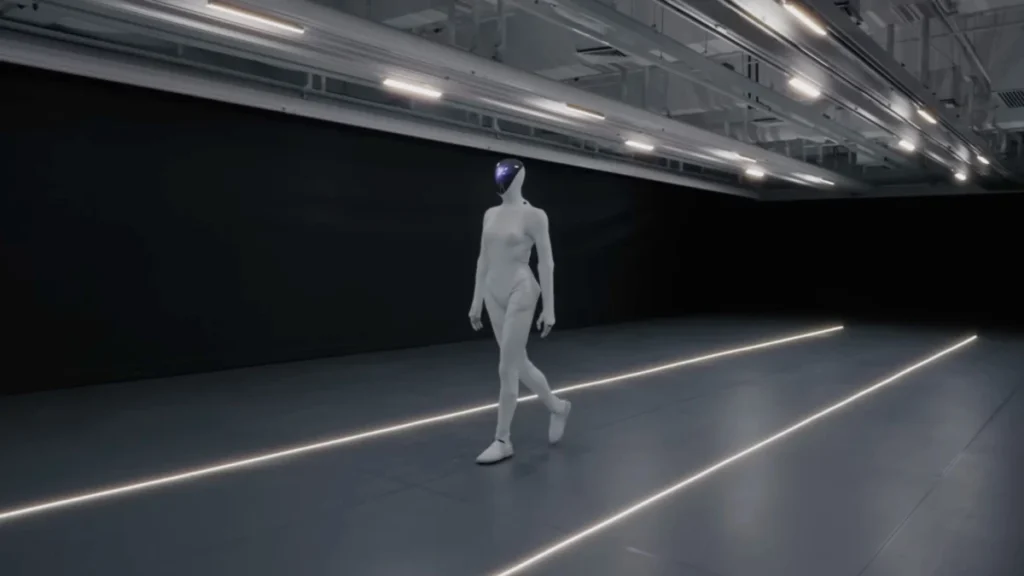
Chinese electric vehicle (EV) giant Xpeng is significantly escalating its efforts to mass-produce its cutting-edge Iron humanoid robot, signaling an ambitious strategic pivot beyond smart mobility into the burgeoning field of embodied artificial intelligence. The company has set an aggressive target to boost its manufacturing capacity for Iron to over 1,000 units per month by the close of 2026, positioning itself for a comprehensive global market rollout slated for 2027. This move underscores Xpeng’s vision of integrating its extensive expertise in AI and autonomous driving, cultivated through its EV development, into a new generation of intelligent, human-like machines.
The initial phase of deployment for the Iron robots will see them serving as sales assistants within Xpeng’s showrooms across China, beginning in the first quarter of 2027. This domestic introduction will pave the way for a broader expansion into overseas markets and international stores later the same year, marking a critical step in the commercialization of humanoid robotics. This strategic initiative positions Xpeng not merely as an EV manufacturer but as a formidable player in the global AI and robotics ecosystem, aiming to redefine human-machine interaction in commercial and potentially personal settings.
Xpeng’s Strategic Expansion into Embodied AI
Xpeng’s foray into humanoid robotics is a natural progression of its core competencies in artificial intelligence and autonomous driving. The company has consistently invested heavily in R&D for advanced AI technologies, which power its sophisticated smart vehicles and underpin its aspirations for fully autonomous driving. This foundation provides a unique advantage in the development of humanoid robots, where real-time perception, complex decision-making, and fluid motion control are paramount. The strategic alignment between Xpeng’s automotive AI and its robotics division highlights a comprehensive vision for physical AI, where intelligent machines can navigate and interact with the physical world autonomously.
In a parallel development showcasing its diverse AI capabilities, Xpeng recently unveiled China’s first production-ready, fully in-house developed robotaxi. Built on its advanced GX platform, this robotaxi is engineered to meet stringent Level 4 autonomous driving standards, signifying a vehicle capable of operating without human intervention under specific conditions. This achievement further solidifies Xpeng’s position at the forefront of AI-driven mobility solutions and demonstrates its ability to translate complex AI research into tangible, commercial products across different domains. The synergy between developing autonomous vehicles and humanoid robots is evident: both require sophisticated sensor fusion, real-time path planning, object recognition, and complex decision-making algorithms, all areas where Xpeng has significant institutional knowledge and technological prowess.
The Ascent of Iron: A Chronology of Innovation
The Iron humanoid robot first captured widespread attention when it was unveiled at Xpeng’s highly anticipated AI Day in November 2025. During its public debut, Iron showcased remarkably smooth, human-like walking and interactive capabilities on stage, drawing immediate awe and, for some, even skepticism. The realism of its movements was so profound that several observers questioned whether a human operator was covertly controlling the robot from within. In response to this widespread curiosity and doubt, Xpeng CEO He Xiaopeng publicly revealed the robot’s intricate internal mechanical structure, reaffirming its fully autonomous and robotic nature.
Since its dramatic unveiling, the development and refinement of Iron have continued at an accelerated pace. The company’s current goal to achieve a monthly production capacity exceeding 1,000 units by the end of 2026 is a testament to its commitment to industrializing humanoid robotics. This aggressive timeline positions Xpeng to be one of the first companies globally to mass-produce advanced humanoid robots, moving them from research labs and limited prototypes to commercial deployment. The subsequent global rollout in 2027, starting with customer-facing roles in showrooms, represents a carefully planned market entry designed to leverage the robot’s interactive capabilities in a controlled commercial environment before potentially expanding to more complex applications.
Engineering Excellence: The Iron Robot’s Advanced Design
The latest iteration of Xpeng’s Iron humanoid robot represents a pinnacle of contemporary robotics engineering, meticulously designed to emulate human form and function while integrating advanced AI. Standing at an impressive 178 cm (5 ft 10 in) tall and weighing 70 kg (154 lb), Iron’s proportions are strikingly similar to those of an average adult, allowing it to navigate and interact with environments designed for humans. Its sophisticated internal mechanical architecture is a marvel of biomimicry, drawing inspiration from the human spine and musculoskeletal system. This design incorporates synthetic muscle-like actuators that enable exceptionally fluid, natural, and expressive movements, setting it apart from more rigid, industrial robots.
Iron boasts an impressive 62 active joints, a critical feature that grants it an extraordinary range of motion. This articulation allows the robot to twist, bend, shrug, and maintain dynamic stability even when traversing uneven or challenging terrain, mimicking human adaptability. Its highly dexterous hands are equipped with 22 degrees of freedom, enabling it to perform intricate tasks such as grasping delicate objects with precision or firmly handling larger tools and equipment. This level of manipulation capability is crucial for its intended roles and potential future applications. Adding to its human-like interaction capabilities, a curved display is elegantly integrated into Iron’s head, serving as a dynamic face that can display a range of expressions, significantly enhancing communication and fostering more natural human-robot interactions.
Powering this advanced machine is a lightweight, all-solid-state battery. Xpeng highlights that this innovative battery technology not only improves safety but also significantly reduces heat generation and extends operating time compared to conventional lithium-ion batteries, a vital factor for sustained commercial use. At the heart of Iron’s intelligence lies its onboard computing system, driven by three self-developed Turing AI chips. These powerful processors deliver a combined 2,250 TOPS (Tera Operations Per Second) of computing power, facilitating real-time perception, complex reasoning, and precise motion planning—essential components for autonomous operation in dynamic environments.
Furthermore, Iron operates on Xpeng’s proprietary Vision-Language-Action (VLA) AI model. This sophisticated model directly links visual understanding and language comprehension with physical actions, allowing the robot to interpret its surroundings, understand human commands, and execute appropriate physical responses. The VLA model has been rigorously trained on thousands of hours of human motion data, enabling Iron to perform tasks with a remarkable degree of naturalness and efficiency. This extensive training allows the robot to walk at impressive speeds of up to 2 meters per second (approximately 4.5 mph) while maintaining impeccable balance, thanks to its advanced shock-absorbing feet designed for stability and agility.
Market Dynamics and the Humanoid Robot Landscape
Xpeng’s aggressive push into humanoid robotics is unfolding within a rapidly evolving global market characterized by intense innovation and significant investment. The market for humanoid robots, though still nascent, is projected for explosive growth in the coming decade. According to various market research reports, the global humanoid robot market size, valued at a few hundred million dollars in the early 2020s, is expected to surge into multi-billion dollar figures by the early 2030s, driven by advancements in AI, robotics, and the increasing demand for automation across industries. Applications are envisioned across manufacturing, logistics, healthcare, retail, and even domestic assistance.
Xpeng enters a competitive landscape populated by established robotics firms and other tech giants. Companies like Boston Dynamics, known for its agile Spot dog-like robot and humanoid Atlas, have demonstrated cutting-edge mobility. Startups such as Figure AI, which recently secured significant funding from major tech players, are also making strides with their general-purpose humanoid robots designed for warehouse work. Agility Robotics, with its Digit robot, focuses on logistics and last-mile delivery. Perhaps Xpeng’s most direct competitor in the "tech giant turned robot maker" category is Tesla, with its much-hyped Optimus (Tesla Bot) project, which shares Xpeng’s ambition of leveraging automotive AI expertise for humanoid development.
China, in particular, has emerged as a powerhouse in robotics development, supported by national strategic initiatives aimed at fostering indigenous innovation in AI and advanced manufacturing. The Chinese government has outlined ambitious plans to accelerate the development and application of robotics, viewing it as crucial for economic transformation and global competitiveness. Xpeng’s commitment to mass production aligns perfectly with these national objectives, positioning it as a key player in China’s drive to lead the next industrial revolution. The ability to scale production to over 1,000 units per month, if achieved, would grant Xpeng a significant early-mover advantage in terms of manufacturing capability and market penetration.
Deployment Strategy: Showrooms and Beyond
The decision to initially deploy Iron robots as sales assistants in Xpeng’s showrooms is a shrewd strategic move. This controlled environment offers several advantages: it allows for real-world testing and refinement of the robots’ interactive capabilities, provides valuable data on human-robot interaction in a commercial setting, and critically, acts as a high-profile demonstration of Xpeng’s technological prowess. For customers, interacting with a sophisticated humanoid robot could significantly enhance the showroom experience, offering a futuristic glimpse into the brand’s innovative spirit and potentially influencing purchasing decisions for its EVs. These robots could handle routine inquiries, provide product information, guide visitors, and even assist with basic transactions, freeing up human staff for more complex customer service tasks.
The planned expansion to overseas stores later in 2027 indicates Xpeng’s global ambitions for its robotics division. This international rollout will introduce Iron to diverse cultural contexts, necessitating further refinements in language processing, cultural nuances, and interaction protocols. Beyond retail, the capabilities demonstrated by Iron – its human-like mobility, dexterity, and advanced AI – suggest a vast array of potential future applications. These could include roles in logistics and warehousing, where robots can assist with picking, packing, and sorting; in manufacturing, performing repetitive or hazardous tasks; in healthcare, offering assistance to patients or staff; and even in education or entertainment. The initial showroom deployment serves as a crucial proving ground for these broader aspirations.
Expert Perspectives and Industry Reactions
Industry analysts largely view Xpeng’s aggressive foray into humanoid robotics as a bold, yet logical, extension of its core competencies. "Xpeng’s deep investment in AI and autonomous driving for its EVs gives it a significant head start in developing complex robotic systems," commented Dr. Chen Li, a robotics expert at a leading tech consultancy. "The convergence of automotive AI and general-purpose robotics is a powerful trend, and Xpeng is positioning itself to be a leader in this new paradigm of ‘physical AI’ companies."
Financial analysts are closely monitoring the potential impact on Xpeng’s valuation. While the initial investment in mass production will be substantial, successful commercialization of Iron could open up entirely new revenue streams and significantly diversify the company’s business model, reducing its sole reliance on EV sales. "Achieving 1,000 units per month by 2026 would be an incredible manufacturing feat for humanoid robots," noted investment strategist Sarah Kim. "If Xpeng can hit those targets and successfully deploy Iron in commercial settings, it could fundamentally alter investor perception of the company, transforming it from an EV pure-play to a diversified AI and robotics powerhouse."
However, experts also caution about the challenges. Scaling production of highly complex, multi-jointed robots is not trivial, and ensuring reliability and safety in diverse public environments will be paramount. Public acceptance and ethical considerations surrounding humanoid robots, particularly those interacting with customers, will also need careful management. Xpeng’s transparent approach, as demonstrated by CEO He Xiaopeng revealing Iron’s internal structure, could help build trust and mitigate skepticism. The company’s strategy to evolve beyond EVs into a broader physical AI company is a clear signal of its long-term vision and commitment to pioneering advanced technological frontiers.
Challenges and Future Outlook
While Xpeng’s ambition is clear, the path to widespread humanoid robot adoption is fraught with challenges. Manufacturing at scale, especially for complex electromechanical systems like Iron, requires sophisticated supply chains, stringent quality control, and significant capital investment. Reducing the unit cost of each robot to make them economically viable for mass deployment will be another critical hurdle. Furthermore, ensuring the robots are robust, reliable, and safe for continuous operation in various public and commercial environments demands rigorous testing and continuous improvement.
Beyond the technical and manufacturing aspects, the societal implications of humanoid robots are profound. Public acceptance, job displacement concerns, and ethical considerations regarding autonomous intelligent agents will shape the trajectory of this technology. Xpeng, like other pioneers in the field, will need to navigate these complex socio-economic landscapes with care, focusing on applications that augment human capabilities and improve efficiency rather than solely replacing human labor.
Looking ahead, Xpeng’s vision for Iron extends beyond showroom assistance. The foundational technologies in Iron, including its advanced mobility, dexterous manipulation, and sophisticated AI, pave the way for a multitude of future applications. As AI models become even more advanced and general-purpose, humanoid robots like Iron could become indispensable tools in industries ranging from logistics and manufacturing to healthcare and personal assistance, fundamentally reshaping the future of work and daily life. Xpeng’s bold move to accelerate Iron’s mass production and global rollout firmly establishes it as a key architect in this unfolding future, pushing the boundaries of what embodied artificial intelligence can achieve.






