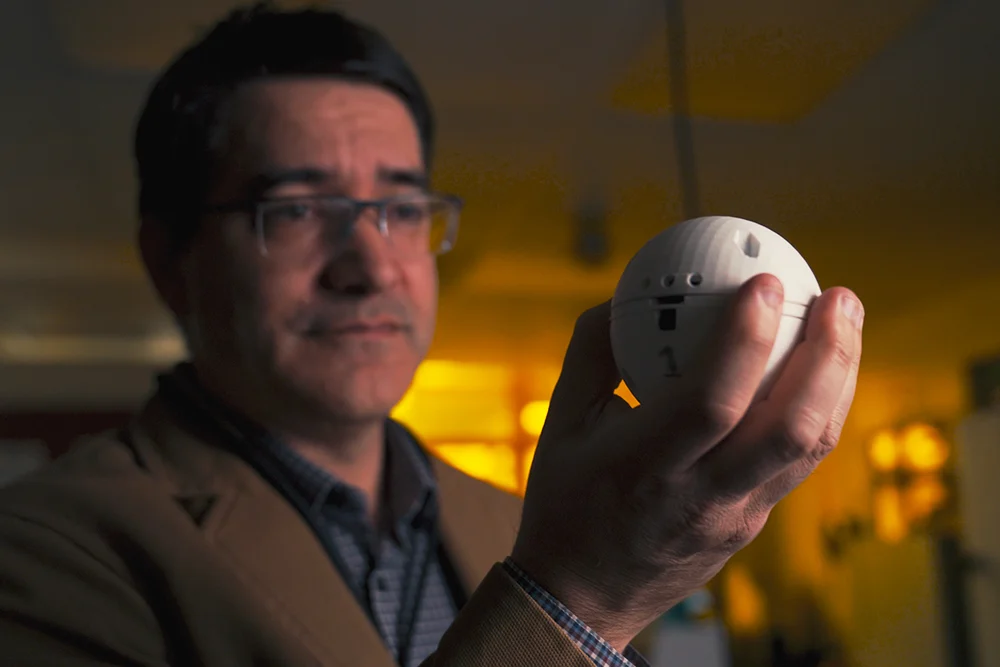
Researchers at MIT Lincoln Laboratory have unveiled a groundbreaking innovation poised to significantly bolster the safety of military personnel, first responders, and law enforcement officers. The newly developed device, codenamed TOSSIT, is a compact, baseball-sized sensor capable of remotely detecting dangerous vapors and aerosols, offering a critical early warning system against a spectrum of chemical threats. This development promises to fill a crucial gap in current threat detection capabilities, particularly for insidious airborne hazards that have previously been difficult to identify with existing portable technologies.
The Tactical Optical Spherical Sensor for Interrogating Threats, or TOSSIT, is engineered for rapid deployment and immediate analysis. Its design allows for it to be thrown, dropped from a drone, or launched into areas where the presence of hazardous substances is suspected. Upon deployment, TOSSIT actively samples the surrounding air. Its sophisticated internal mechanism then utilizes a camera to observe any color changes occurring on a removable dye card. These color shifts are calibrated to indicate the presence of specific dangerous chemicals, ranging from potent nerve and blister agents to hazardous emissions from industrial accidents or even the presence of airborne fentanyl dust, a substance that has become a growing public health crisis.
A New Era of Chemical Threat Detection
The development of TOSSIT addresses a critical and often unmet need in the field of chemical threat detection. Traditional methods for identifying airborne toxins can be time-consuming, require specialized equipment, and often necessitate personnel to enter potentially contaminated zones for sample collection. TOSSIT circumvents these limitations by providing an immediate, remote alert system. Once a chemical threat is detected, the sensor can transmit this crucial information to users through a dedicated mobile application or trigger audible alarms directly from the device itself. This immediate feedback loop allows for faster decision-making, enabling personnel to enact appropriate safety protocols, evacuate threatened areas, or deploy specialized decontamination units with greater efficiency and reduced risk to human life.
The significance of this technological leap is amplified when considering the diverse range of scenarios where TOSSIT could prove invaluable. In military operations, it can provide advance warning of chemical warfare agents, allowing units to maintain operational readiness and protect soldiers from insidious attacks. For civilian first responders, such as firefighters and HAZMAT teams, TOSSIT offers a vital tool for assessing the safety of sites affected by industrial chemical spills, explosions, or incidents involving the illicit manufacturing of dangerous substances. The ability to quickly ascertain the presence of specific toxins can dictate the level of personal protective equipment required, the evacuation radius, and the overall strategy for incident containment and mitigation.
The Science Behind TOSSIT: Colorimetric Sensing and Remote Analysis
At the core of TOSSIT’s functionality lies a clever application of colorimetric sensing. The device incorporates specialized dye cards, treated with chemical indicators that undergo distinct visual changes when exposed to specific analytes. These changes are not arbitrary; they are the result of chemical reactions between the airborne substances and the indicator compounds on the card. For instance, exposure to a nerve agent might cause a specific color to appear or disappear, while a different chemical might trigger a different hue.
The integration of an internal camera is what elevates TOSSIT beyond simple passive indicators. This camera captures high-resolution images of the dye card after it has been exposed to the sampled air. Sophisticated image processing algorithms then analyze these images, comparing the observed colors and patterns against a pre-programmed library of known chemical signatures. This allows for not only the detection of a threat but also, in many cases, the identification of the specific type of chemical agent present.
"TOSSIT fills an unmet need, providing a low-cost sensing option for vapors and solid aerosol threats — think toxic dust particles — that would otherwise not be detectable by small deployed sensor systems," stated Richard Kingsborough, the principal investigator on the project at MIT Lincoln Laboratory. His emphasis on the "low-cost" aspect is particularly noteworthy, as it suggests that TOSSIT could be deployed in significant numbers, creating a dense network of detection capabilities in areas of concern, a feat that would be prohibitively expensive with more complex and costly sensor technologies.
A Journey from Concept to Field Deployment
The development of TOSSIT represents a significant investment in research and development at MIT Lincoln Laboratory, a federally funded research and development center. While the exact timeline of its conceptualization and development has not been publicly detailed, the announcement of its readiness for transfer to the U.S. military signifies years of rigorous laboratory testing, prototyping, and, critically, extensive field trials. These field tests are essential to validate the device’s performance under realistic and challenging operational conditions, ensuring its reliability and effectiveness in diverse environmental factors such as temperature fluctuations, humidity, and varying atmospheric pressures.
The transfer of TOSSIT technology to the U.S. military is a crucial step in its lifecycle, marking its transition from a research project to a deployable asset. This process typically involves further refinement based on military feedback, integration with existing command and control systems, and scaled manufacturing to meet the demands of armed forces. The implications of this transfer extend beyond the military, as the underlying technology and its successful validation could pave the way for broader civilian applications, potentially leading to the development of commercial versions for emergency services and industrial safety monitoring.
Supporting Data and Broader Context
The need for advanced chemical threat detection systems is underscored by a consistent global threat landscape. Incidents involving chemical weapons, though less frequent than conventional attacks, have devastating consequences. The Syrian Civil War, for instance, has seen repeated allegations of chemical weapons use, highlighting the persistent danger posed by these agents. Domestically, the opioid crisis, particularly the proliferation of synthetic opioids like fentanyl, presents a growing concern for law enforcement and first responders. Fentanyl and its analogues are extraordinarily potent, and exposure to even minute quantities of airborne dust can be lethal. TOSSIT’s ability to detect such fine particulate matter offers a crucial layer of protection in situations involving drug interdictions or clandestine laboratories.
Furthermore, the increasing frequency of industrial accidents, from chemical plant explosions to transportation spills, necessitates robust and rapid detection capabilities. The 2014 West Texas fertilizer plant explosion, for example, released toxic gases and highlighted the potential dangers associated with industrial chemical storage. In such scenarios, TOSSIT could provide immediate alerts, enabling swift evacuation and preventing unnecessary exposure to hazardous fumes.
The cost-effectiveness mentioned by Dr. Kingsborough is a significant factor. While specific pricing for TOSSIT has not been released, the promise of a "low-cost" sensor implies a potential for widespread adoption. If TOSSIT can be produced at a scale that makes it economically viable for equipping individual units or deploying in large numbers, its impact on situational awareness and force protection could be immense. This contrasts with more sophisticated, but significantly more expensive, laboratory-based or vehicle-mounted chemical detection systems.
Official Responses and Future Implications
The formal announcement of TOSSIT’s readiness for transfer to the U.S. military is likely to be met with considerable interest from defense procurement agencies and operational commands. While specific official statements from military leadership regarding TOSSIT have not yet been released, the proactive development and successful field testing by a renowned institution like MIT Lincoln Laboratory strongly suggest a high level of confidence in its capabilities.
The implications of TOSSIT extend far beyond its immediate deployment. Its success could spur further innovation in the field of miniaturized chemical sensors, leading to even more advanced and specialized detection devices. The development of robust image processing algorithms for chemical signature identification could also find applications in other fields, such as environmental monitoring, medical diagnostics, or even food safety.
Looking ahead, the potential for TOSSIT to be integrated with other sensor technologies, such as biological threat detectors or radiation sensors, could lead to comprehensive multi-threat detection platforms. This would provide an even more holistic picture of the risks present in a given environment, enabling a more coordinated and effective response to complex emergencies. The evolution of TOSSIT from a concept to a field-ready device is a testament to the power of dedicated research and development in addressing pressing national security and public safety challenges. Its adoption is expected to mark a significant advancement in safeguarding those who operate in the most dangerous environments.