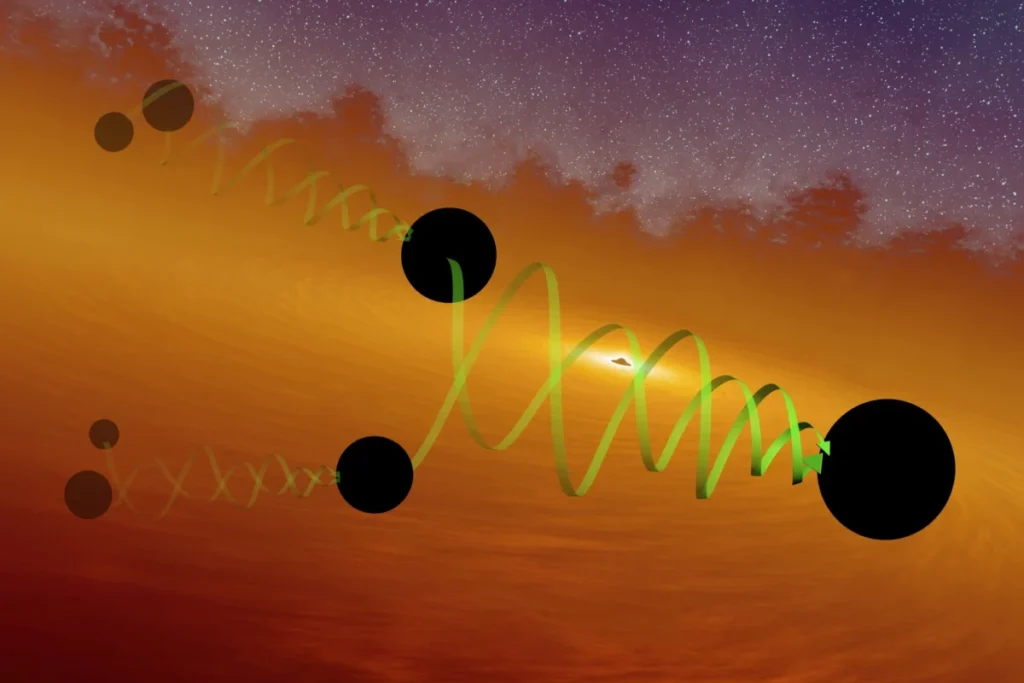
The traditional narrative of black hole formation, a cornerstone of astrophysics for decades, posits a singular lifecycle: a massive star exhausts its nuclear fuel, undergoes a violent supernova explosion, and collapses into an infinitely dense point of no return. While this "textbook" origin story accounts for a vast number of the black holes in our universe, a groundbreaking new analysis from the Massachusetts Institute of Technology (MIT) suggests that a significant portion of these celestial enigmas have a far more complex lineage. According to research published this week in Physical Review Letters, approximately 14 percent of merging black holes are not the direct remnants of dead stars, but are instead "second-generation" entities formed from the prior collision of two smaller black holes.
This phenomenon, known as hierarchical merging, represents a cosmic "recycling" process. It suggests that the universe is not merely a graveyard of dead stars, but a dynamic laboratory where black holes themselves serve as the building blocks for even larger gravitational monsters. By re-examining data from the world’s most sensitive gravitational-wave observatories, the MIT team has provided the most robust evidence to date that hierarchical merging is a primary driver of black hole evolution in dense galactic environments.
The Shift from Stellar Collapse to Hierarchical Merging
For nearly a century, the scientific community focused on the stellar-mass black hole—objects typically three to dozens of times the mass of our sun. These were understood to be the final evolutionary stage of stars at least 20 times more massive than the sun. However, the advent of gravitational-wave astronomy in 2015 changed the landscape of the field. By detecting the literal ripples in the fabric of spacetime caused by the collision of massive objects, scientists began to see a population of black holes that defied simple stellar evolution models.
"We’re finding that, for some of these merging black holes, it’s not their first rodeo," says Cailin Plunkett, the study’s lead author and a graduate student in MIT’s Department of Physics. "Overall in the universe, black holes are merging all the time. The question of how often they are repeatedly merging was pretty uncertain. Now we’re seeing a relatively consistent picture where there’s a decent percentage of black holes that are coming from this repeated pathway."
Hierarchical merging occurs when the product of a black hole merger remains in a gravitationally bound environment—such as a dense star cluster or the center of a galaxy—long enough to find another partner. If this process repeats, it can create "generations" of black holes, each significantly more massive and faster-spinning than the last.
Identifying the "Smoking Gun": Spin and Mass Disparity
The MIT researchers, including associate professor of physics Salvatore Vitale, Thomas Callister of Williams College, and Michael Zevin of the Adler Planetarium, focused on two primary physical characteristics to distinguish first-generation black holes from their second-generation counterparts: spin and mass.
When a single star collapses, the resulting black hole is expected to have relatively low angular momentum. The process of a supernova is so violent that it sheds the majority of the star’s outer layers and, with them, most of its rotational energy. Consequently, first-generation black holes are generally "slow" rotators.
In stark contrast, when two black holes merge, the orbital angular momentum of the pair is converted into the rotational spin of the newly formed hole. "They would be spinning very fast, at about 70 percent of their maximum possible spin," explains Vitale. This high spin serves as a biological marker, or a "DNA trace," indicating a previous merger event.
Furthermore, the team looked for "lopsided" pairs. In a standard binary system formed from two sibling stars, the masses are often relatively similar. However, a hierarchical merger often involves a second-generation black hole (which has already doubled its mass) pairing up with a standard first-generation black hole. This results in a significant mass imbalance and a characteristic "wobble" in the orbital plane.
The Role of LIGO, Virgo, and KAGRA
The data for this study was drawn from the Gravitational Wave Transient Catalog 4.0 (GWTC-4.0), a comprehensive record of detections from the international network of observatories: LIGO (the Laser Interferometer Gravitational-Wave Observatory in the U.S.), Virgo (in Italy), and KAGRA (in Japan). These facilities use ultra-precise lasers to measure changes in distance smaller than the width of an atomic nucleus, caused by passing gravitational waves.
The team analyzed 155 pairs of binary black holes. While previous studies often examined individual, high-profile events, Plunkett and Vitale developed a sophisticated population-based model to search for patterns across the entire dataset. They specifically looked for "precession"—a phenomenon where the axis of the black holes’ orbit shifts or wobbles because their individual spins are not aligned with the orbital plane. This wobbling is a hallmark of mergers involving at least one high-spin, second-generation black hole.
Two specific signals detected in 2024, labeled GW241011 and GW241110, served as key case studies. These events displayed clear evidence of one partner spinning significantly faster than the other, providing the impetus for the broader statistical analysis of the 155-pair catalog.
Chronology of Gravitational-Wave Discovery
To understand the significance of the 14 percent finding, it is essential to view it within the timeline of gravitational-wave science:
- 1916: Albert Einstein predicts the existence of gravitational waves as part of his General Theory of Relativity.
- 1974: Hulse and Taylor discover a binary pulsar, providing indirect evidence of gravitational waves as the stars’ orbit decays.
- September 2015: LIGO makes the first direct detection of gravitational waves (GW150914) from two merging black holes, confirming Einstein’s theory and opening a new window into the cosmos.
- 2017: The Virgo detector joins LIGO, allowing for better localization of cosmic events. The first detection of merging neutron stars is recorded.
- 2020-2023: KAGRA joins the network. The catalog of detections grows from a handful to nearly 100 events, revealing black holes much larger than previously thought possible.
- 2024: Analysis of GW241011 and GW241110 identifies specific hierarchical merger candidates.
- Present: The MIT study concludes that roughly one in seven black hole mergers involves a second-generation participant.
Solving the "Mass Gap" Mystery
One of the most compelling aspects of the hierarchical merging theory is its ability to explain the existence of black holes in the "upper mass gap." According to stellar evolution theory, stars with a certain initial mass undergo "pair-instability supernovae." In these events, the explosion is so total and catastrophic that it leaves behind no remnant at all—no neutron star and no black hole.
This theory suggests a "forbidden zone" for black holes between roughly 50 and 120 solar masses. However, gravitational-wave detectors have repeatedly found black holes residing squarely within this gap.
"One of the reasons why the 40-and-above regime is interesting is that stellar evolution theory predicts you shouldn’t be able to form black holes in that mass range at all from just a supernova," says Plunkett. "We think supernovae from really massive stars end up being so violent that they leave no black holes at all above roughly 45 solar masses. Yet we have seen black holes that are that massive. And the question is: Where did they come from?"
The MIT study provides the answer: these "forbidden" black holes are the children of previous mergers. By combining two 25-solar-mass black holes, the universe creates a 50-solar-mass entity, effectively bypassing the limitations of stellar collapse.
Implications for Galactic Evolution and Future Research
The discovery that 14 percent of mergers are hierarchical has profound implications for our understanding of where black holes live. For hierarchical merging to occur, black holes must be "packed" into tight quarters where they can find new partners after their initial collision.
This points toward globular clusters—ancient, dense collections of hundreds of thousands of stars—and the nuclear star clusters at the centers of galaxies as the primary "factories" for these second-generation objects. In these crowded environments, the gravity is strong enough to retain a black hole even after it receives a "kick" from a merger, allowing it to stay in the game and merge again.
The study’s findings also set the stage for the next generation of detectors. Future facilities like the Einstein Telescope in Europe and the Cosmic Explorer in the United States will be significantly more sensitive than current observatories. They are expected to detect black hole mergers from the very edge of the observable universe, potentially revealing third, fourth, or even tenth-generation black holes.
By establishing that a "decent percentage" of the black hole population follows this repeated pathway, the MIT team has shifted the focus of the field. The study confirms that the universe is far more interactive and transformative than a simple "birth-to-death" stellar model suggests. Instead, it is a place of constant cosmic assembly, where the remnants of the dead are forged into ever-greater titans of gravity. This work, supported in part by the National Science Foundation and the Brinson Foundation, marks a definitive step in mapping the genealogy of the darkest objects in the cosmos.