Researchers have shown that an unusual class of quantum states known as fractional Fermi seas can be deliberately created, according to a new study published in Physical Review Letters. This landmark discovery, achieved through a collaboration between the Nägerl group at the University of Innsbruck and theoretical physicist Alvise Bastianello of CNRS and Université Paris-Dauphine, represents a significant leap in our understanding of non-equilibrium quantum dynamics. The study demonstrates how a new critical phase of matter can emerge when quantum particles are pushed far from their normal equilibrium conditions, effectively challenging the long-standing paradigms of one-dimensional quantum physics.
Using ultracold cesium atoms confined to a one-dimensional (1D) environment, the research team repeatedly altered the strength of particle interactions, cycling them between states of intense repulsion and attraction. This process resulted in a state of matter that transcends the behavior predicted by the Tomonaga-Luttinger liquid theory, which has served as the bedrock for understanding 1D quantum systems for decades. This publication provides the comprehensive theoretical framework for recent experimental research conducted by the group of Hans-Christoph Nägerl at the Department of Experimental Physics, signaling a new era in the manipulation of many-body quantum systems.
The Foundation of One-Dimensional Quantum Physics
To understand the magnitude of this discovery, it is necessary to examine the traditional rules governing quantum particles. In the macroscopic world, objects can move freely in three dimensions. However, when particles are confined to a single dimension—essentially a narrow line—their behavior changes fundamentally. In 1D, particles cannot move past one another without colliding or interacting. This constraint leads to highly correlated collective behaviors where the motion of one particle affects all others in the system.
For over half a century, the Tomonaga-Luttinger liquid (TLL) theory has been the standard model for describing these systems. TLL theory suggests that at low temperatures, the individual identities of particles like fermions disappear, replaced by collective excitations that behave like waves. However, TLL theory is primarily an "equilibrium" theory, describing systems in their lowest energy states or near-equilibrium conditions. The discovery of the fractional Fermi sea breaks this mold by demonstrating a stable, organized state that exists far from equilibrium, created through active manipulation rather than passive cooling.
The Mechanics of Creating a Fractional Fermi Sea
The experimental and theoretical breakthrough centered on the concept of the "Fermi sea." In standard quantum mechanics, fermions—a category of particles that includes electrons, protons, and certain atoms like specific isotopes of cesium—obey the Pauli Exclusion Principle. This principle dictates that no two fermions can occupy the same quantum state simultaneously. Consequently, at absolute zero, fermions stack into the lowest available energy levels, filling them up like water filling a basin. This stack is known as the Fermi sea.
The research team, led by Yi Zeng and supervised by Hans-Christoph Nägerl and Alvise Bastianello, asked a radical question: What happens if this stack is forcibly reorganized through extreme, periodic changes in interaction?
"Fermions, for instance, stack neatly into the available energy states to form the so-called ‘Fermi sea,’" explains Alvise Bastianello. "But what happens if one forces interacting atoms to continuously cycle through extreme conditions, smoothly shifting them from strongly repelling each other to strongly attracting each other?"
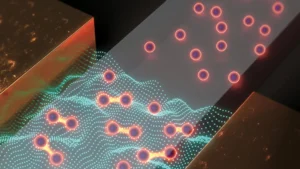
To answer this, the researchers utilized a "quantum simulator"—a highly controlled environment using lasers to create a one-dimensional optical lattice. Within this lattice, they trapped cesium atoms cooled to temperatures just billionths of a degree above absolute zero. By employing magnetic fields to trigger Feshbach resonances, the team could precisely tune the interactions between these atoms. By cycling these interactions repeatedly, they drove the atoms out of their ground state.
Instead of the system collapsing into chaos or simply heating up into a disorganized gas, the atoms reorganized into a highly excited but remarkably stable configuration. This state is "fractional" because the occupancy rules of the energy states appear altered; the particles behave as though they are filling a sea with a reduced or "fractional" capacity compared to a standard Fermi sea.
Deciphering the Hidden Order and Friedel Oscillations
One of the most striking findings of the study is the presence of "hidden order" within this highly excited state. Typically, when a quantum system is injected with energy (pushed far from equilibrium), it undergoes thermalization—a process where it loses its quantum information and settles into a state of high entropy, effectively becoming "hot" and random.
The fractional Fermi sea defies this expectation. "This state is highly excited, but it is not random," says Hanns-Christoph Nägerl. "It has a hidden order that becomes visible in its correlations."
The researchers identified this order through mathematical correlations between particles, which revealed pronounced ripples known as Friedel oscillations. In standard metals or quantum liquids, Friedel oscillations are density fluctuations that occur around impurities or boundaries. In the fractional Fermi sea, these oscillations exhibit distinctive decay behaviors and patterns that persist across all levels of repulsive interactions. These signatures are the "fingerprints" of the new phase, proving that the system has entered a state of matter that is mathematically distinct from a Tomonaga-Luttinger liquid.
Chronology of the Discovery
The journey toward the discovery of fractional Fermi seas has been a multi-year effort involving both rigorous mathematical modeling and advanced cryogenic engineering.
- Phase I: Theoretical Conceptualization (2020-2022): Theoretical physicists, including Alvise Bastianello, began exploring the limits of Floquet engineering—the practice of periodically driving a quantum system to create new effective Hamiltonians. They hypothesized that specific interaction cycles could lead to non-thermal excited states.
- Phase II: Experimental Setup in Innsbruck (2022-2023): The Nägerl group refined their 1D cesium atom traps. Using "optical tweezers" and lattice modulation, they achieved the precision necessary to cycle interactions without losing atoms from the trap.
- Phase III: Observation of the New Phase (Late 2023): The lead author, Yi Zeng, and the experimental team observed that the system was not heating as expected. Instead, it was maintaining a structured correlation pattern even after multiple interaction cycles.
- Phase IV: Publication and Verification (2024): The theoretical framework was published in Physical Review Letters, establishing the mathematical reality of the fractional Fermi sea. A companion paper detailing the experimental realization is currently under peer review, marking the transition from theoretical prediction to laboratory fact.
Supporting Data and Technical Analysis
The study’s data points toward a transition into what physicists call a "critical phase." In physics, a phase is "critical" when it exists at the edge of a transition, where its properties are characterized by scale invariance and long-range correlations.
The researchers utilized a technique called "Bethe Ansatz," a method for solving 1D quantum many-body problems, to verify their findings. The data showed that the momentum distribution of the particles in the fractional Fermi sea does not follow the standard "step function" of a normal Fermi gas. Instead, it displays a "smeared" but structured distribution that suggests the emergence of new quasiparticles.
"We are not yet sure how we should name these new quasiparticles," Hanns-Christoph Nägerl noted. "Perhaps ‘super-Fermions’?" These quasiparticles represent the collective movement of the atoms in this new phase, behaving as if they are a new type of fundamental particle with properties different from the original cesium atoms.
Official Responses and Scientific Reactions
The announcement has sent ripples through the condensed matter physics community. While the study is rooted in fundamental research, its implications for quantum simulation are profound.
Yi Zeng, the study’s lead author, emphasized the control aspect of the discovery: "Instead of simply heating the system, the interaction cycle reorganizes the atoms into a new many-body state. This gives us a controlled way to explore quantum matter beyond the usual equilibrium paradigms."
Independent commentators in the field have noted that this work opens a new door for "non-equilibrium phase engineering." By demonstrating that periodic driving can create stable, organized phases rather than just heat, the Innsbruck-Paris team has provided a blueprint for creating other exotic states of matter that do not exist in nature.
Broader Impact and Future Implications
The discovery of fractional Fermi seas is more than a laboratory curiosity; it has significant implications for the future of quantum technology and fundamental physics.
1. Advancing Quantum Simulators:
Quantum simulators are designed to solve problems that are too complex for classical supercomputers, such as the behavior of high-temperature superconductors or the properties of complex molecules. By showing that simulators can create states "beyond established paradigms," this research proves that we can use cold atoms to explore entirely new mathematical territories, not just replicate known ones.
2. Development of Quantum Materials:
The "super-Fermions" identified in this study could eventually lead to the development of new materials with custom-engineered electronic properties. Understanding how to maintain order in highly excited states is key to developing materials that function in extreme conditions.
3. Refining Quantum Field Theory:
The breakdown of Tomonaga-Luttinger liquid theory in this context suggests that our current mathematical models for 1D systems are incomplete. This discovery provides the data needed to refine quantum field theories, potentially leading to a more unified understanding of how matter behaves across different dimensions.
4. Quantum Information Processing:
The "hidden order" found in these states could potentially be used to encode quantum information in a way that is robust against certain types of noise. Because the state is highly excited yet organized, it may offer unique pathways for protecting quantum bits (qubits) from decoherence.
As the companion paper detailing the experimental realization nears the end of its review process, the scientific community prepares for a shift in how 1D quantum systems are studied. The discovery of fractional Fermi seas serves as a reminder that even in well-trodden fields like quantum mechanics, there are still "seas" of unknown phenomena waiting to be navigated. As Hanns-Christoph Nägerl concludes, "The discovery shows how far we can push quantum simulation: not only reproducing known models, but creating and probing states that go beyond established paradigms."