The pursuit of next-generation quantum technologies has long been hindered by a fundamental gap in understanding how energy moves within the microscopic imperfections of solid-state materials. These imperfections, specifically known as spin defects, are increasingly viewed as the primary building blocks for quantum sensors, communication networks, and stable qubits. However, the ability to predict how these defects lose energy over time—a process critical to their performance—has remained one of the most significant challenges in computational materials science. Researchers at the University of Chicago Pritzker School of Molecular Engineering (UChicago PME) have recently bridged this gap, developing a sophisticated computational method that provides a comprehensive simulation of the entire optical cycle of spin defects, including the elusive process of internal conversion.
The research, led by Giulia Galli, the Liew Family Professor of Electronic Structure and Simulations, marks a turning point in the field of quantum material design. By integrating years of mathematical derivations with high-performance computing, the team has successfully modeled how energy transitions from excited electrons into the vibrational modes of surrounding atoms. This breakthrough, published in the journal Physical Review Letters, not only clarifies long-standing discrepancies in quantum experiments but also offers a powerful new tool for the development of renewable energy technologies.
The Mechanics of Spin Defects and the Optical Cycle
To appreciate the significance of this development, one must first understand the role of spin defects in materials like diamond and silicon carbide. In a perfect crystal lattice, atoms are arranged in a flawless, repeating pattern. A spin defect occurs when an atom is missing (a vacancy) or replaced by a different element (an impurity). When light, such as a laser beam, strikes these defects, it can elevate electrons to an excited state.
This interaction initiates what scientists call the optical cycle. Ideally, for quantum applications, these defects should function as stable qubits whose quantum states can be precisely initialized and read. The efficiency of this reading process depends on how the defect returns to its ground state. There are three primary pathways for this energy release:
- Radiative Decay: The defect releases a photon of light, which can be detected and measured.
- Intersystem Crossing: The electron transitions between states with different spins, a process vital for "setting" the quantum state.
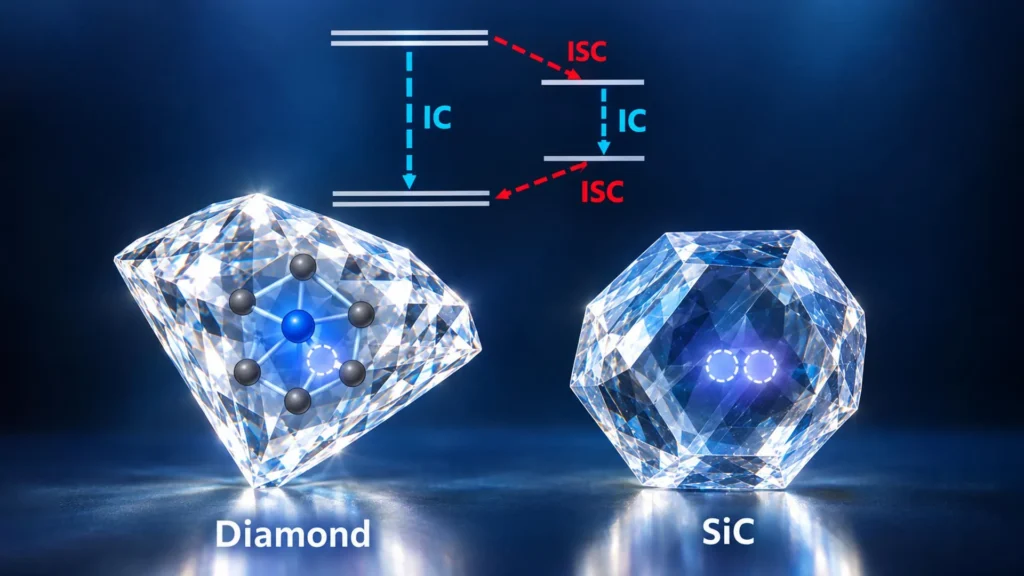
- Internal Conversion: The energy is transferred into the vibrations of the surrounding atomic lattice, effectively becoming heat.
While the first two processes have been relatively well-modeled using the standard equations of quantum mechanics, internal conversion has historically been a "black box." The sheer complexity of calculating how a single electronic state interacts with the collective vibrations of hundreds or thousands of atoms created a computational bottleneck that prevented accurate predictions of defect lifetimes and stability.
Overcoming Computational Barriers with WEST
The UChicago PME team, including postdoctoral researcher Stefano Villani and former graduate student Yu Jin (now at the Flatiron Institute), addressed this bottleneck by combining several proprietary computational techniques developed over the last decade. Central to their success was the use of many-body wavefunctions—mathematical descriptions that account for the complex, simultaneous interactions between multiple electrons and atoms rather than treating them as isolated entities.
The researchers moved beyond traditional approximations by deriving exact mathematical formulas that quantify the strength of the interaction between excited electronic states and atomic movements. This allowed them to simulate the coupling of electronic states with all possible vibrational configurations of the surrounding lattice simultaneously.
This framework was integrated into WEST (Without Empty States), an open-source simulation software package. Developed by Galli’s group through the Midwest Integrated Center for Computational Materials (MICCoM), WEST is uniquely optimized for graphics processing units (GPUs). Since its inception in 2015, MICCoM—funded by the U.S. Department of Energy’s Office of Basic Energy Sciences—has focused on creating interoperable software tools to simulate the properties of functional materials. The inclusion of the internal conversion module into WEST represents the culmination of years of theoretical work and provides the global scientific community with a robust platform for quantum research.
Case Studies: Diamond vs. Silicon Carbide
To validate their new methodology, the researchers applied it to two of the most prominent materials in quantum science: diamond and silicon carbide.
The Nitrogen-Vacancy Center in Diamond
The team first examined the nitrogen-vacancy (NV) center in diamond, perhaps the most famous spin defect used in quantum sensing. Their simulations of the NV center’s triplet and singlet states closely aligned with existing experimental spectroscopy data. In the triplet state, they found that internal conversion played a minor role in energy loss. However, in the singlet state, internal conversion was identified as the dominant mechanism. These results confirmed the accuracy of the model, as they mirrored established scientific expectations.
The Silicon Carbide Revelation
The true power of the new computational method was revealed when the team turned their attention to the divacancy defect in silicon carbide (SiC). Silicon carbide is a particularly attractive material for quantum applications because it is already widely used in the semiconductor industry and can host spin defects that operate at telecommunication wavelengths.
For years, there had been a persistent disagreement between theoretical models and experimental observations regarding the lifetime of the excited triplet state in SiC defects. The UChicago team’s simulations discovered that internal conversion had a much more profound influence on this lifetime than any previous model had suggested.
"We were expecting to see an effect, but of a smaller magnitude," Professor Giulia Galli noted regarding the SiC findings. "What we found is that this internal conversion process turns out to be more important than we thought." This discovery effectively provides the "missing piece" of the puzzle, explaining why earlier predictions fell short and allowing for a much more accurate characterization of SiC-based qubits.
Timeline of Development and Institutional Support
The development of this framework did not happen in isolation but was the result of a long-term strategic investment in computational physics.
- 2013–2015: Initial development of the WEST code and early exploration of many-body perturbation theory.
- 2015: The U.S. Department of Energy establishes MICCoM at Argonne National Laboratory and the University of Chicago to develop open-source software for materials discovery.
- 2018–2021: Yu Jin and the Galli group focus on the mathematical derivations required to link electronic excited states with vibrational phonons.
- 2022–2023: Integration of the internal conversion module into the GPU-accelerated WEST platform and testing on diamond lattices.
- 2024: Publication of the silicon carbide findings in Physical Review Letters, marking the completion of the full optical cycle simulation capability.
Broader Implications: From Quantum Sensors to Renewable Energy
While the immediate application of this work lies in quantum computing and sensing, the implications extend far into the realm of energy science. Internal conversion is a universal process in materials science. It is a critical factor in how solar cells convert sunlight into electricity and how materials used in renewable energy storage dissipate energy.
"This internal conversion process is not only relevant to spin defects—it’s also related to processes of interest to energy technologies," Galli emphasized. In organic solar cells, for instance, understanding how energy is lost to heat (vibrations) versus being converted into current is the key to increasing efficiency. By providing a way to model these losses accurately, the UChicago team has created a tool that could lead to the design of more efficient photovoltaic materials and catalysts for fuel production.
Furthermore, the ability to predict the behavior of defects in silicon—the backbone of the modern electronics industry—is the next frontier for the team. As the industry moves toward "silicon quantum electronics," having a computational map of how defects behave in silicon will be indispensable for manufacturing.
Future Directions: Artificial Intelligence and Efficiency
Despite the success of the new framework, the researchers acknowledge that the simulations are extremely resource-intensive. Modeling the interactions of thousands of atoms requires significant "supercomputing" time. To address this, Stefano Villani and the rest of the team are looking toward the next technological frontier: Artificial Intelligence.
"We are working on ways to integrate machine learning into excited states calculations to further improve the efficiency of our method," Villani said. By training AI models on the data generated by WEST, the researchers hope to develop "surrogate models" that can predict the optical properties of new materials in a fraction of the time currently required.
The integration of AI could democratize this technology, allowing researchers at smaller institutions without access to massive GPU clusters to utilize these advanced simulations. This would accelerate the global pace of material discovery, potentially leading to breakthroughs in room-temperature quantum computing and ultra-sensitive medical imaging devices.
Conclusion
The work of the University of Chicago Pritzker School of Molecular Engineering has provided the scientific community with a more complete lens through which to view the quantum world. By solving the "internal conversion" problem, Galli and her team have moved the field from a state of observation to a state of prediction. As quantum technology moves out of the laboratory and toward commercial realization, the ability to simulate and "pre-design" materials at the atomic level will be the catalyst for the next great leap in technological innovation. The "missing piece" has been found, and with it, the roadmap for the future of quantum and energy materials has become significantly clearer.