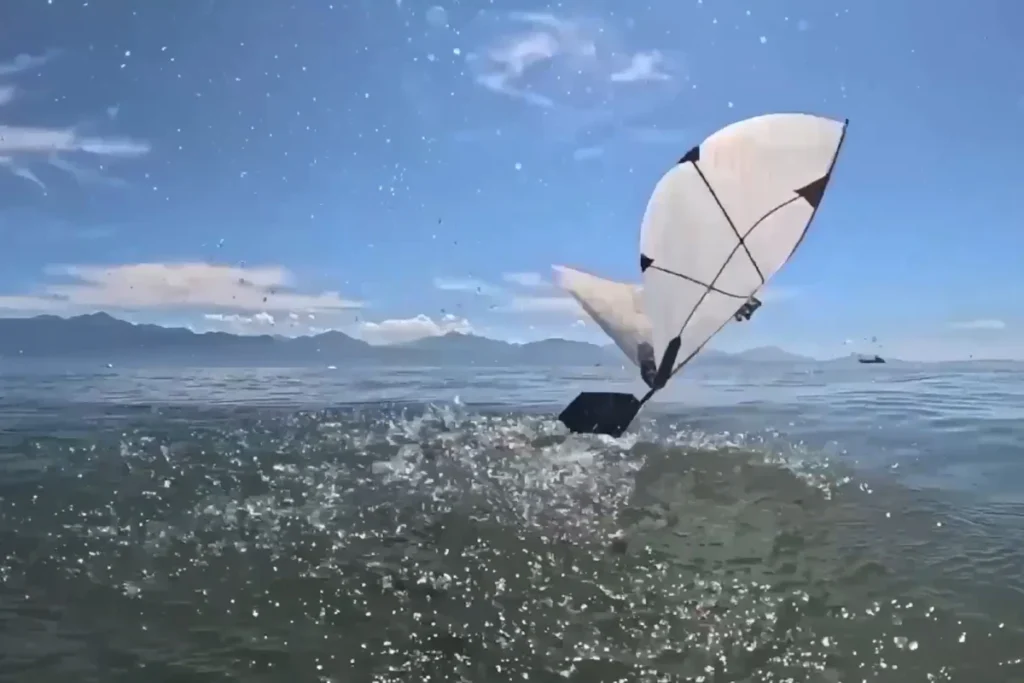
A revolutionary robotic system, dubbed the "flapping-wing aerial-aquatic vehicle" (FAAV), has been successfully developed by a collaborative team of engineers from the Massachusetts Institute of Technology (MIT) and EPFL in Lausanne, Switzerland. This pioneering robot, weighing less than 300 grams, represents a significant leap in bio-inspired robotics, demonstrating the unprecedented ability to both swim underwater and then launch itself into the air to fly, mirroring the remarkable capabilities of diving birds such as loons, gulls, puffins, and petrels. These natural aquatic aviators, numbering over 100 species, have long fascinated scientists with their unique adaptation to two vastly different physical mediums, inspiring a new generation of robotic exploration.
The research, published today in the prestigious journal Science, not only offers profound insights into the complex mechanics that enable diving birds to navigate both air and water but also paves the way for an entirely new class of aerial-aquatic drones and autonomous vehicles. The potential applications are vast, ranging from advanced oceanographic research and marine biology studies to environmental monitoring in challenging or dangerous aquatic regions that are often inaccessible to traditional vessels.
The Bimodal Masters of Nature: A Source of Inspiration
The natural world is replete with examples of incredible engineering, and diving birds stand out as paragons of bimodal locomotion. Species like the Atlantic Puffin (Fratercula arctica), the Common Murre (Uria aalge), and various species of cormorants and kingfishers have evolved highly specialized anatomies and behaviors that allow them to plunge beneath the waves in pursuit of prey, only to re-emerge and take flight with surprising agility. This dual capability is not trivial; water is approximately 1,000 times denser and significantly more viscous than air. Moving efficiently through one medium typically requires vastly different physical properties and propulsion mechanisms than moving through the other.
For instance, birds optimized for aerial flight often have lightweight, broad wings designed to generate lift in thin air, while birds adapted for underwater propulsion tend to have denser bones, streamlined bodies, and wings or feet that function as effective hydrofoils or paddles. Diving birds, however, represent a remarkable compromise, possessing features that allow them to perform competently in both realms. They use their wings for both flight and "underwater flight," adapting their flapping frequency and wing kinematics to the surrounding medium. Smaller diving birds, for example, typically flap their wings around 10 times per second when flying through the air, but slow this frequency to approximately four times per second when propelling themselves through water. Larger birds exhibit slightly lower flapping frequencies due to their wider wingspans, but maintain the same proportional adaptation between air and water. This natural solution to a complex engineering problem served as the fundamental inspiration for the MIT and EPFL team.
The Engineering Conundrum: Designing for Dichotomous Environments
For decades, roboticists have grappled with the challenge of creating vehicles capable of operating effectively in multiple environments. Traditional drones are designed purely for aerial performance, prioritizing lightweight structures, powerful rotors or wings for lift, and aerodynamic efficiency. Conversely, underwater vehicles, or Autonomous Underwater Vehicles (AUVs), are typically built with robust, watertight hulls, powerful thrusters for propulsion and maneuvering in dense water, and often carry heavy sensor payloads. The idea of combining these capabilities into a single, compact robotic platform has remained a formidable engineering challenge due to the inherent trade-offs involved.
The disparity in fluid properties—the sheer density difference, varying drag forces, and the distinct requirements for lift and propulsion—means that a design optimized for air is typically suboptimal for water, and vice versa. A rigid wing ideal for generating lift in air might experience immense drag and provide little propulsion underwater. Conversely, a robust propeller effective in water would be inefficient and add unnecessary weight for aerial flight. The MIT and EPFL team recognized that the key to overcoming this dichotomy lay in mimicking nature’s solution: a flapping-wing mechanism that could adapt its kinematics to the surrounding medium. Their goal was not just to create a robot that could survive in both environments, but one that could smoothly and reliably transition between them, a feat few previous robotic systems have achieved with such elegance.
Development and Design of the Flapping-Wing Aerial-Aquatic Vehicle (FAAV)
The FAAV is a testament to meticulous bio-inspired design and advanced materials engineering. At its core, the robot features a central body, or fuselage, which houses the critical components: a battery, a waterproof electric motor, and a crankshaft mechanism. This crankshaft is ingeniously designed to translate the motor’s rotational energy into the synchronized up-and-down flapping motion of the robot’s two flexible wings.
The wings themselves are a critical innovation. Made from thin, yet durable, membranes, they are coated with hydrophobic nanoparticles. This specialized coating is crucial for repelling water, minimizing adhesion, and allowing the robot to shed water quickly upon exiting the surface, thereby reducing drag and enabling a swift transition to aerial flight. The flexibility of these wings is paramount; they need to be pliable enough to minimize flapping amplitude and accommodate the high drag forces when operating in water, yet firm enough to generate sufficient lift and thrust to keep the robot airborne.
Adding to its versatility, the FAAV incorporates a steerable tail. This motorized component allows the robot to precisely adjust its pitch angle, a critical factor for both diving underwater and executing a successful launch into the air. The modular design further enhances its research utility, as both the wings and tail can be easily swapped out for different sizes. This modularity enabled the researchers to systematically test various configurations, optimizing for performance in both air and water, and crucially, during the transition phase.
The research was spearheaded by Raphael Zufferey, an assistant professor of mechanical engineering at MIT, who leads the AURA Lab. His lab focuses on engineering small-scale aerial and aquatic vehicles inspired by biomechanics observed in nature, with a broader mission to develop unobtrusive tools for exploring and monitoring the health of oceans and waterways. This vision underscores the FAAV’s design philosophy: a compact, agile, and adaptable platform capable of gathering vital environmental data without disturbing the ecosystems it studies.
A Chronology of Experimentation and Breakthrough Findings
The development of the FAAV involved a rigorous experimental phase, designed to systematically identify the optimal parameters for its bimodal operation. The team fabricated and tested three sets of wings: small (60 centimeters wide), medium (80 centimeters), and large (100 centimeters). Initial experiments were conducted in a controlled water tank environment, allowing for precise observation and data collection. Following successful preliminary tests, the research moved to a more realistic setting: Lake Geneva in Switzerland, where the robot could be evaluated under conditions more closely resembling its intended operational environment.
During these tests, the FAAV was submerged approximately half a meter below the surface. Engineers programmed the wings to flap at various frequencies and the tail to pitch at different angles throughout the robot’s flight path. High-speed cameras and sensors meticulously recorded the robot’s movement, allowing the team to identify the precise combinations of wing size, flapping frequency, and tail angle that enabled a smooth and reliable transition from swimming underwater to breaking through the surface and continuing its journey through the air.
The findings were insightful:
- Optimal Wing Size: The medium-sized wings (80 cm wide) proved most effective, striking the ideal balance between flexibility for water propulsion and rigidity for aerial lift.
- Flapping Frequencies: The robot achieved impressive speeds in both mediums, swimming through water at almost 1 meter per second when flapping at approximately 5 Hertz (five flaps per second). It could then transition to flying through the air at around 6 meters per second, maintaining a similar flapping frequency. These speeds and frequencies closely mirrored the observed biomechanics of actual diving birds, validating the biomimetic approach.
- Critical Take-off Angle: For a successful leap from water to air, the robot needed to be pitched at a steep angle of 70 degrees. This specific angle proved crucial in preventing the wingtips from re-entering the water’s surface as the robot flapped upwards, ensuring a clean and efficient transition. Any steeper, and the robot risked tipping back into the water; any shallower, and the wingtips would create unwanted drag, hindering ascent.
Perhaps one of the most surprising discoveries was that the FAAV could execute this complex water-to-air transition without needing to paddle its "feet." Many diving birds, such as puffins and ducks, utilize their webbed feet in conjunction with their wings and tail to generate additional thrust during take-off from the water surface. The FAAV’s optimized wing design, flapping kinematics, and tail pitch proved sufficient to overcome the water’s resistance and launch into the air, simplifying the robotic system and offering a new perspective on the fundamental mechanics of bimodal locomotion. As Zufferey noted, "If you look at birds, most birds need to paddle at the surface to take off. And the question was, do we need the same for robots? And it turns out we don’t."
Broader Implications and Transformative Applications
The successful development of the FAAV carries profound implications across several scientific and technological domains, promising to revolutionize how we explore and interact with our planet’s aquatic environments.
Oceanography and Marine Biology: One of the most significant challenges in ocean science is the frequent and widespread collection of data, particularly in remote, hazardous, or rapidly changing aquatic regions. Traditional oceanographic vessels are expensive to operate, slow, and often limited by weather conditions or logistical constraints. The FAAV offers a compelling solution to these limitations. Raphael Zufferey articulates a compelling vision: "Our dream vision is for oceanographers, marine biologists, and members of coastal communities to launch this robot from a boat, or from shore, and it would fly close to the area of interest, such as an iceberg or a port facility, or over a pod of whales. It would dive into the water to take a measurement or collect a sample, and fly back to deliver the data at a fraction of the cost of traditional methods. Then it could go back out to dive for more."
This capability could transform climate change research, allowing for rapid deployment to monitor melting glaciers, collect water samples for salinity and temperature readings, or track marine life migration patterns with unprecedented agility. Imagine a fleet of these robots providing hourly updates on ocean conditions, detecting pollution hotspots, or observing sensitive ecosystems like coral reefs without the need for large, intrusive vessels. The cost-effectiveness and rapid deployment potential could democratize access to critical oceanic data, empowering a broader scientific community.
Drone Technology and Robotics: The FAAV marks the inception of a new class of aerial-aquatic drones. Current drone technology is largely confined to a single medium. This breakthrough opens doors for highly versatile robotic platforms capable of performing tasks that currently require multiple specialized vehicles or human intervention. Applications could extend to search and rescue operations in coastal areas, where a drone could fly over a disaster zone, identify a target, dive into the water to investigate, and then return to air for reporting. Infrastructure inspection, particularly for offshore platforms, bridges spanning waterways, or underwater pipelines near shorelines, could also benefit immensely from a robot that can inspect both above and below the surface. The ability to transition seamlessly offers significant operational advantages, reducing deployment time and enhancing mission flexibility.
Environmental Monitoring and Conservation: The AURA Lab’s overarching mission to create small, unobtrusive vehicles for monitoring oceans and waterways aligns perfectly with the FAAV’s capabilities. Its compact size and biomimetic design mean it can operate in sensitive ecological areas with minimal disturbance. This makes it an ideal tool for long-term ecological studies, monitoring water quality in lakes and rivers, tracking aquatic invasive species, or assessing the health of coastal wetlands. Its capacity for repeated, high-frequency data collection could provide invaluable insights into environmental changes over time, aiding conservation efforts and informing policy decisions.
Challenges and the Path Forward
While the FAAV represents a remarkable engineering achievement, the research team acknowledges that further development is necessary before widespread deployment. Immediate next steps for the team include improving the design of the wings to enable directional turning, in addition to their current up-and-down flapping motion. This enhanced maneuverability will be crucial for navigating complex environments both in the air and underwater.
Furthermore, the robot’s performance needs to be rigorously tested under more turbulent conditions. This includes evaluating its ability to launch from choppy waters and maintain stable flight through varying wind speeds. These real-world challenges are critical for ensuring the robot’s robustness and reliability in diverse environmental scenarios. Long-term goals include enhancing energy efficiency for extended missions, increasing payload capacity to carry more sophisticated sensors, and developing advanced autonomous navigation and decision-making capabilities to operate in complex and dynamic environments without constant human supervision.
The support received from a Marie Skłodowska-Curie Actions fellowship grant underscores the international recognition of this research’s potential. As Raphael Zufferey concludes, the FAAV could address one of ocean science’s major hurdles: "collecting data both frequently and across many locations, which is something this robot could do in the future. You could send this out not just every week, but every hour. It could fly out at high speeds, dive in fly back, deliver its data, and go back out, multiple times." This vision promises a future where autonomous, bio-inspired robots serve as tireless sentinels, offering an unprecedented window into the mysteries and health of our planet’s vast and vital aquatic realms.






