Three years after its pioneering flight aboard the European Space Agency’s shoebox-sized TRISAT-R CubeSat, an exceptionally miniaturized imaging technology developed by the University of Maribor in Slovenia has undergone rigorous radiation testing at CERN’s CHARM facility. This tiny camera, measuring approximately the edge of a 20-cent coin, previously captured a remarkable image of Earth from the harsh environment of medium Earth orbit, demonstrating its resilience and potential for space applications. The recent comprehensive testing at CERN, supported by the RADNEXT project, aimed to explore its capabilities for spacecraft attitude and orbit determination, particularly its ability to withstand the intense particle bombardment characteristic of space.
H2: A Miniature Marvel’s Journey Through Space and Simulation
The TRISAT-R mission, a testament to European innovation in miniaturized satellite technology, launched in the preceding years, carrying a suite of advanced instruments. Among these was the novel imaging system, a critical component designed to operate under the extreme conditions of space. Its successful demonstration in orbit, capturing an image of Earth despite facing a constant barrage of highly energetic particles – meaning particles traveling at extremely high velocities – was a significant achievement. These particles, a pervasive hazard in the vacuum of space, can easily disrupt or damage sensitive electronics. Medium Earth orbit, where TRISAT-R operated, is particularly challenging due to the presence of trapped radiation belts and frequent solar particle events.
The development of this miniaturized imaging technology was facilitated by the European Space Agency’s General Support Technology Programme (GSTP). This initiative is crucial for fostering and advancing cutting-edge technologies that have the potential to revolutionize space exploration and operations. The TRISAT team’s success in building a camera that could not only function but also capture usable imagery in such a demanding environment highlighted the significant progress in microelectronics and radiation-hardened components.
H2: CERN’s CHARM Facility: Simulating the Cosmic Gauntlet
To further validate and quantify the camera’s performance and resilience, the TRISAT team, in collaboration with SkyLabs, subjected the miniature imaging system to an accelerated radiation campaign at CERN’s CERN High-energy Accelerator Ring for Medical applications (CHARM) facility. CHARM is specifically designed to simulate the diverse and intense radiation environments encountered in space, providing researchers with a controlled setting to test the effects of various particle types and energies on electronic components.
The RADNEXT project, a collaborative European initiative focused on radiation effects in scientific and technological applications, enabled this crucial testing phase. RADNEXT connects various radiation facilities across Europe, facilitating access for researchers and promoting standardized testing methodologies. The campaign at CHARM exposed the miniature camera to a mixed-field particle environment, meticulously recreating conditions analogous to those found in Earth’s magnetic field and those generated during powerful solar flares. This included exposure to hadrons such as protons, neutrons, and pions, which are common and highly energetic particles in space.
H3: The Data Unveiled: A Canvas of Cosmic Impacts
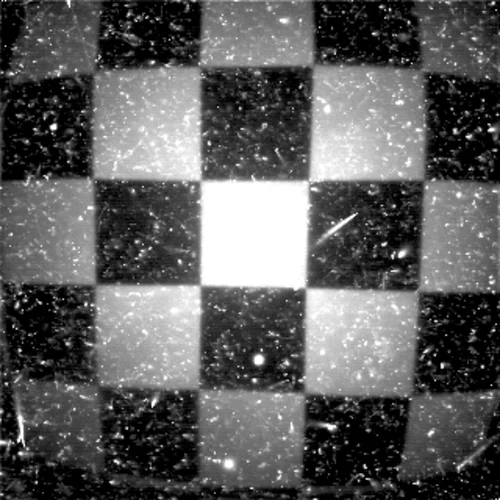
The camera was positioned to capture images of a 13 cm wide chequerboard, serving as a standardized reference pattern. For over 108 hours, the imaging system operated within the CHARM chamber, acquiring an astonishing volume of data: more than 4 million images at a rate of 10 frames per second. This extensive dataset provides an unprecedented opportunity to study the intricate ways in which high-energy particles interact with imaging sensors.
The resulting images present a stark visual representation of these interactions. Scattered across the chequerboard background are countless bright dots and streaks, aptly described as "radiation-induced artefacts." Each of these ephemeral marks signifies a high-energy particle that traversed the image sensor, momentarily disrupting its pixels. While these artefacts highlight the inherent challenges of imaging in space, they also serve as invaluable data points for understanding radiation effects.
"Our tiny imaging system spent more than 108 hours in the CHARM chamber, exposed to a mixed-field radiation environment containing high-energy particles, including hadrons such as protons, neutrons and pions," explained Iztok Kramberger, principal investigator of the TRISAT programme at the University of Maribor. "The camera, pointed at a 13 cm wide chequerboard which served as a reference pattern, acquired over 4 million images at a rate of 10 frames per second. Of these, we kept more than 160,000 images for detailed analysis to study radiation-induced pixel activation and the subsequent recovery of the image sensor following particle interactions."
H3: Quantifying the Damage and Recovery
The detailed analysis of over 160,000 selected images focuses on several key aspects. Researchers are meticulously examining the frequency and spatial distribution of these radiation-induced artefacts. Furthermore, they are investigating the number of pixels affected by each particle event, the temporal dynamics of affected pixels – how and when they recover their normal function – and crucially, the ability to differentiate between transient, recoverable effects and permanent, detrimental radiation damage.
This meticulous analysis is crucial for developing more sophisticated image processing algorithms. By understanding the patterns and characteristics of radiation-induced noise, engineers can design software that can effectively filter out these artefacts, thereby improving the clarity and reliability of images captured in space. This is particularly important for applications such as attitude and orbit determination, where precise and accurate data is paramount for mission success.
H2: Collaboration and Resilience: The Role of SkyLabs
The success of the radiation testing was also attributed to the robust design and protective measures incorporated into the camera system by SkyLabs, a partner in this endeavor. SkyLabs implemented specialized protection mechanisms to ensure that the intense radiation environment did not lead to permanent damage or functional loss of the camera.
"For this test we have joined forces with SkyLabs, who implemented protection mechanisms into the camera system to make sure the intense radiation doesn’t cause any permanent damage or loss of functionality," added Kramberger.
This collaborative approach, combining the expertise of academic research institutions like the University of Maribor with specialized industry partners like SkyLabs, is a hallmark of successful space technology development. It ensures that cutting-edge research is translated into reliable and resilient hardware.
H2: Implications for Future Spacecraft and Missions
The implications of this successful radiation testing are far-reaching. The TRISAT-R imaging system represents a significant step forward in miniaturized space-based imaging technology. Its ability to function and retain data integrity under extreme radiation conditions opens up new possibilities for smaller, lighter, and more cost-effective spacecraft.
H3: Advancing Attitude and Orbit Determination
One of the primary objectives of this testing was to assess the camera’s potential for spacecraft attitude and orbit determination. Accurate knowledge of a spacecraft’s orientation and position is fundamental for navigation, communication, and scientific observation. Traditional systems can be bulky and power-intensive. A miniaturized, radiation-hardened camera that can provide this information could significantly reduce the size and complexity of future spacecraft, enabling more ambitious missions with limited budgets.
H3: Enabling Swarm Missions and Constellations
The development of such robust and compact imaging systems is also a key enabler for the deployment of large satellite constellations and swarms. These formations, comprising hundreds or even thousands of small satellites, rely on precise coordination and autonomous operation. Miniature cameras capable of self-assessment and providing reliable attitude data are essential for maintaining the integrity and functionality of these complex systems.
H3: Contribution to Space Weather Monitoring
The insights gained from analyzing radiation-induced artefacts can also contribute to a better understanding of space weather. By studying the frequency and intensity of particle impacts, scientists can refine models of solar activity and its effects on Earth’s magnetosphere. This improved understanding is vital for protecting critical infrastructure, both in space and on the ground, from the disruptive potential of solar storms.
H2: A Chronology of Innovation
- Pre-2020s: Development of miniaturized imaging technologies and CubeSat platforms is ongoing, driven by the need for more accessible space exploration.
- Early 2020s (specific date not provided, but implied): The TRISAT-R CubeSat, equipped with the miniaturized imaging system developed by the University of Maribor, is launched into medium Earth orbit.
- During the TRISAT-R mission: The camera successfully captures an image of Earth, demonstrating its operational capability in a harsh radiation environment.
- Recent Months (leading up to the news release): The TRISAT imaging system undergoes extensive radiation testing at CERN’s CHARM facility, facilitated by the RADNEXT project.
- Current Reporting: The results of the CERN testing are analyzed, revealing detailed insights into the camera’s performance and resilience against high-energy particles. The University of Maribor and SkyLabs announce the findings and discuss the implications for future space missions.
H2: Broader Impact and Future Outlook
The work undertaken by the University of Maribor and SkyLabs, supported by ESA and CERN, exemplifies the collaborative spirit and technological advancement driving the future of space exploration. The TRISAT-R camera’s journey from a conceptual design to surviving extreme simulated cosmic conditions underscores the progress in radiation-hardened electronics and miniaturization.
The data gathered from this extensive testing campaign will be instrumental in developing next-generation attitude and orbit determination technologies. By understanding and mitigating the effects of radiation, engineers can design spacecraft that are not only more resilient but also more capable. This could lead to a new era of smaller, smarter, and more autonomous satellites, pushing the boundaries of what is possible in space science, Earth observation, and telecommunications. The continued pursuit of such robust, miniaturized technologies is essential for humanity’s expanding presence in orbit and beyond.