Scientific progress is rarely a sudden flash of brilliance. Instead, it is typically a tapestry woven from threads of incremental advancements, where years of dedicated research and meticulous engineering gradually transform the extraordinary into the commonplace. Now, scientists appear to be on the cusp of a significant turning point in this evolutionary journey. Researchers from the University of Michigan and the Air Force Research Laboratory (AFRL) have achieved a remarkable feat: the 3D printing of intricate tubular structures with a unique internal geometry that enables them to suppress vibrations with an efficacy previously unseen in natural materials. These engineered creations fall under the umbrella of mechanical metamaterials, a class of substances whose extraordinary properties are derived not from their chemical composition, but entirely from their meticulously designed architecture.
The ability to effectively block or significantly reduce vibrations holds immense promise for a wide array of industries. From enhancing the quietness and ride quality of transportation systems to improving the stability and longevity of buildings and infrastructure, the applications are vast. The team’s groundbreaking findings, detailed in the latest issue of the esteemed journal Physical Review Applied, represent the culmination of decades of theoretical exploration and sophisticated computer modeling. They have now translated these abstract principles into tangible, real-world structures capable of passively disrupting the propagation of mechanical vibrations.
"The truly novel aspect is the realization that we can actually bring these designs to fruition," stated James McInerney, a research associate at AFRL. McInerney, who was a postdoctoral fellow at the University of Michigan working under Professor Xiaoming Mao, a leading figure in physics and a co-author of the new study, emphasized the practical implications. "We are optimistic that these advancements can be harnessed for beneficial purposes, with vibration isolation being a prime example," he added.
This ambitious project received crucial financial backing from prominent governmental agencies, including the Defense Advanced Research Projects Agency (DARPA) and the Office of Naval Research. Further support was provided by the U.S. National Research Council Research Associateship Program, expertly administered by the National Academies of Sciences, Engineering, and Medicine. The collaborative effort also saw significant contributions from Serife Tol, an associate professor of mechanical engineering at the University of Michigan, Othman Oudghiri-Idrissi from the University of Texas, and Carson Willey and Abigail Juhl, both affiliated with AFRL.
Professor Xiaoming Mao elaborated on the fundamental shift in material science this work represents. "For centuries, humanity has improved materials by modifying their chemical makeup. Our research builds upon the burgeoning field of metamaterials, where it is the intricate geometry – rather than the chemistry – that bestows unusual and highly useful properties," Mao explained. "These fundamental geometric principles possess scalability, applicable from the nanoscale to the macroscale, thereby imparting extraordinary robustness to the resulting structures."
Structural Foundations: Engineering Vibrational Silence
According to McInerney, this pivotal study represents a sophisticated synthesis of classical structural engineering principles, contemporary physics, and advanced manufacturing technologies, most notably 3D printing.
"There is a very real probability that we will be able to manufacture materials from the ground up with an astonishing degree of precision," McInerney projected. "The overarching vision is to create materials with highly specific architectures, and our central question is: ‘What novel functionalities can we unlock with such control? How can we engineer materials that diverge significantly from those we currently utilize?’"
As Professor Mao highlighted, the research team is deliberately moving away from altering a material’s inherent chemistry or molecular structure. Instead, their focus is on exploring how precise control over shape and form at a fine scale can generate new and advantageous mechanical properties. This approach mirrors principles observed in nature, where biological structures like human bones and the shells of plankton leverage intricate geometries to achieve remarkable strength and resilience from relatively simple constituent materials. With the advent of technologies like 3D printing, scientists are now empowered to replicate and even enhance these natural design strategies in a wide range of materials, including metals and polymers, to achieve effects previously considered unattainable.
"The objective is not to supplant existing materials like steel and plastics, but rather to enable their more effective and specialized application," McInerney clarified.
A Fusion of Eras: New-School Innovation Meets Old-School Principles
While the current work is undeniably rooted in modern technological innovations, it also draws upon significant historical underpinnings. One such influence is the work of 19th-century physicist James Clerk Maxwell. Though primarily celebrated for his seminal contributions to electromagnetism and thermodynamics, Maxwell also delved into mechanics. He developed important design considerations for creating stable structures composed of repeating subunits, a concept known as Maxwell lattices, as explained by McInerney.
Another crucial conceptual foundation for the current study emerged in the latter half of the 20th century. Physicists at that time began to recognize that peculiar and intriguing behaviors often manifested at the edges and boundaries of materials. This discovery spurred the development of a new and still highly active field of study known as topology, which seeks to elucidate these phenomena and explore their practical applications.
"Approximately a decade ago, a pivotal publication demonstrated that Maxwell lattices could exhibit a topological phase," McInerney recounted.
Over the subsequent years, McInerney and his collaborators have meticulously investigated the implications of this discovery for the field of vibration isolation. The team successfully developed a comprehensive model explaining this topological behavior and outlining a pathway for designing real-world objects that could exhibit it. Their recent achievement represents the most advanced stage of this research, as they have now successfully fabricated such objects using 3D-printed nylon, thus proving the efficacy of their theoretical framework.
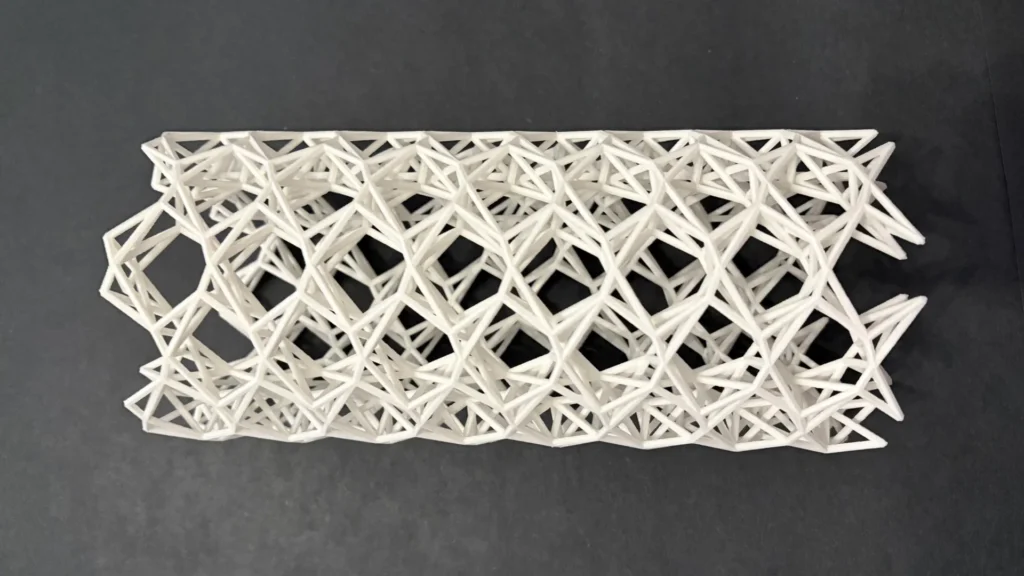
A cursory examination of these printed structures reveals the inherent challenges in their prior creation. They bear a resemblance to a chain-link fence that has been meticulously folded and rolled into a tubular form, featuring interconnected inner and outer layers. Physicists refer to these intricate arrangements as kagome tubes, a nomenclature derived from traditional Japanese basket weaving techniques that employ similar geometric patterns.
However, McInerney cautioned that this successful fabrication is merely the initial step in realizing the full potential of these novel structures. For instance, the study also revealed a critical trade-off: the greater a structure’s ability to suppress vibrations, the reduced its load-bearing capacity becomes. This presents a significant challenge, potentially even an unacceptable compromise, for certain applications. Nevertheless, it also highlights fascinating opportunities and fundamental questions that remain to be addressed.
As these novel structures move from theoretical concepts to physical realities, scientists and engineers will face the imperative to develop new standards and methodologies for their testing, characterization, and assessment. This challenge, McInerney noted, is one that genuinely excites him.
"Because we are dealing with such unprecedented behaviors, we are still in the process of uncovering not only the underlying models but also the most effective ways to test these structures, the conclusions we can draw from such tests, and how to integrate these findings into the design process," he articulated. "I believe these are the fundamental questions that must be thoroughly answered before we can effectively address questions related to specific applications."
Broader Implications and Future Trajectories
The development of these vibration-suppressing metamaterials has far-reaching implications across numerous sectors. In the aerospace industry, such materials could lead to quieter and more stable aircraft cabins, reducing passenger fatigue and improving communication clarity. For the automotive sector, enhanced vibration isolation could translate into a smoother, more comfortable ride and potentially extend the lifespan of critical components by mitigating wear and tear. The construction industry could benefit from buildings that are more resilient to seismic activity and other external vibrations, leading to safer and more durable structures.
The ability to precisely control the mechanical properties of materials through geometric design opens up possibilities that were previously confined to science fiction. Imagine bridges that actively dampen wind-induced oscillations or sensitive scientific equipment housed in enclosures that perfectly isolate them from ambient vibrations, ensuring unparalleled measurement accuracy.
The research also underscores a broader trend in materials science: a shift towards designing materials from the "bottom up." This approach allows for the creation of bespoke materials tailored to specific needs, rather than relying on the serendipitous discovery of new chemical compounds or the limited modifications of existing ones.
A Chronology of Progress
While the recent publication marks a significant milestone, the journey leading to this breakthrough can be traced back through several key stages:
- 19th Century: James Clerk Maxwell’s theoretical work on structural stability and repeating subunits (Maxwell lattices) lays foundational principles for understanding mechanical behavior.
- Mid-to-Late 20th Century: The emergence of topological physics identifies unique behaviors at material boundaries and edges, providing a new lens for material design.
- Early 21st Century (circa 2010s): Seminal research demonstrates the existence of topological phases in Maxwell lattices, sparking renewed interest in their potential applications.
- Recent Years: Researchers at the University of Michigan and AFRL begin modeling and designing specific geometric structures, like kagome tubes, to harness these topological properties for vibration suppression.
- Present: The team successfully 3D prints these intricate tubular structures, validating theoretical models and demonstrating a tangible realization of metamaterial-based vibration isolation.
Expert Reactions and Inferred Perspectives
While direct quotes from parties not involved in the study are not provided in the source material, it is logical to infer that the broader scientific and engineering communities would view this development with considerable interest and optimism.
Professor Tol, a co-author from the University of Michigan, likely shares Professor Mao’s enthusiasm for the geometric approach to material design. Her expertise in mechanical engineering would be crucial in bridging the gap between theoretical physics and practical engineering applications, ensuring that the printed structures are not only functional but also manufacturable and scalable.
Similarly, the contributions of Oudghiri-Idrissi, Willey, and Juhl highlight the interdisciplinary nature of this research. Their work, whether in advanced simulation, material characterization, or experimental validation, would have been instrumental in reaching this successful outcome.
The involvement of DARPA and the Office of Naval Research suggests a keen interest from defense agencies in advanced materials that can enhance the performance and survivability of military assets. Vibration isolation is critical for everything from sensitive electronic equipment on naval vessels to the structural integrity of aircraft and ground vehicles operating in demanding environments.
The Road Ahead: Challenges and Opportunities
The acknowledged trade-off between vibration suppression and load-bearing capacity presents a significant area for future research. McInerney’s candid acknowledgment of this challenge is indicative of the scientific rigor guiding the team. Future work will undoubtedly focus on optimizing designs to mitigate this compromise, potentially through multi-material printing or by incorporating active feedback systems.
Furthermore, the need for new testing and characterization methodologies, as articulated by McInerney, signifies the dawn of a new era in materials science. As we move beyond conventional materials, our tools and frameworks for understanding their behavior must evolve in parallel. This presents a fertile ground for innovation in experimental physics and engineering.
The successful demonstration of 3D printed tubular metamaterials for vibration suppression represents a significant leap forward. It validates decades of theoretical work and opens up exciting new avenues for designing materials with unprecedented functionalities. While challenges remain, the journey from abstract concept to tangible reality, fueled by interdisciplinary collaboration and cutting-edge manufacturing, heralds a future where materials are engineered with precision and purpose, shaping the technologies and environments of tomorrow.