Researchers at the U.S. Department of Energy’s (DOE) Oak Ridge National Laboratory (ORNL) have achieved a significant breakthrough in additive manufacturing with the development of a novel system capable of detecting and rectifying errors in real-time during the 3D printing of large composite parts. This advanced automated technology promises to enhance the capabilities of U.S. manufacturers, enabling the production of complex, custom-designed components with significantly fewer defects. The implications extend to reducing material waste, lowering production costs, and bolstering America’s competitive edge in the rapidly evolving field of additive manufacturing.
Large-scale additive manufacturing (LFAM), often referred to as 3D printing, involves extruding heated thermoplastic materials, frequently reinforced with either continuous or chopped fibers, through a robotic nozzle. These layers are meticulously deposited to construct substantial objects, ranging from structural components for the construction industry, such as walls, to intricate aerodynamic elements for aircraft and automotive parts like bumpers. The precision required in LFAM is immense, as numerous printing variables—including material temperature, extrusion speed, and layer adhesion—must be carefully balanced. Maintaining optimal conditions, where layers are sufficiently bonded yet firm enough to retain their shape, demands constant, vigilant oversight, a process that can be both labor-intensive and prone to human error.
The new controller system developed at ORNL fundamentally redefines this oversight. It functions as an autonomous supervisor, freeing human operators to concentrate on higher-level strategic tasks and design refinements. The system integrates a sophisticated suite of sensors designed to meticulously track critical parameters of the printing process. These include the precise positional data of the robotic nozzle, the rate at which material is being deposited, and the temperature of the polymer as it is extruded.
A key innovation lies in the augmentation of this sensor array with low-cost thermal cameras. These cameras, strategically positioned in a ring around the printing nozzle, provide continuous, real-time monitoring of the deposited material’s temperature as it cools. This thermal imaging capability is crucial for identifying subtle temperature fluctuations that can lead to printing defects.
Leveraging computer vision, a sophisticated branch of artificial intelligence that empowers machines to interpret and understand visual information, the ORNL-developed controller can analyze the live-streamed thermal imagery. This AI-driven analysis allows the system to pinpoint the exact location and temperature of the molten material. When a deviation from the pre-programmed target temperature is detected, the controller intervenes by automatically adjusting the speed of the 3D printing process. This dynamic adjustment ensures that each deposited layer reaches the optimal cooling temperature before the subsequent layer is applied, thereby guaranteeing proper structural integrity and robust interlayer bonding. The direct result is a significant reduction in print failures and a considerable decrease in wasted material.

A Paradigm Shift in Manufacturing Control
Kris Villez, the lead researcher on the project, likens the controller’s operation to that of an experienced human craftsman. "It controls the process almost like a human would: by observing and nudging the setting until it reaches the desired outcome," Villez explained. This analogy highlights the system’s adaptive and intuitive approach to complex manufacturing challenges. Villez collaborated closely with Chris O’Brien, a graduate student from the University of Tennessee, on this pioneering research.
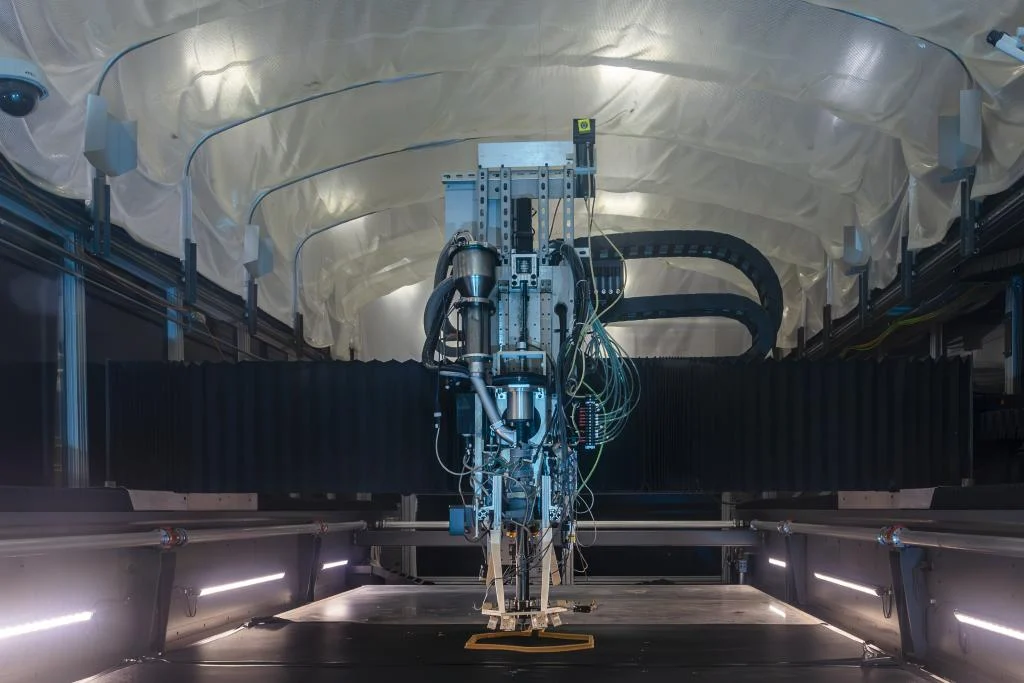
The team meticulously calibrated the control system and fine-tuned the positioning of the six thermal cameras encircling the robotic nozzle. This assembly, described as resembling a column of metal tubes interwoven with colorful wires, is suspended within a printer unit that dwarfs standard machinery, akin to the size of a boxcar. To rigorously test the controller’s capabilities, researchers initiated experiments by deliberately manipulating print speed to observe its impact on layer temperature.
Demonstrating Real-Time Correction on a Grand Scale
A pivotal demonstration involved printing a hexagonal structure exceeding the dimensions of a truck tire. This large-scale print served as a comprehensive testbed for the controller’s performance on a full-size component. The printing process commenced with a deliberately slow print speed to challenge the newly implemented controller. Initially, this resulted in the deposited material being approximately 30% cooler than the optimal temperature required for proper adhesion to the subsequent layer.
Upon detecting this critical temperature deviation, the controller seamlessly intervened. It automatically increased the print speed, a precise adjustment designed to maintain the ideal thermal conditions for effective layer fusion. This real-time correction in action vividly illustrated the system’s efficacy and its capacity to overcome adverse printing conditions autonomously.
Chris O’Brien elaborated on the system’s precision, noting its ability to detect and correct temperature variances as small as a few degrees. This level of accuracy is paramount, as temperature inconsistencies are a primary culprit behind ruined prints in large-scale additive manufacturing. Furthermore, a distinct advantage of ORNL’s controller over some existing monitoring systems is its inherent flexibility. It does not require extensive retraining for each new design, thereby conserving valuable time and computational resources, while simultaneously enhancing operational agility. The system is engineered for universal compatibility, designed to function seamlessly with any large-area composite printer, irrespective of the plastic material used or the complexity of the part’s geometry.
The Power of Digital Twins and Collaborative Research
The project also incorporated the utilization of machine learning to construct a virtual replica, or "digital twin," of the physical printing process. This digital twin serves as a risk-free environment for experimenting with novel designs and materials before committing to physical production. This approach significantly mitigates the potential for costly failures and accelerates the iterative design process.

This groundbreaking work builds upon a foundational ORNL study conducted in collaboration with Purdue University and the University of Maine (UMaine). That earlier research highlighted the significant benefits of integrating thermal imaging with statistical modeling for enhanced fault detection in LFAM. More recently, a joint effort between the University of Tennessee-Knoxville and ORNL demonstrated that this combined approach could reliably detect print speed discrepancies as minor as 15% from the programmed settings. While the earlier project focused on automating the identification of faults, the new system represents a substantial advancement by incorporating immediate error correction capabilities.
"There is a vast opportunity space to make these machines more intelligent and more responsive," Villez remarked, envisioning a future where additive manufacturing operates with unprecedented autonomy. "In the end, we’d love this to work like baking bread: You set the oven temperature, put in your dough, and return when the timer goes off to see if it’s done. You don’t have to monitor the oven temperature in real time throughout the baking." This aspiration encapsulates the ultimate goal of achieving fully automated, hands-off manufacturing for complex components.
The development of this advanced system was a collaborative effort involving ORNL researchers Katie Copenhaver and Alex Roschli. The project received crucial funding from the DOE’s Advanced Materials and Manufacturing Technologies Office, underscoring the national strategic importance of advancing domestic additive manufacturing capabilities.
Broader Implications for American Industry
The implications of ORNL’s real-time error detection and correction system are far-reaching for American manufacturing. By minimizing print failures and material waste, the technology directly contributes to cost reduction, making domestically produced goods more competitive on a global scale. The ability to produce large, custom-designed parts with greater speed and reliability can unlock new possibilities in sectors such as aerospace, automotive, construction, and defense. For instance, the aerospace industry could benefit from the rapid production of lighter, more complex structural components for aircraft, leading to improved fuel efficiency and performance. In the automotive sector, this technology could accelerate the development and production of customized parts, enabling faster innovation and more personalized vehicle designs.
The enhanced precision and reduced defect rates also translate to improved product quality and safety, particularly critical for applications in high-stakes industries. Furthermore, the system’s adaptability to various materials and designs reduces the barrier to entry for smaller manufacturers looking to adopt advanced additive manufacturing techniques, fostering a more dynamic and innovative industrial landscape. The development also aligns with broader national initiatives aimed at revitalizing domestic manufacturing and ensuring supply chain resilience. By reducing reliance on foreign manufacturing for complex components, the U.S. can strengthen its industrial base and create high-skilled jobs. The continuous innovation in additive manufacturing, exemplified by ORNL’s work, signals a promising future for American industrial competitiveness and technological leadership.