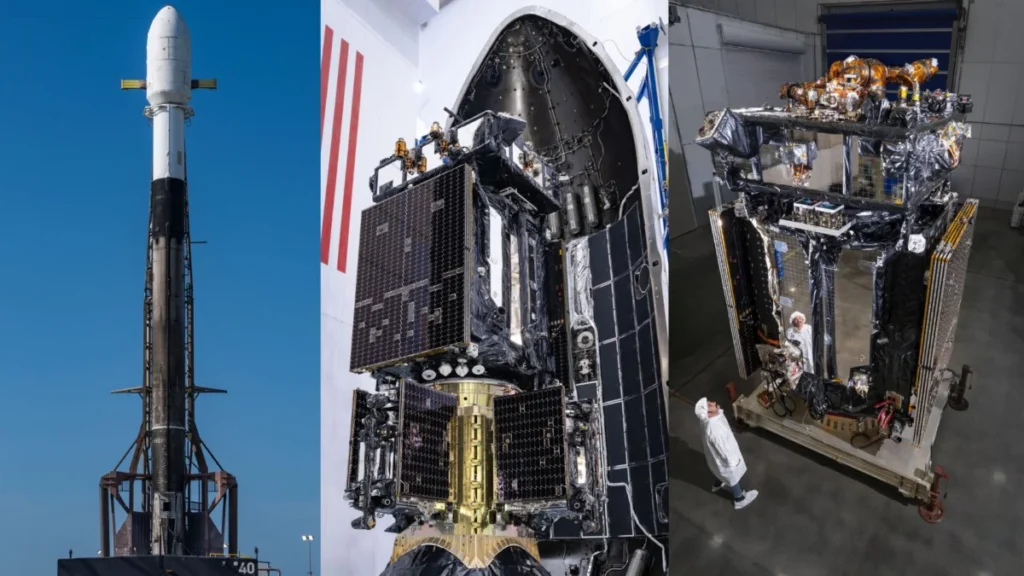
The Mission Robotic Vehicle (MRV), accompanied by three initial Mission Extension Pods (MEPs), embarked on its journey to geostationary orbit (GEO) aboard a SpaceX Falcon 9 rocket from Cape Canaveral Space Force Station in Florida on July 21. This landmark mission represents a significant leap forward in space logistics, shifting the paradigm from the costly and time-consuming process of replacing satellites to a more sustainable model of maintenance and life extension. The launch itself demanded the Falcon 9’s maximum performance, requiring a high-energy trajectory that left no margin for the recovery of the first-stage booster, which was subsequently retired after an impressive 32 flights, a testament to the booster’s operational longevity. The spacecraft will now transit to its operational altitude in geostationary orbit, approximately 35,786 kilometers (22,236 miles) above the Earth, where its innovative servicing campaign is expected to commence in the coming weeks.
A New Paradigm for On-Orbit Servicing
This mission marks a crucial evolution in Northrop Grumman’s approach to satellite life extension. Unlike the company’s earlier Mission Extension Vehicles (MEVs), which were designed to dock with and remain attached to a single satellite for the remainder of its operational life, the MRV introduces a multi-client servicing model. The MRV itself is a highly agile robotic spacecraft, equipped with two advanced robotic arms that will enable it to perform complex maneuvers and precise installations in the unforgiving vacuum of space.
The operational sequence for the MRV is designed for efficiency and flexibility. Upon reaching a client satellite, the MRV will first retrieve a Mission Extension Pod from its internal bay. It will then precisely approach the target satellite, using its sophisticated navigation and rendezvous systems. The robotic arms will then engage with the client satellite, securely attaching the MEP to its structural ring, typically located at the rear of the spacecraft. Once the installation is complete and verified, the MRV will disengage, leaving the MEP to take over propulsion and attitude control functions, and proceed to its next assignment, demonstrating a critical capability for future in-space assembly and repair.
The Ingenuity of Mission Extension Pods
The Mission Extension Pods are central to this new servicing model. Crucially, these pods do not transfer fuel to the client satellite. Instead, they operate as self-contained propulsion units, equipped with their own electric propulsion systems. These systems are significantly more fuel-efficient than traditional chemical propulsion, enabling the MEPs to provide station-keeping and attitude control for an extended period. By attaching to the structural ring of a geostationary communications satellite, the MEP effectively becomes an auxiliary engine, taking over the critical tasks of maintaining the satellite’s orbital position and orientation.
Northrop Grumman estimates that this technology can extend the operational life of a typical geostationary communications satellite by approximately six additional years. This extension offers substantial benefits to satellite operators, who face the immense capital expenditure and lead times associated with designing, building, launching, and commissioning new satellites, which can range from hundreds of millions to over a billion dollars per spacecraft. Extending the life of an existing, functional satellite through an MEP installation provides a far more cost-effective alternative, allowing operators to continue generating revenue from their assets and defer the significant investment in a replacement. This capability is particularly vital in the highly competitive and capital-intensive telecommunications industry, where continuity of service and optimization of assets are paramount.
Commercial Customers Lead the Way
The initial phase of the MRV mission is dedicated to serving commercial satellite operators, underscoring the immediate market demand for such services. Intelsat, a global leader in satellite services, has ordered two of the first Mission Extension Pods, while Australia’s Optus, a major telecommunications provider in the Asia-Pacific region, has acquired the third. These early commitments highlight the commercial viability and critical need for on-orbit servicing solutions.
The MRV itself is engineered for a long operational lifespan, expected to remain active for about 15 years in geostationary orbit. Following the completion of these initial installations, Northrop Grumman plans to launch additional pods to meet the growing demand from future customers. The servicing spacecraft will remain in orbit, poised to retrieve and install these new pods as required, establishing a sustained, on-demand servicing infrastructure. This model allows satellite operators to purchase life extension services as needed, rather than committing to full satellite replacement cycles, offering unprecedented flexibility in their asset management strategies.
Evolution from Previous Missions
This innovative MRV mission builds directly upon the proven success of Northrop Grumman’s earlier satellite life-extension technology, the Mission Extension Vehicles (MEVs). The MEV program successfully demonstrated the feasibility and reliability of autonomous docking and persistent attachment in geostationary orbit. MEV-1, launched in 2020, successfully docked with the Intelsat 901 satellite, extending its operational life by five years. MEV-2 followed suit in 2021, docking with the Intelsat 10-02 satellite and providing similar life extension services. A total of three docking missions were completed by MEV-1 and MEV-2 between 2020 and 2025, serving both Intelsat and Optus satellites. These pioneering missions established the foundational technologies and operational procedures for close-proximity operations and autonomous rendezvous and docking in GEO.
However, a key distinction lies in the operational model: while MEV-1 and MEV-2 remained permanently attached to a single client spacecraft, effectively becoming its new propulsion system, the MRV is designed to be a free-flying, multi-client servicer. This architectural shift from dedicated servicer to shared utility dramatically enhances efficiency and cost-effectiveness, enabling the MRV to service multiple satellites over its extensive lifetime, thus maximizing its utility and reducing the overall cost per service. This transition reflects a maturing vision for in-space operations, moving from bespoke solutions to scalable, reusable services.
DARPA’s Foundational Role in Orbital Servicing
The sophisticated robotic servicing system at the heart of the MRV mission traces its origins to a pivotal government initiative: the Defense Advanced Research Projects Agency’s (DARPA) Robotic Servicing of Geosynchronous Satellites (RSGS) program, which commenced in 2016. DARPA, renowned for fostering high-risk, high-reward research, conceived the RSGS program to demonstrate the capabilities required for advanced on-orbit satellite servicing, including complex robotic manipulation, inspection, repair, and upgrade functionalities. The agency was responsible for developing the core robotic payload, which included the MRV’s articulated arms and the associated control software, pushing the boundaries of what was technologically feasible in space robotics.
Initially, Space Systems Loral (now Maxar Technologies) partnered with DARPA on the commercial adaptation of the RSGS technology. However, Loral exited the project in 2019, leading to a significant shift in the program’s trajectory. The following year, Northrop Grumman’s SpaceLogistics division, which had already been developing the MEV program, stepped in to take over the commercial portion of the RSGS program. SpaceLogistics successfully adapted DARPA’s foundational robotic technology for commercial operations and completed the development of the servicing vehicle, integrating the advanced robotics into a robust, flight-ready platform. This collaboration exemplifies a successful model of government-funded research transitioning into viable commercial applications, significantly de-risking advanced space technologies for private industry.
Strategic Implications and Government Interest
Beyond its immediate commercial applications, the MRV’s capabilities hold significant strategic implications, particularly for government and defense space operators. The U.S. Space Force has explicitly indicated its interest in gaining access to the MRV once the spacecraft enters operational service. This interest stems from the understanding that commercial capabilities like the MRV can provide critical resilience and flexibility for government space assets. In an increasingly contested space domain, the ability to repair, reposition, or extend the life of vital national security satellites without the delays and costs associated with launching replacements offers a distinct strategic advantage.
While Northrop Grumman has not yet announced any specific government contracts tied to the MRV, the company anticipates expanding the mission with future pod deployments as demand for on-orbit servicing grows across both commercial and governmental sectors. The concept of "commercial augmentation" for military space operations is gaining traction, where government entities leverage commercially developed and operated services to enhance their capabilities, reduce costs, and accelerate innovation. The MRV represents a tangible example of how advanced commercial space technology can directly contribute to national security objectives, offering a path for the U.S. Space Force to maintain and optimize its orbital assets in a dynamic operational environment.
Broader Impact and the Future of Space Logistics
The successful deployment and operation of the MRV are poised to trigger a profound shift in the economics and logistics of space operations. Economically, the ability to extend the life of high-value satellites by several years will significantly reduce the total cost of ownership for satellite operators, leading to potentially lower service costs for end-users and improved financial returns for investors in the space sector. This could also spur innovation in satellite design, encouraging modularity and "servicability" as key design principles for future spacecraft.
Environmentally, on-orbit servicing offers a pathway to more sustainable space operations. By extending the operational life of satellites, the MRV helps to mitigate the growth of space debris, as fewer satellites will need to be replaced and deorbited prematurely. It also promotes the more efficient use of increasingly congested geostationary orbital slots, ensuring that valuable positions are occupied by active, revenue-generating assets for longer periods.
Technologically, the MRV validates the maturity of complex on-orbit robotics, autonomous rendezvous and docking, and advanced electric propulsion systems. These capabilities are foundational for a future where in-space assembly, manufacturing, and repair (OSAM) become routine. The MRV is not just about life extension; it is a precursor to a more robust, dynamic, and economically viable space economy where infrastructure can be built, maintained, and upgraded directly in orbit. The lessons learned from the MRV mission will directly inform the development of future generations of orbital service vehicles, pushing the boundaries of what is possible in space. Northrop Grumman’s statement following the launch encapsulated this broader vision: "Today’s launch is the start of something bigger. Our Mission Robotic Vehicle is opening the door to a future where repairing, upgrading and building in space is part of the routine, not the exception." This mission represents not merely the launch of a new spacecraft, but the dawn of a new era in humanity’s utilization and stewardship of the final frontier.