When ice transitions into water, the transformation is remarkably swift and definitive. As soon as the ambient temperature reaches the melting point, the rigid, crystalline lattice of ice instantaneously collapses into the fluid, disordered state of liquid water. This rapid, all-at-once switch from a solid to a liquid is the hallmark of phase transitions in most familiar three-dimensional materials, a phenomenon governed by well-understood thermodynamic principles. However, the world of extremely thin, two-dimensional (2D) materials defies this conventional understanding, exhibiting a far more intricate melting pathway that has long puzzled scientists.
A groundbreaking study led by researchers at the University of Vienna has now provided the first direct experimental confirmation of an unusual intermediate state, known as the hexatic phase, during the melting of an atomically thin crystal. This elusive phase, theorized for decades but never before unequivocally observed in strongly bonded atomic crystals, represents a hybrid condition that sits precariously between the orderly solid and the chaotic liquid. Published recently in the prestigious journal Science, these findings not only significantly advance our fundamental understanding of how phase transitions operate in two dimensions but also challenge certain long-standing theoretical expectations regarding the nature of these transitions.
The Enigma of 2D Melting: A Theoretical Precedent
The concept of melting in two dimensions has been a subject of intense theoretical debate and investigation since the 1970s. Unlike their 3D counterparts, 2D materials lack the extensive network of bonds that stabilize a solid structure, making them inherently more susceptible to thermal fluctuations. In three dimensions, materials typically melt through a first-order phase transition, meaning the solid and liquid phases coexist at the melting point, and the transformation occurs abruptly with a latent heat exchange. This is often explained by criteria like the Lindemann criterion, which posits that melting occurs when the average amplitude of atomic vibrations exceeds a certain fraction of the interatomic distance.
However, theoretical models, most notably the Kosterlitz-Thouless-Halperin-Nelson-Young (KTHNY) theory, proposed that 2D melting might occur through a two-step process involving an intermediate hexatic phase. This theory, which earned Kosterlitz and Thouless a share of the Nobel Prize in Physics in 2016, suggests that a 2D solid first loses its "translational order" – the regular spacing between atoms – transitioning into a hexatic phase. In this state, the atoms are no longer regularly spaced like in a crystal, but they still maintain a degree of "bond-orientational order," meaning the angles between neighboring bonds remain partially aligned. Only in the second step does the material lose this bond-orientational order, finally becoming a true isotropic liquid.
For decades, the hexatic phase had remained largely a theoretical construct, with experimental observations primarily confined to simplified model systems. These included colloidal suspensions, which are systems of microscopic particles dispersed in a fluid, or liquid crystals, materials that exhibit properties between those of conventional liquids and solid crystals. While these model systems offered valuable insights, they could not fully replicate the behavior of real, atomically thin crystals held together by strong chemical bonds. The question remained: could the hexatic phase truly exist in the realm of everyday, strongly bonded materials at the atomic scale?
Breaking New Ground: Direct Observation in an Atomic Crystal
The international research team, spearheaded by scientists at the University of Vienna, has now definitively answered this long-standing question. By focusing on atomically thin crystals of silver iodide (AgI), a material known for its superionic properties in bulk, the researchers were able to directly observe the hexatic phase for the first time in a material where atoms are held together by strong covalent and ionic bonds. This monumental achievement not only validates a key prediction of the KTHNY theory but also opens new avenues for exploring the intricacies of matter at its most fundamental scales.
The discovery confirms that this elusive phase is not merely a theoretical curiosity or a phenomenon restricted to simplified models. It genuinely manifests in real two-dimensional crystals, providing unprecedented details about the mechanics of melting when materials are reduced to atomic thickness. This has profound implications for the design and engineering of future 2D materials, which are increasingly critical for advancements in electronics, optoelectronics, catalysis, and energy storage.
The Experimental Design: A Graphene Sandwich at Extreme Temperatures
Observing such a delicate and transient process at the atomic level required a sophisticated experimental setup and cutting-edge techniques. The researchers engineered a unique "sandwich" structure: a single atomic layer of silver iodide was meticulously encapsulated between two sheets of graphene. Graphene, a single layer of carbon atoms arranged in a hexagonal lattice, is renowned for its exceptional strength, thermal conductivity, and transparency to electron beams, making it an ideal protective casing for the fragile 2D silver iodide crystal. This graphene encapsulation served a dual purpose: it prevented the delicate, atomically thin crystal from collapsing or evaporating at high temperatures, while simultaneously allowing it to melt naturally and enabling high-resolution imaging.
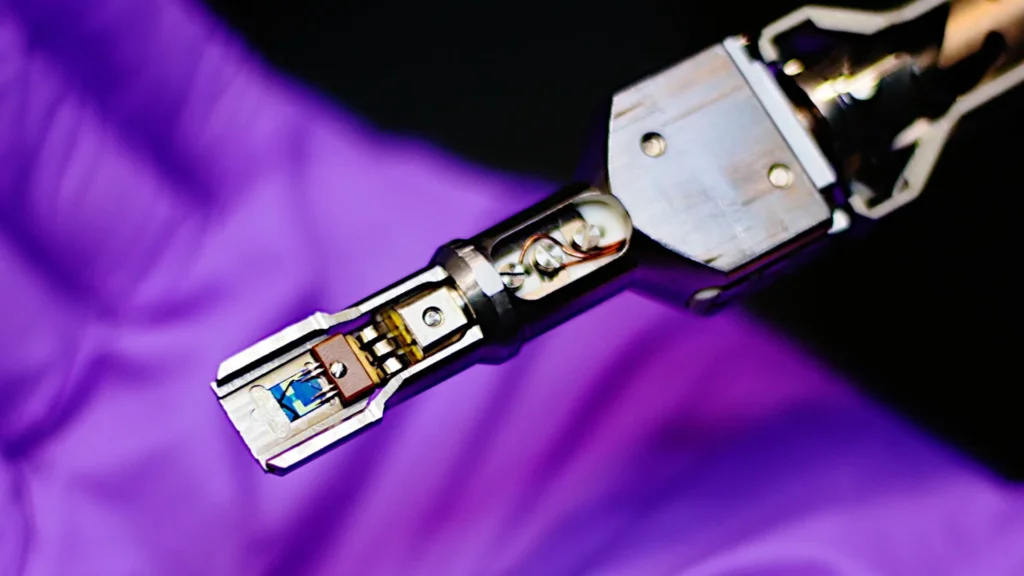
With the sample prepared, the team employed a state-of-the-art scanning transmission electron microscope (STEM) equipped with a specialized heating holder. This advanced setup allowed them to precisely control and gradually elevate the temperature of the sample to extraordinary levels, exceeding 1100 °C. The STEM instrument, capable of imaging materials with atomic resolution, then recorded the entire melting process in real-time. This combination of extreme temperature control, protective encapsulation, and atomic-scale imaging was crucial for capturing the fleeting moments of the hexatic phase.
AI as the Unsung Hero: Unlocking Atomic Insights
The sheer volume and complexity of data generated during such an experiment are staggering. Tracking the individual motions and positions of thousands of atoms across numerous frames as they transition from an ordered solid to a disordered liquid state produces an enormous dataset. According to Kimmo Mustonen from the University of Vienna, the senior author of the study, the meticulous analysis required for this task would have been virtually impossible without the aid of artificial intelligence. "Without the use of AI tools such as neural networks, it would have been impossible to track all these individual atoms and extract meaningful information from their movements and arrangements," he explained, emphasizing the transformative role of AI in modern materials science.
To tackle this analytical challenge, the researchers meticulously trained their neural network using extensive sets of simulated data. This training process enabled the AI system to accurately identify individual atomic positions, track their trajectories, and discern subtle changes in their local environment – such as interatomic spacing and bond angles – even amidst the noise inherent in electron microscopy data. Once robustly trained, the AI system then processed thousands of high-resolution microscope images captured during the experiment, performing an atom-by-atom analysis that would have taken human researchers an unfeasible amount of time. This synergistic approach, combining advanced experimental techniques with powerful computational intelligence, underscores a new paradigm in scientific discovery.
Unveiling the Hexatic Phase: A Hybrid State of Matter
The rigorous AI-driven analysis yielded a profound discovery. Within a surprisingly narrow temperature range, approximately 25 °C below the final melting point of silver iodide, the atomically thin crystal entered a clearly defined hexatic phase. This precise temperature window, far from the abrupt melting behavior of 3D materials, provided the first direct evidence of this intermediate state in a strongly bonded 2D crystal.
Further electron diffraction measurements provided robust corroboration of this observation. Electron diffraction patterns reveal the structural order of a material; a sharp, distinct pattern indicates a crystalline solid, while a diffuse halo signifies a disordered liquid. The diffraction patterns obtained during the hexatic phase displayed characteristics intermediate between these two extremes, consistent with a state that had lost translational order but retained partial orientational order. Specifically, the material exhibited irregular spacing between particles, reminiscent of a liquid, yet the angles between neighboring atoms maintained a degree of order, a trait typically associated with solids. This hybrid nature makes the hexatic phase a unique form of matter, possessing properties from both solid and liquid states.
Challenging Established Theory: A Surprising Second Transition
Beyond confirming the existence of the hexatic phase, the study also unveiled unexpected behavior that challenges certain aspects of the existing KTHNY theory. Earlier theoretical models had largely suggested that both transitions – from solid to hexatic, and subsequently from hexatic to liquid – should occur gradually, exhibiting a continuous, second-order phase transition.
However, the researchers observed a different scenario. While the initial shift from the ordered solid to the hexatic phase indeed unfolded smoothly and gradually, consistent with theoretical predictions for the first step, the subsequent transition from the hexatic phase to the fully disordered liquid state was found to be strikingly abrupt. This sudden collapse from the partially ordered hexatic state to a complete liquid mirrored the instantaneous melting observed in familiar 3D materials like ice turning into water.
"This suggests that melting in covalent two-dimensional crystals is far more complex than previously thought," commented David Lamprecht from the University of Vienna and the Vienna University of Technology (TU Wien), one of the main authors of the study, alongside Thuy An Bui, also from the University of Vienna. This unexpected discontinuity in the second transition points to subtleties in interatomic interactions and thermal fluctuations in 2D systems that were not fully accounted for in earlier models, necessitating a refinement of existing theoretical frameworks.
Broader Implications for Materials Science and Technology
The implications of this discovery are far-reaching. Scientifically, it provides the most compelling experimental validation to date for the KTHNY theory of 2D melting, a cornerstone of condensed matter physics, while simultaneously highlighting areas where the theory may need further development. The direct observation of the hexatic phase in an atomically thin, strongly bonded crystal resolves a mystery that had persisted for decades, deepening our understanding of fundamental phase transitions.
Technologically, the ability to control and understand these intermediate phases could unlock new possibilities for engineering advanced 2D materials. Materials often exhibit unique properties at their phase transitions, and a stable hexatic state could potentially be leveraged for novel applications. For instance, designers of nanoscale electronic devices, catalysts, or sensors could benefit from knowing precisely how materials behave at these critical temperature ranges. The hexatic phase, with its unique combination of liquid-like disorder in position and solid-like order in orientation, might possess entirely new electrical, optical, or mechanical properties that could be harnessed for specific functionalities. For example, its intermediate fluidity could allow for faster diffusion rates while maintaining a degree of structural integrity important for certain chemical reactions or membrane applications.
Jani Kotakoski, who heads the research group at the University of Vienna, underscored the significance of the methodological advancements. "Kimmo and his colleagues have once again demonstrated how powerful atomic-resolution microscopy can be, especially when combined with sophisticated data analysis tools like artificial intelligence," he stated. This study serves as a powerful testament to the synergy between cutting-edge experimental physics and advanced computational techniques, paving the way for future discoveries in materials science where phenomena at the atomic scale are increasingly accessible and decipherable.
The research not only redefines our understanding of melting in two dimensions but also establishes a new standard for investigating dynamic processes at the atomic level. It underscores the ongoing revolution in materials science, where theoretical predictions, once confined to abstract models, are now being directly confirmed and refined through increasingly precise experimental observations and intelligent data analysis. As scientists continue to explore the unique properties of 2D materials, the insights gained from understanding the hexatic phase will undoubtedly play a crucial role in shaping the next generation of advanced technologies.